Rules of Amun-Re
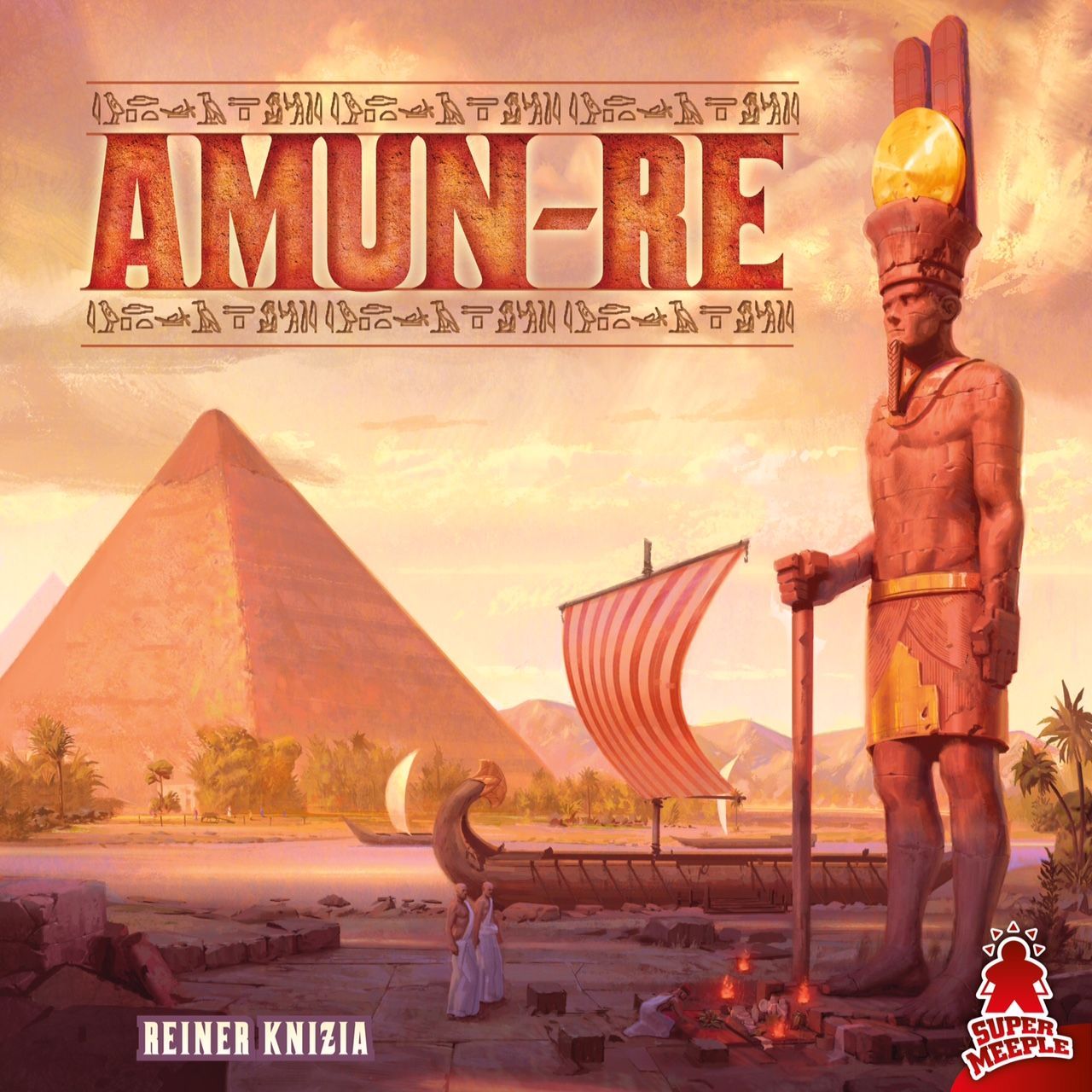
Summary
Amun-Re is an auction and development game set in ancient Egypt across two ages, the Old Kingdom and the New Kingdom. Players bid for provinces, build pyramids, farm, and make offerings to Amun-Re. The player with the most victory points at the end of the game wins.
Setup
Place the game board in the center and form supplies of Stones, Pyramids, Double Pyramids, and Farmer tokens. Sort the Gold cards by value into a Gold Reserve beside the board and place the Offering tiles face-up beside it. Deal each player 1 Architect Favor card, then shuffle the remaining Favor cards into a face-down deck. Build the Province deck with 3 Province cards per player, returning unused Province cards to the box. Each player picks a color and takes the 3 Scribe pawns of that color, plus a Victory Point marker placed beside the score track. Deal each player Gold totaling 20, and 1 Theft card. Randomly choose a Start Player and give them the Start Player token.
A turn
Each round has four phases in order: Auction, Market, Offering, and Harvest. Each phase begins with the current Start Player and proceeds clockwise.
- Auction: Draw one Province card per player and place them face-up on the board, adding any Stones, Favor cards, and Gold shown in their Immediate Bonuses. Players take turns placing a Scribe pawn on a bidding space, each bid must exceed the current bid on that Province, and players may pass if they hold the winning bid. Outbid players may move to another Province they have not just been outbid on. The auction ends when each Province has exactly one pawn. Winners pay their bids to the Reserve, leave their pawns to claim control, and take the Immediate Bonuses.
- Market: In buying order (Favor cards, then Farmers, then Stones), players buy from the supply by paying the cost scale on the board. Favor cards are limited by the highest Favor symbol count in one Province you control. Farmers must go into open Field spaces in your Provinces, and Stones go into your Provinces. Three Stones in one Province become a Pyramid, and a second Pyramid there becomes a Double Pyramid. Architect cards let you build a Pyramid with 2 Stones, but only during this phase.
- Offering: Players secretly choose Gold cards or their Theft card, then reveal simultaneously. The total is the collective Offering, reduced by 3 for each Theft card played. Offering Adjustment cards can raise or lower the collective total by 3, in turn order. Place the matching Offering tile on the Nile Delta. The top contributor receives 3 Rewards, the second receives 2, and all others receive 1, in turn order, with ties going to the earlier player. Theft players receive no Reward but steal 3 Gold. The highest Gold offering takes the Start Player token for the next round.
- Harvest: Starting with the Start Player, collect Gold from your Gold Mines, from Caravans if the Offering tile shows a camel, and from each Farmer token at the value shown on the Offering tile. Big Harvest and Treasury Favor cards may be played here to change income from a chosen Province.
End of the game
After the third round of an age, the Province deck is empty and Intermediate Scoring occurs. At the end of the Old Kingdom, remove Scribe pawns and Farmer tokens from the board, return Farmers to the supply, and shuffle the Province cards back into the deck. Pyramids and Stones stay on the board, but the Provinces are no longer controlled. After the New Kingdom, the game proceeds to Final Scoring and ends.
Scoring
Intermediate Scoring at the end of each age awards victory points for: Temples in your Provinces (1 to 4 VP each, based on the current Offering tile); 1 VP per Pyramid in your Provinces, with Double Pyramids counting as two; 3 VP for your Province with the fewest Pyramids, if you have no empty Province; 5 VP each to the player with the most Pyramids in a Province on each side of the Nile, with ties broken by Stones; and 3 VP for each satisfied yellow Favor card.
Final Scoring ranks players by total Gold card value: 6 VP to the highest, 4 VP to the second, and 2 VP to the third. Tied players all receive the higher award, and the next place is pushed down. The player with the most victory points wins. A tie is broken by most Pyramids, then most Stones, and if still tied the victory is shared.
Variants
Expert rules: at setup, deal each player 3 Province cards and return the rest to the box unseen. At the start of each Auction Phase, each player secretly selects one of their Province cards, and the chosen cards are revealed together and auctioned that round. At the beginning of the New Kingdom, shuffle the Province cards played during the Old Kingdom and deal them evenly to the players.
Changes
- Variants, by the rulebook draft, 23 November 2026 (shown now)
- Scoring, by the rulebook draft, 23 November 2026 (shown now)
- End of the game, by the rulebook draft, 23 November 2026 (shown now)
- A turn, by the rulebook draft, 23 November 2026 (shown now)
- Setup, by the rulebook draft, 23 November 2026 (shown now)
- Summary, by the rulebook draft, 23 November 2026 (shown now)