Rules of Arcadia Quest: Inferno
Summary
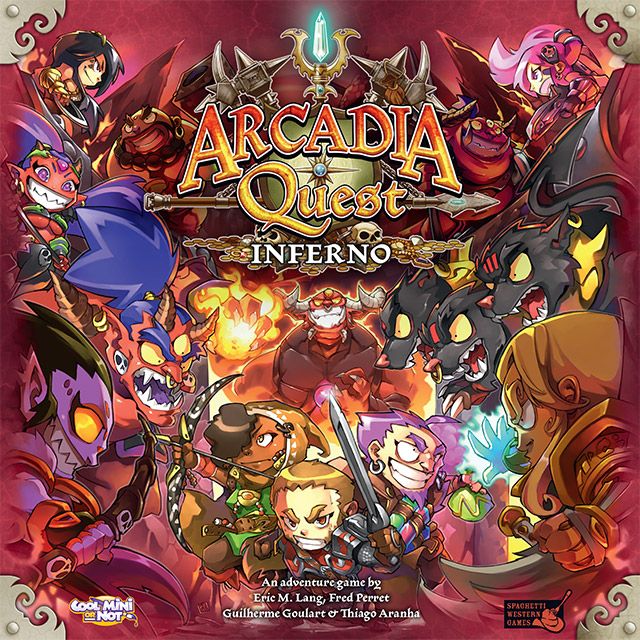
Arcadia Quest: Inferno is a campaign game for 2 to 4 players. Each player leads a Guild of three Heroes that descends through the circles of Inferno to defeat the Underlord, while the Guilds still compete against each other. Each scenario is won by the first Guild to complete three Quests, with at least one of them a PvE Quest (in a 2-player game, two Quests are enough).
Setup
Each player chooses a Guild color (Yellow, Purple, Teal or Gray) and takes its dashboard and Guild tokens. Players then pick three Heroes each, either freely or by drafting, and attach their figures to bases in their Guild color. The Heroes stay the same for the whole campaign.
Each Guild gets the five starter Upgrade cards (Dusty Blade, Vile Trident, Short Bow, Lifebound, Grimbolt), which it may split among its Heroes. Each Hero can only use the four cards in its own inventory.
For each scenario, follow the scenario map and list: place tiles, doors, portals, Brimstone cards (face down), Quest tokens, a random set of Exploration tokens (face down), Spawn tokens, and Monsters. Use only the Monster cards whose level matches the scenario number. Lay out the Quest cards, tucking any listed Reward cards under them, and put Wound, Death, Damnation, coin and dice supplies in a common area. Players are randomly assigned Starting Areas, and their Heroes start there. With 3 players, Player 4's area is unused; with 2 players, Players 3 and 4's areas are unused.
A turn
Players take turns clockwise. On a turn, a player either activates one Hero or rests the Guild, never both.
Activating a Hero: the Hero may use up to 3 Movement points and make one Attack, in either order. The Movement cannot be split around the Attack. Each Movement point can move the Hero one Space, use a portal, open or close a door on its Space's edge, or reveal a Brimstone card in its Space.
Attacks: exhaust an unexhausted Attack card, then roll its black Attack dice against the target's white Defense dice. Melee attacks reach only Close targets; Ranged attacks need a clear line of sight. Each Save cancels one Hit and any leftover Hits become Wounds. CRITs count as successes and give an extra die.
Guard and Payback Reactions: a Hero leaving a Space Close to a Monster makes that Monster attack it before the move. Attacking a Monster activates it to strike back, and it may move before attacking. Attacks on non-adjacent targets while a Monster is Close also provoke that Monster.
Resting: none of the Guild's Heroes act. Instead, the player may remove all Guild tokens from the dashboard cards, reorganize Upgrade cards and Exploration tokens (not Death Curses or Quest tokens), and resurrect killed Heroes.
End of the game
A scenario ends immediately when a player completes the required Quests. Players then record the results, go through the Upgrade Phase, and the winner of the scenario picks the next one.
The campaign has six scenarios: one in the First Circle, two in a chosen Second Circle (East or West), two in the Third Circle, and the Final Showdown at the Underlord's Throne Room. Once the sixth scenario is finished, the Campaign Finale is played.
Scoring
During a scenario, a Guild earns coins for:
- Killing a Monster (the amount on its card)
- Killing an enemy Hero (1 coin)
- Killing a Hero with a Monster or other game effect (each other Guild gets 1 coin)
- Being first to complete a Quest (1 coin, a First Bonus)
- Completing a Quest (1 coin per Quest at the end of the scenario)
- Treasure Chest tokens held at the end of the scenario
Coins are spent in the Upgrade Phase. The credit for a kill goes to the Hero that inflicts the final Wound.
Campaign achievements are recorded after each scenario: Winner, Least Deaths, Most Coins, Won Reward and Won Title. If Guilds tie for an achievement, all of them earn it.
In the Campaign Finale, each achievement type is awarded as a Medal to the Guild that won it most often, with all tied Guilds receiving the Medal. The Guild with the most Medals takes the seat on the Guild Council. The Guild that lands the killing blow on the Underlord is the Savior of Arcadia. A Guild that wins both is the Ultimate Arcadian.
Variants
Advanced drafting: if all players agree, shuffle the Hero cards, deal them out, and each player secretly picks one Hero before passing the rest left. This repeats until each player has three Heroes. Leftover cards are returned to the box.
Episodic Mode: a one-off game unconnected to the campaign.
- Set up the Guilds as usual, with Heroes chosen to give each Guild three.
- Choose a level from 1 to 6. Higher levels mean stronger Monsters and more Upgrade cards.
- For each level above 1, deal 6 cards from each earlier level's Upgrade deck, keep 2, and pass the rest on. Discard any cards beyond 12.
- Play any scenario using the Monster cards for the chosen level, or a custom scenario.
- The winner is the player with the most coins at the end. Each Guild gets its usual Quest coins and loses 1 coin per Death token (every 2 Damnation counts as one Death token). The Guild that finishes the scenario gets 5 extra coins.
Changes
- Variants, by the rulebook draft, 22 November 2026 (shown now)
- Scoring, by the rulebook draft, 22 November 2026 (shown now)
- End of the game, by the rulebook draft, 22 November 2026 (shown now)
- A turn, by the rulebook draft, 22 November 2026 (shown now)
- Setup, by the rulebook draft, 22 November 2026 (shown now)
- Summary, by the rulebook draft, 22 November 2026 (shown now)