Rules of Arkadia
Summary
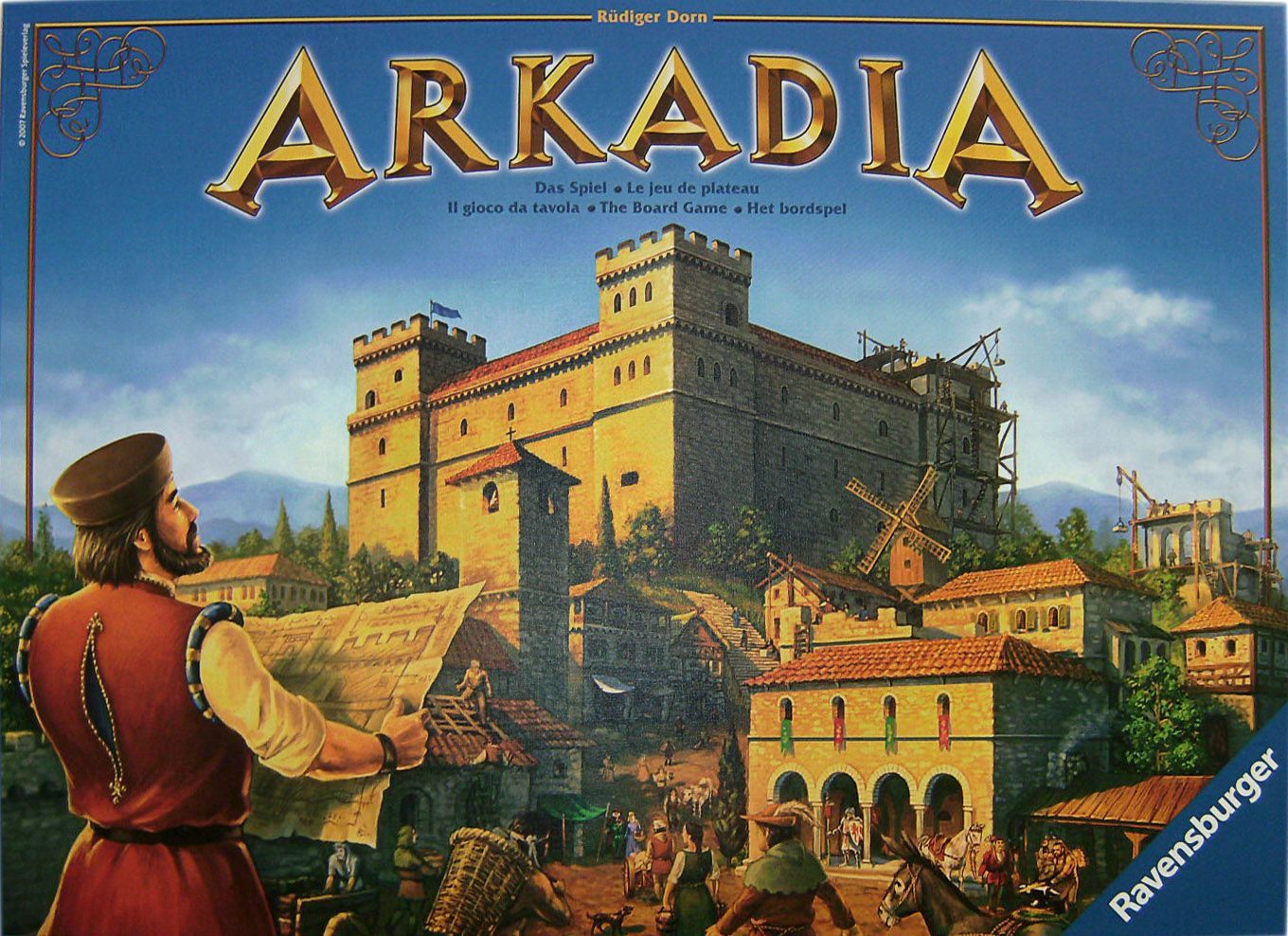
Players are architects building houses and a central castle in the town of Arkadia. They collect seals of four wealthy families, which they can convert into gold at moments of their choice. The player with the most gold at the end wins.
Setup
Place the game board in the centre of the table and put the building lot for the castle on the grid, leaving every tent camp square uncovered.
Each player takes a screen, the 4 architect banners in their colour and 3 workers, which they keep behind the screen. The remaining workers, including the neutral beige ones, form a general pool beside the board.
Place the 12 castle pieces for the first and second floors on their pool areas, three of each family colour per floor. With only 8 squares available, stack two pieces of the same colour on the border squares. Place the remaining 4 coloured castle pieces on the coloured pool squares for the third floor, and leave the neutral third-floor squares empty for now.
Sort the buildings by form and put them beside the board, along with the seals and gold. Shuffle the building cards, deal 4 face down to each player, place 3 face up beside the board and make a face-down stack of the rest. The youngest player starts, and play goes clockwise.
A turn
A turn has two parts. First, the player must choose one of two actions.
- Lay out a building: Take a building card from your hand and place the matching building on the board. It must touch an existing building (the castle lot counts) or a worker horizontally or vertically, and every square it covers must be empty. Put a seal of the card's colour on the building, then discard the card. Refill your hand to four cards by taking one of the three face-up cards or the top card of the stack, and if you took a face-up card, replace it from the stack. If the building covers any tent camps, take one neutral worker from the pool for each tent camp covered.
- Introduce workers: Choose one building on the board and place any number of your own and/or neutral workers from behind your screen onto empty squares adjacent to it. All workers introduced in the same turn must touch that same building. Workers stay where they are for the rest of the game. Placing a worker on a tent camp gives you no neutral worker.
If a building becomes fully enclosed by either action, it is completed (see below).
Second, the player may use one architect banner. Playing a banner gives you two workers of your colour from the general pool, and the banner is then out of the game. After playing a banner you may also evaluate your own seals (see Scoring).
Building completion: a building is completed when all squares horizontally or vertically adjacent to it are occupied by workers, other buildings or the board border. A building that is placed already enclosed also completes.
Payout: each player who has their own workers adjacent to the completed building receives one seal of that building's seal colour per such worker. The active player also receives the seal lying on the completed building. Neutral workers earn nothing. If several buildings complete at once, each is evaluated separately, so one worker can earn several seals. If the normal seal supply runs short, 5 seals may be exchanged for one seal of value 5.
Castle construction: the active player places one castle piece per newly completed building on the castle lot. The first floor must be completed before the second floor. Pieces may go on any vacant square, including on top of others. Once all 10 squares of the first floor are filled, the 2 remaining first-floor pieces move to the third-floor pool. The second floor is then built the same way, and its remaining 2 pieces also move to the third-floor pool.
End of the game
The end of the game begins as soon as the last castle piece of the second floor is placed. The two remaining pieces then go to the third-floor pool. If a single turn places more pieces than are left on the second floor, the leftover second-floor pieces go to the third-floor pool first, and any further pieces are then taken from the third-floor pool.
The player who triggered the end finishes their turn as usual, and may still use a banner. Each player then gets one last turn, and the player who began the end of the game plays last. Castle pieces for any buildings completed during this final round come from the third-floor pool.
After the final round, each player evaluates all their remaining seals in one last evaluation. Workers that were never introduced are worth nothing.
Scoring
Seals are converted to gold through evaluations. A seal's value equals the number of castle squares of its family's colour visible from above. For example, if 7 red seals are exchanged while 3 red squares are visible, that is 21 gold, and any seals exchanged in one evaluation are scored at the current castle state.
Each player may make at most four evaluations during the game, each unlocked by playing a banner. The final evaluation at the end of the game is not limited this way.
The player with the most gold at the end wins. If two or more players tie for the most gold, they all share the victory.
Variants
Beginner set-up (recommended for a first game): remove the seven building cards listed in the rulebook. Place the seven corresponding buildings and the castle lot on the board as shown in the rulebook illustration, using the tent camps as guides, and put a seal of the shown colour on each building.
Each player also gets extra neutral workers: 3 each with 2 players, 2 each with 3 players, and 1 each with 4 players. Prepare the rest of the material as in the normal set-up.
The rulebook gives no solo, team or other short-form variants.
Changes
- Variants, by the rulebook draft, 23 November 2026 (shown now)
- Scoring, by the rulebook draft, 23 November 2026 (shown now)
- End of the game, by the rulebook draft, 23 November 2026 (shown now)
- A turn, by the rulebook draft, 23 November 2026 (shown now)
- Setup, by the rulebook draft, 23 November 2026 (shown now)
- Summary, by the rulebook draft, 23 November 2026 (shown now)