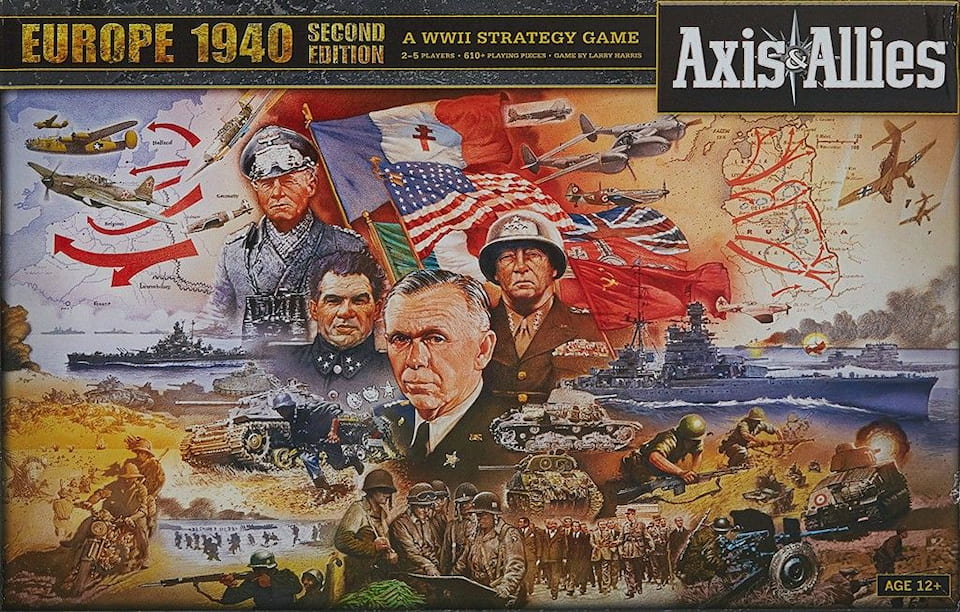
Rules of Axis & Allies Europe 1940
Summary
Axis & Allies Europe 1940 is a turn-based war game for up to five players, split into an Axis side and an Allied side, where each player controls one or more world powers. Players build units, move them into hostile spaces, and resolve attacks with dice. The Axis win by controlling 8 victory cities for a complete round while holding an Axis capital (Berlin or Rome); the Allies win by controlling Berlin and Rome for a complete round while holding an Allied capital (Washington, London, Paris, or Moscow).
Setup
Divide players into the Axis and Allied sides, and assign each player one or more powers that all sit on the same side.
Place each power's starting units on the board as listed on its setup chart, and set its national control marker on the national production chart at its starting income level (Germany 30, Soviet Union 28, United States 35, United Kingdom 29, Italy 10, France 17).
Give each power its starting IPC treasury equal to its starting income. Have one player act as banker and track treasuries, using the IPC Tracking Chart or another agreed method.
Keep the battle strip, casualty strip, dice, plastic chips, and national control markers ready. Gray chips stand for 1 unit, green for 3, and red for 5; any stack can be built with chips and a marker of the unit type if pieces run short.
A turn
Each power takes a turn in a fixed order: Germany, Soviet Union, United States, United Kingdom, Italy, then France (controlled by an Allied player). A round is one turn for each power. A turn has six phases:
- Purchase and Repair Units: Buy any units you can afford and pay to remove facility damage at 1 IPC per point. Place purchased units in the mobilization zone. Capital ships in serviced sea zones are repaired for free.
- Combat Move (powers at war only): Declare any war you choose at the start of this phase. Move units into hostile spaces, announce any amphibious assaults, and blitz tanks where allowed. Most units must stop on entering a hostile space.
- Conduct Combat (powers at war only): Resolve strategic and tactical bombing raids first, then amphibious assaults, then general combat in each contested space. Combat uses the battle strip, with attacker and defender rolling dice to score hits.
- Noncombat Move: Move units that did not move or fight this turn. Land all surviving air units in friendly territories or on friendly carriers.
- Mobilize New Units: Place purchased units at eligible industrial complexes and naval or air facilities you controlled since the start of your turn. Units beyond production limits are returned to the box and refunded.
- Collect Income: Collect your national production income plus any bonus income from national objectives, minus convoy disruption losses. Your capital must be under your control to collect income.
End of the game
The game ends when one side meets its victory condition at the start of a power's turn. The Axis win if they have controlled at least 8 victory cities continuously since the end of their last turn and hold an Axis capital (Berlin or Rome) at the end of that round. The Allies win if they have controlled both Berlin and Rome continuously since the end of their last turn and hold an Allied capital (Washington, London, Paris, or Moscow) at the end of that round. Liberating a capital during the turn in question also counts toward winning.
Scoring
There are no points. Players compete for victory cities and capitals, and the game ends with the victory conditions described above. The rulebook does not describe a tiebreak or point-based winner.
Variants
Global play: Axis & Allies Europe 1940 can be combined with Axis & Allies Pacific 1940 to make a single game for two to six players. The map wraps horizontally, the Axis win with 8 victory cities on Europe or 6 on Pacific, and the United Kingdom runs separate European and Pacific economies. Powers are split among players according to the listed player counts.
Optional Research and Development: Players may buy research dice to gain technological breakthroughs. This rule is intended for combined play and China may not use it.
Changes
- Variants, by the rulebook draft, 23 November 2026 (shown now)
- Scoring, by the rulebook draft, 23 November 2026 (shown now)
- End of the game, by the rulebook draft, 23 November 2026 (shown now)
- A turn, by the rulebook draft, 23 November 2026 (shown now)
- Setup, by the rulebook draft, 23 November 2026 (shown now)
- Summary, by the rulebook draft, 23 November 2026 (shown now)