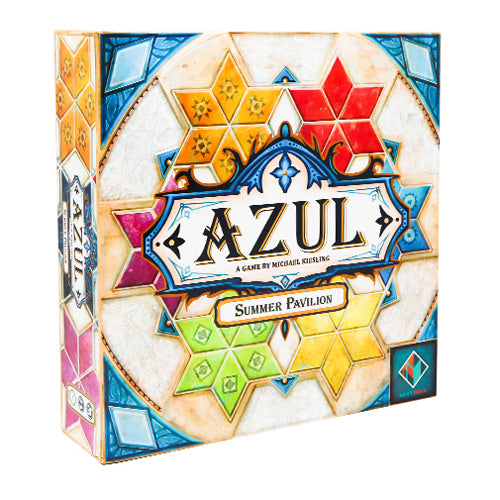
Rules of Azul: Summer Pavilion
Summary
In Azul: Summer Pavilion, players are master artisans building a star-patterned pavilion by collecting colored tiles and placing them on their player boards. Points come from each placed tile, extra points for tiles placed next to connected tiles, bonuses from surrounding pillars, statues and windows, and final goals. The player with the most points wins.
Setup
Each player takes a player board in one color and places it in front of them with the colored stars face up. Place the Factory displays in a circle around the center of the table: 5 for two players, 7 for three, or 9 for four. Place the scoring board next to them and put the round counter on round 1, where purple is the wild color. Each player takes a scoring marker in their color and places it on space 5 of the scoring track. Fill the bag with the 132 tiles, draw 10 at random and place them on the supply spaces in the center of the scoring board. Then fill each Factory display with exactly 4 random tiles from the bag. Place the start player token in the center of the table and the tower between the Factory displays and the scoring board. Set the point tokens aside. Return unused player boards, scoring markers and Factory displays to the box.
A turn
The youngest player starts, and play goes clockwise. A round has three phases. In Phase 1, Acquire Tiles, you must take either all tiles of one non-wild color from a single Factory display, moving the remaining tiles to the center of the table, or all tiles of one non-wild color from the center. If the chosen source has wild tiles, you must also take exactly one of them. If it has only wild tiles, you may take just one. If you are the first player to take from the center in a round, you take the start player token and move your scoring marker back one space for each tile taken, but not past space 1. Phase 1 ends when all Factory displays and the center are empty. In Phase 2, Play and Score Tiles, starting with the start player and going clockwise, you may place one tile on an empty diamond space of your board whose star color matches the tile, provided you have collected enough tiles of that color for the number shown on the space. Discard the other tiles needed for that space into the tower. Wild tiles can replace a missing color but cannot go onto a space of a different color. The center star has no color restriction, but all six tiles there must be different colors. If you cannot or do not want to place, you pass: you may keep up to 4 leftover tiles in the corners of your board, discard the rest into the tower and lose 1 point per discarded tile, and you take no more turns that round. Phase 2 repeats until no one can or wants to place more tiles. In Phase 3, Preparation for the Next Round, the start player advances the round counter (skipped after round 6), refills each Factory display with 4 tiles from the bag, and returns the start player token to the center. If the bag runs out, refill it with the tiles from the tower. Then players move any corner tiles next to their boards.
End of the game
The game ends after 6 rounds, and Phase 3 is not played in the last round. Players then check the end-of-game goals for completed stars and covered numbers. Any tiles left in the corners of player boards are discarded into the tower, costing 1 point each.
Scoring
Each tile placed earns 1 point, and the scoring marker moves forward accordingly. A tile placed next to connected tiles on the same star earns 1 point for each tile it connects to. Surrounding the four spaces next to a pillar gives an immediate bonus of one supply tile of your choice, surrounding a statue gives two tiles, and surrounding a window gives three tiles, which are taken from the supply spaces. Passing 80 points means taking a point token. At the end, completing the multicolored star gives 12 points. Completing a single-colored star gives 14 points for red, 15 for blue, 16 for yellow, 17 for orange, 18 for green and 20 for purple. Covering all 1s gives 4 points, all 2s 8 points, all 3s 12 points and all 4s 16 points. Leftover corner tiles cost 1 point each. The player with the most points wins, and tied players share the victory.
Variants
For a different game, all players turn their boards to the monochrome side, which has different numbers on the stars. Players choose the colors placed on each of the seven stars. A multicolored star must use six different colors, as in the normal game, and a single-colored star must use only one color. More than one star of the same color, or more than one multicolored star, is allowed, and points for these stars are scored as in the normal rules.
Changes
- Variants, by the rulebook draft, 22 November 2026 (shown now)
- Scoring, by the rulebook draft, 22 November 2026 (shown now)
- End of the game, by the rulebook draft, 22 November 2026 (shown now)
- A turn, by the rulebook draft, 22 November 2026 (shown now)
- Setup, by the rulebook draft, 22 November 2026 (shown now)
- Summary, by the rulebook draft, 22 November 2026 (shown now)