Rules of Balderdash
Summary
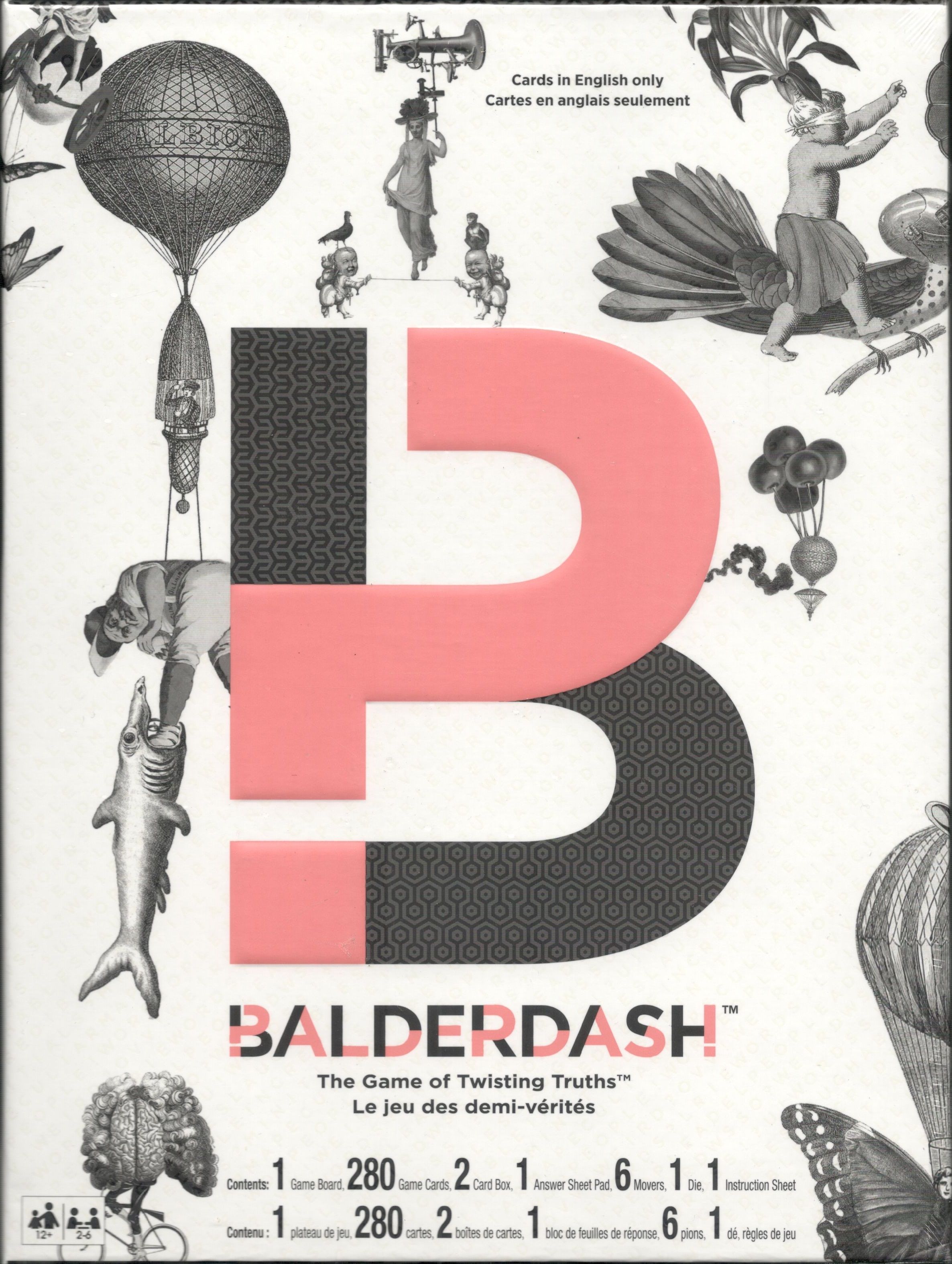
Balderdash is a bluffing word game where players invent convincing fake dictionary definitions for a word and try to pick out the real one. Players score by fooling others and by spotting the true meaning. The first player to reach the space marked FINISH wins, and ties are not allowed.
Setup
Each player takes a definition sheet, picks a coloured playing piece, and places it on the space marked START.
A turn
Each round has one dasher (leader). Players roll the die to determine the first dasher, and the role then passes to the left after each round.
- The dasher draws the first card from the card box and keeps it hidden from the other players.
- The dasher rolls the die to choose which word on the card is played: a 1 means the first word, a 2 the second, and so on. A 6 lets the dasher choose any of the five words.
- The dasher reads the word aloud and spells it. The other players write down an invented meaning that could pass for the real one, then initial their sheets and hand them to the dasher.
- While the others write, the dasher copies the real meaning from the card onto the dasher's own sheet and returns the card to the back of the box.
- The dasher shuffles all the definitions, including the real one, and reads them aloud. The dasher may read them a second time if needed.
- Moving clockwise from the dasher's left, each player guesses which definition is correct. The dasher initials each guess in the SCORE section.
- The dasher reveals the true meaning, totals the points, and moves the pieces. The player to the dasher's left becomes the next dasher.
End of the game
The game ends when a player's piece reaches the space marked FINISH. The first player to reach it wins.
Scoring
- Each player earns one point for every vote their invented definition receives.
- A player who picks the true meaning earns two points and moves two spaces.
- The dasher earns three points if no player picks the true meaning.
- A player who submits a definition very close to the real meaning earns three points and moves three spaces. The dasher sets that definition aside, and it is not read or voted on.
- If two or more definitions are very close to the real meaning, the round is cancelled and the dasher draws a new card. Players who submitted close definitions still earn their three points.
- Players may vote for their own definition as a bluff, but they earn no points for that vote.
- Points are converted into spaces moved along the board, and the first player to reach FINISH wins. Ties are not allowed. If players tie on reaching FINISH in the same round, the player to the dasher's left moves first.
Variants
Two players only: One player picks any of the five words on a card and reads all five definitions aloud. The other player guesses which one is correct. A correct guess earns two points and moves two spaces. An incorrect guess gives the reader one point. Play alternates until one player reaches FINISH.
Optional play: Instead of rolling the die, the dasher may choose any of the five words on the card.
Optional bluff (four players or fewer): The dasher also writes a bluff definition, which adds another option for the other players to choose from.
Changes
- Variants, by the rulebook draft, 23 November 2026 (shown now)
- Scoring, by the rulebook draft, 23 November 2026 (shown now)
- End of the game, by the rulebook draft, 23 November 2026 (shown now)
- A turn, by the rulebook draft, 23 November 2026 (shown now)
- Setup, by the rulebook draft, 23 November 2026 (shown now)
- Summary, by the rulebook draft, 23 November 2026 (shown now)