Rules of Band of Brothers: Screaming Eagles
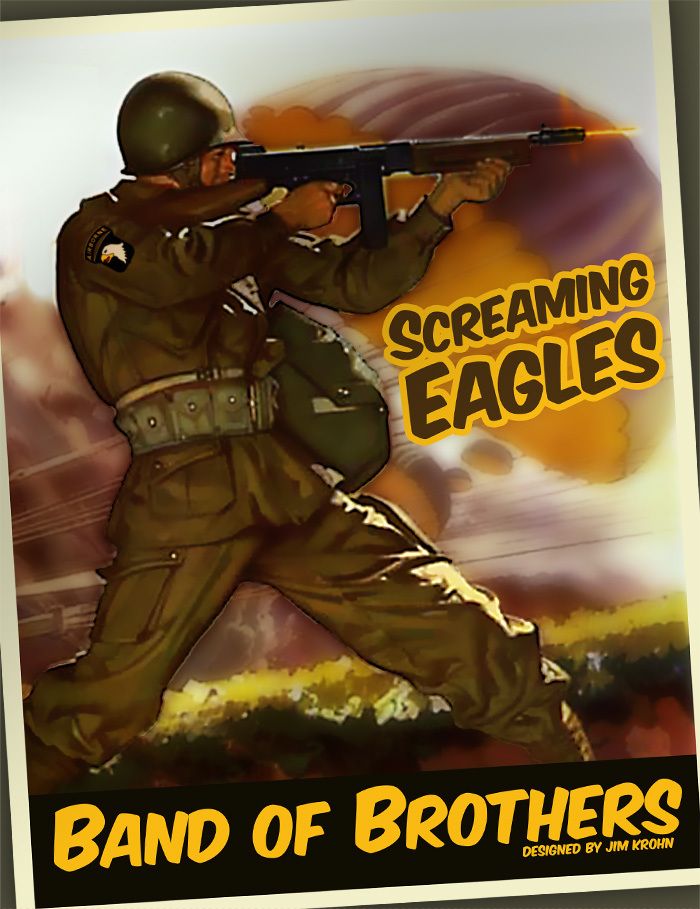
Summary
Band of Brothers is a tactical World War II combat game in which players command infantry squads, weapons teams, guns, vehicles and off-board assets such as artillery. The rulebook gives the core rules, and each scenario card sets its own objectives. This rulebook excerpt does not describe a general winning condition beyond what the scenario card specifies.
Setup
Each player takes the Command Point (CP) counters allotted by the scenario. Units are placed according to the scenario card. Units in suitable terrain, or set up outside the line of sight of all enemy units, may start under Conceal counters. Some scenarios give a side Decoys, which are placed as concealed fake units. Reinforcements are set up before their turn begins and may enter Concealed, but may not be placed adjacent to an enemy unit. Vehicles cannot be set up with a Move counter.
A turn
Each game turn has four phases, each representing about two minutes of play.
- Operations Phase: Players alternate using units and assets within their Operations Range, which is a minimum and maximum number of units given on the scenario card. Each unit used counts once, while Guns, Vehicles and Artillery count as three. Each unit may move, fire, be marked for Opportunity Fire, or be marked as Used. Players must use all units, and may choose whether to use assets.
- Rout Phase: Infantry and Guns that are in danger, such as sharing a hex with an enemy or being exposed within 5 hexes, must take a Morale Check. Units that fail may flee toward cover or be eliminated.
- Melee Phase: Infantry or Guns sharing a location with an enemy fight a round of Melee with two dice each.
- Recovery Phase: Suppression wears off one step, Used and Op Fire markers are removed, and the turn marker advances.
Infantry must pass a Morale Check before moving or firing. Opportunity Fire lets a non-moving player interrupt an enemy move with a fire attack, and Final Op Fire does the same after a unit has been marked as Used.
End of the game
The scenario ends after the last turn on the turn track, and victory is then determined as the scenario card specifies. In campaign games, play continues while the Attacker wishes to keep going. If the Attacker stops, the other side may take over as Attacker, and the scenario ends when neither side wishes to continue. Any Melee still in progress is resolved first. In scenarios that require eliminating a side, surviving Decoys alone do not give that side the victory.
Variants
- Infantry facing: Optional in European scenarios and required in Pacific scenarios.
- Combat Events: Optional in European scenarios and required in Pacific scenarios.
- Sustained Fire: An optional rule that lets machine gun teams cover adjacent hexes with Final Op Fire.
- Unconfirmed Kills and Critical Hits: Optional rules for fire against vehicles.
- Campaign Game: Linked scenarios with Command and Control, Company Hubs, Fatigue, and regrouping between scenarios.
- Solo play: A recommended method that uses Possible unit counters drawn from a cup in place of hidden units.
- Pacific modules: Terrain and rules shown in green are optional or intended for Pacific scenarios.
Changes
- Variants, by the rulebook draft, 23 November 2026 (shown now)
- End of the game, by the rulebook draft, 23 November 2026 (shown now)
- A turn, by the rulebook draft, 23 November 2026 (shown now)
- Setup, by the rulebook draft, 23 November 2026 (shown now)
- Summary, by the rulebook draft, 23 November 2026 (shown now)