Rules of Blue Moon City
Summary
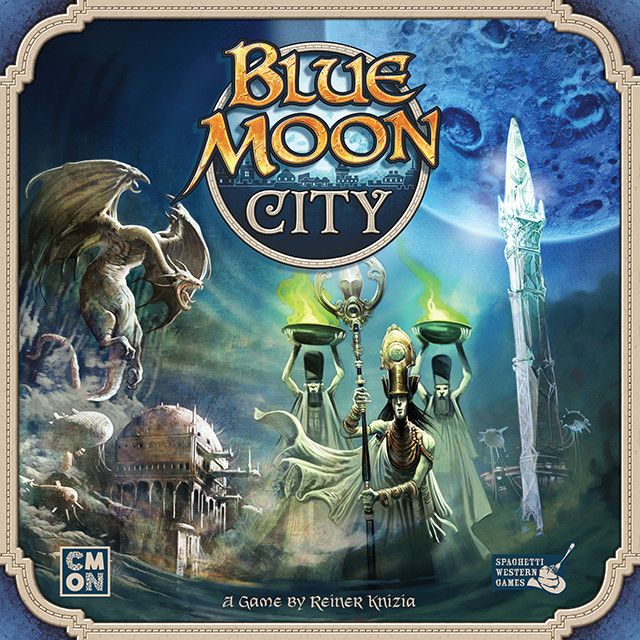
Players rebuild the buildings of Blue Moon City by spending cards of matching colors as contributions. Finished buildings reward players with crystals, cards, and golden scales. Players spend crystals to make offerings on the obelisk. The first player to reach the required number of offerings wins: 6 in a 2-player game, 5 in a 3-player game, or 4 in a 4-player game.
Setup
- Place the courtyard in the center. Place the three temples and the royal palace next to it as shown in the illustration. Shuffle the remaining building tiles and place them randomly to complete the city shape. Sketch sides face up.
- Place the obelisk next to the city.
- Place the crystal tokens face up beside the obelisk.
- Place the golden scales on the other side of the obelisk: 15 for four players, 12 for three players, or 9 for two players. Return any extras to the box.
- Place the three dragons next to the city.
- Each player chooses a color and takes the matching figure, which goes on the courtyard, and the matching markers. Return unused figures and markers to the box.
- Shuffle the cards and deal 8 to each player. Place the rest as a face-down deck next to the city.
A turn
Players take turns clockwise. On your turn, go through these phases in order:
- Movement: Move your figure up to two steps along adjacent building tiles. Diagonal moves are not allowed. You may change direction during the move.
- Contribution: On the building where you ended your move, you may contribute cards. If you ended on the courtyard, you may make an offering to the obelisk instead.
- Discard and draw: Discard zero, one, or two cards to a face-up discard pile. Then draw two more cards than you discarded. If the deck runs out, shuffle the discard pile to form a new deck.
Card powers may be used during your turn by discarding the card, as shown on the card.
To contribute to a building, discard cards of the matching color from your hand whose total equals or exceeds the value in an open box, then place one of your markers on that box. You may make several contributions, each with separate cards. The royal palace boxes may use any color, but each box must use only one color.
When your marker fills the last open box, the building is complete and scored (see Scoring). Afterwards, return all markers to their owners, flip the tile to its completed side, and return any figures and dragons on it to their tile.
If dragons are present on the building where you make a contribution, you receive one golden scale for each dragon. You receive these only once per turn, however many contributions you make.
An offering to the obelisk costs crystals. The obelisk boxes fill from the bottom up. Spend the required crystals to place one of your markers on the matching box. Dragons on the courtyard have no effect on offerings.
End of the game
The game ends when a player makes the required number of offerings to the obelisk (6 in a 2-player game, 5 in a 3-player game, or 4 in a 4-player game). That player wins.
If every building is rebuilt but no player has enough crystals to reach the required offerings, play continues until each player has made as many offerings as possible. The player with the most offerings wins.
If all players run out of markers, the game is a draw.
Scoring
When a building is completed, the player with the most markers on it receives the reward to the right of the asterisk. Ties are broken by the marker farthest to the left. Every player who made at least one contribution receives the reward under the asterisk. Each contributor also receives the neighborhood rewards from every completed building orthogonally adjacent to it. A player scores each building only once, no matter how many contributions they made.
Golden scales are scored instantly when the last scale is taken. The player with the most scales receives 6 crystals. If players are tied for the most, each receives 3 crystals. Any player with at least 3 scales receives at least 3 crystals. Players with fewer than 3 scales receive no crystals. Scales that could not be awarded because the supply ran out still count toward totals. Players who receive crystals return their scales to the supply, while others keep theirs. Crystals are not limited, so extra tokens may be used.
If no player can complete the offerings, the player with the most offerings wins. A tie is broken by the most remaining crystals. If still tied, the tied players share the victory.
Changes
- Scoring, by the rulebook draft, 23 November 2026 (shown now)
- End of the game, by the rulebook draft, 23 November 2026 (shown now)
- A turn, by the rulebook draft, 23 November 2026 (shown now)
- Setup, by the rulebook draft, 23 November 2026 (shown now)
- Summary, by the rulebook draft, 23 November 2026 (shown now)