Rules of Brian Boru: High King of Ireland
Summary
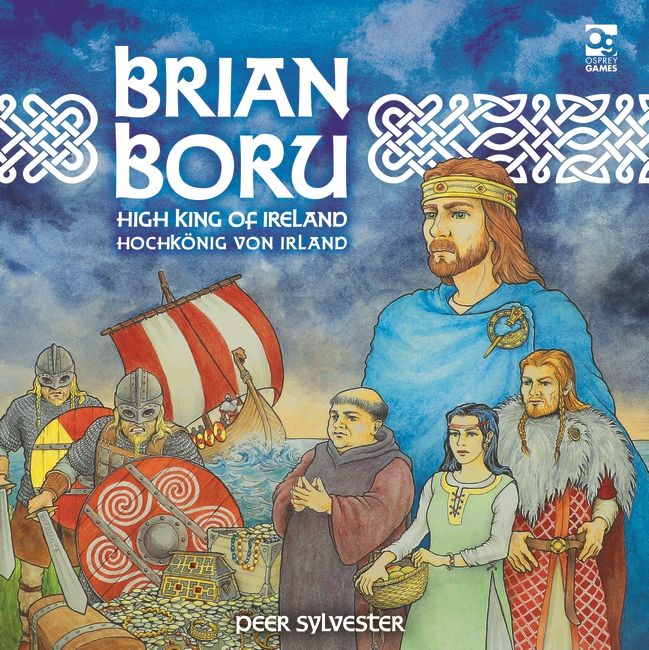
Brian Boru is a game for three to five players in which you compete to unite Ireland under your control. Over several rounds you draft and play action cards to take towns, arrange marriages, repel Viking raiders, build monasteries and claim regions. The player with the most points at the end wins.
Setup
- Place the board in the middle of the table and make a supply of coins, renown tokens, monastery tokens, Viking raider tokens and Viking control tokens.
- Each player takes one colour of discs and places one disc on the first space of the marriage track and one on space 10 of the score track. Each player also gets three coins, one renown token and a reference card.
- Place all claim tokens face down in their slots. Put the Princess of Denmark marriage card beside the marriage track and remove the German Dänische Prinzessin card from the game.
- Shuffle the other marriage cards and place a set number face down on top of the Princess: two cards for three players, three cards for four or five players. Remove the remaining marriage cards without looking at them.
- Shuffle the Viking cards and place them face down by the battle area. Place the action cards near the board.
- Randomly choose a starting player and give them the active town marker. Clockwise from them, each player places a disc on a town, but no player may place a disc in a region where another player already has one.
A turn
The game is played in rounds, and each round has four phases: preparation, draft, action and upkeep.
Preparation: Reveal the top Viking card and place raiders in the battle area equal to its invasion strength, then discard it. Reveal the top marriage card and place it at the top of the marriage track. If the marriage deck is now empty, this is the final round.
Draft: Shuffle the action cards and deal eight each (three players), six each (four players) or five each (five players). With three or four players, set one remaining card aside face down. Choose two cards and place them face down in front of you, then pass the rest to the player on your left. Repeat until all cards are placed; you may look at your chosen cards but not swap them. When you are passed only one or two cards from the right, they go straight onto your pile. Then take all your cards into hand.
Action: Play tricks until each player has one card left, then discard that card. In each trick, the player with the active town marker places it on an empty town and plays a card matching that town's colour or a white royal card. Each other player, clockwise, then plays any card. The highest value card in the town's colour wins the trick, with royal cards counting as that colour. Players then act in ascending order of their card's value: the winner performs the primary action at the top of the card, and each loser chooses one secondary action. Used cards go to a shared discard pile. The trick winner takes the active town marker for the next trick.
Upkeep: Resolve the marriage, battle, church and claim regions steps in order.
End of the game
After the upkeep phase, if no marriage cards remain in the deck, the game ends and final scores are counted. With three players this is after three rounds; with four or five players, after four rounds.
Scoring
Final scoring works as follows:
- The player with the most coins scores one point. If tied for most, no one scores.
- The player holding the active town marker scores one point.
- Each renown token you have scores one point.
- Each face-up claim token in front of you scores its listed points. Each face-up token on the board gives half its points, rounded down, to every player tied for the most towns in that region.
- Face-down claim tokens score nothing.
- You score by the number of regions where you control at least one town: 1–2 regions give 0 points, 3–4 give 1, 5 gives 3, 6 gives 5, 7 gives 7 and 8 gives 10.
The Princess of Denmark card can change how Viking-controlled towns count for you, depending on the side chosen.
The player with the most points wins. Ties are broken by most claim tokens, then most marriage cards. If still tied, the tied players share the victory.
Changes
- Scoring, by the rulebook draft, 22 November 2026 (shown now)
- End of the game, by the rulebook draft, 22 November 2026 (shown now)
- A turn, by the rulebook draft, 22 November 2026 (shown now)
- Setup, by the rulebook draft, 22 November 2026 (shown now)
- Summary, by the rulebook draft, 22 November 2026 (shown now)