Rules of Call to Adventure
Summary
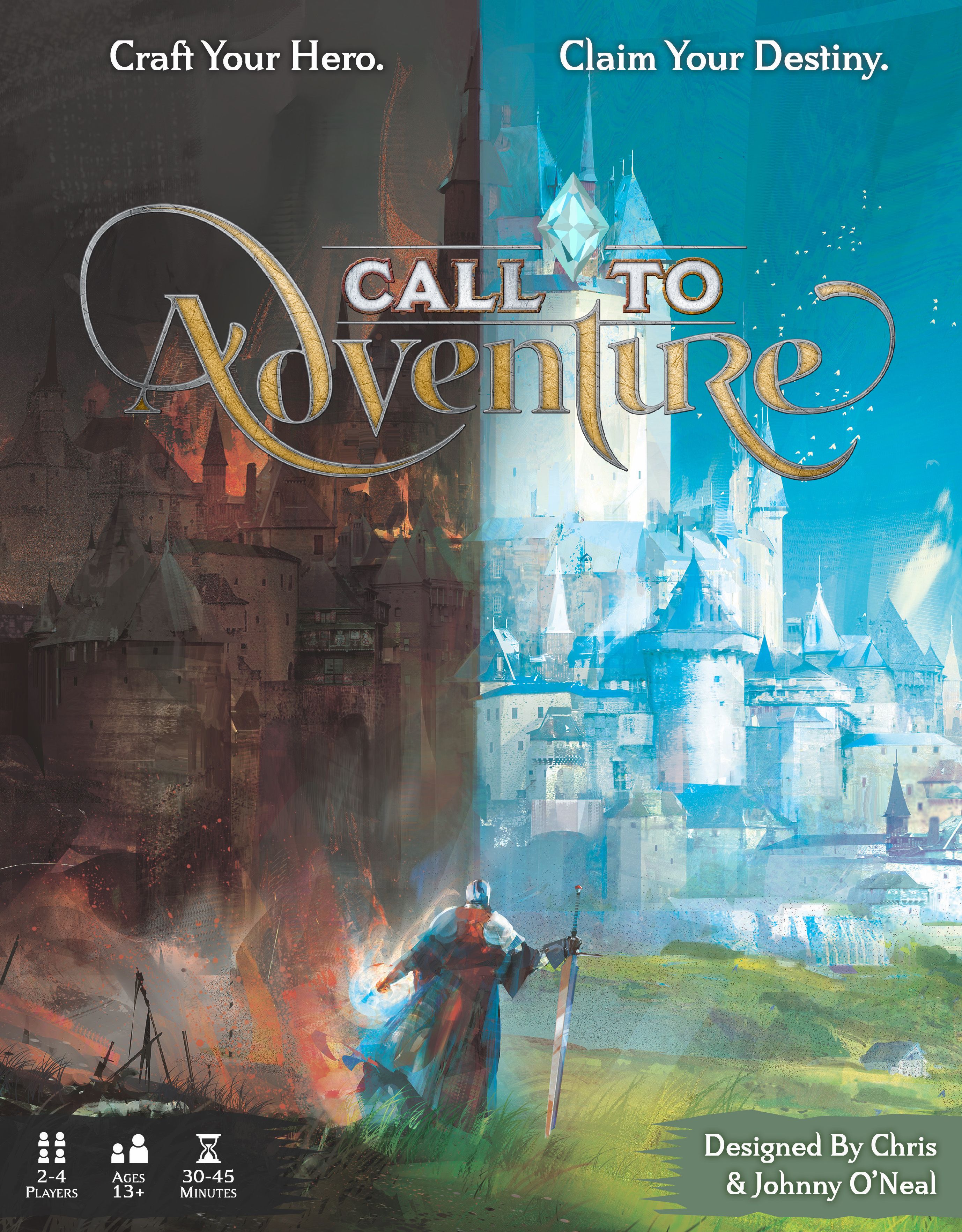
Call to Adventure is a competitive card game in which players build fantasy heroes by gaining Traits, overcoming Challenges, and growing Abilities across three Acts. The player with the highest Destiny score at the end of the game wins.
Setup
Shuffle the decks and prepare the play space. Each player is dealt six Character cards (two Origins, two Motivations, two Destinies) and keeps one of each, returning the rest to the box. Each player also draws one Hero card to hold hidden and receives three Experience tokens. Lay out your Origin face-up on the left, Motivation face-up in the middle, and Destiny face-down on the right. Place your Hero marker on the neutral third level of the Corruption tracker on your player board.
Prepare the three Story decks (Act I, Act II, Act III) plus the Hero and Antihero decks. Beside each Story deck, lay out a row of face-down cards: four per Act in a 2-3 player game, or five per Act in a 4-player game. Turn the Act I row face-up. Place the rune tray within reach of everyone. For a first game, you may remove the Allies, Adversaries, and their related cards. The player who most recently finished reading a novel goes first.
A turn
On your turn you may either gain a Trait or attempt a Challenge, then take any other actions you have available.
- Gain a Trait: If you meet a Trait's prerequisite, gain it and tuck it under the matching Story card (Act I under Origin, Act II under Motivation, Act III under Destiny), leaving its top visible.
- Attempt a Challenge: Check the difficulty on the left of the card and choose a path (top or bottom). A path marked with an extra icon raises the difficulty by 1. Gather your core runes, plus one matching Ability rune for each relevant Ability icon in your Story, plus any Dark runes you pay Experience for. Apply any card effects, then cast the runes. If the total meets or beats the difficulty, you overcome the challenge and tuck it under your Character card showing the chosen path. If you fail, discard it and gain an Experience token.
After gaining or discarding a card from the table, refill that spot from the same Act deck.
Other actions, usable as often as you can afford: Journey (once per turn, pay Experience to swap a visible card for another from the same deck), playing Hero or Antihero cards, and using card effects. At the end of your turn, end temporary effects and draw to replace any cards you claimed.
Dark runes can be bought with Experience, up to three per turn, before you attempt a challenge. Ability runes are capped at three per Ability, and the third one unlocks a Special rune.
End of the game
An Act ends for a player once they have placed three trait or challenge cards under their current Act card, after which they can no longer gain cards from that Act. When the first player completes an Act, the next row of cards is revealed for everyone. The game ends when one player has gained three cards under their Destiny card. Each other player then takes one final turn.
Scoring
To determine the winner, reveal your Destiny card and total your score:
- Add all Triumph and Tragedy points printed under your Character cards.
- Add points from Story icon sets. Each of the six icon types scores as a set, with bonuses depending on how many matching icons you hold.
- Add one point for each unspent Experience token.
- Add the Triumph or Tragedy value of each Hero and Antihero card you played, regardless of Corruption position.
- Add the Triumph or Tragedy value of your final Corruption track position. These values do not stack, so only your final position counts. A neutral position scores nothing, and a villainous position gives a penalty.
- Add any points from your Destiny card whose requirements you met.
The player with the highest Destiny score wins. Each player then tells their hero's story.
Variants
Solo and Co-Op play: Set aside all Adversary cards and randomly choose one as your opponent. Take the matching Adversary Quest card and the Rise of the Adversary card. Set aside the Antihero cards marked with the Adversary icon to form the Adversary's special deck, and place the double-sided Victory card under the Adversary, using the side for your player count.
Each time you cast core runes and get the Adversary result, draw a Hero or Antihero card, then reveal and apply the top card of the Adversary's deck, discarding it at the end of each turn. The Adversary wins by reaching its Experience goal. You may attempt the Adversary challenge only on your last turn, which begins once any player has gained eight Story cards. Defeating the Adversary tucks it under your Destiny card. In Co-Op, all players win if the Adversary is defeated, but the highest Destiny score is the ultimate winner.
Allies and Adversaries expansion: Shuffle Allies into the Act I and II decks and Adversaries into the Act II and III decks. An Ally attaches to a challenge in its Act, and overcoming that challenge adds the Ally to your Story. An Adversary is a single-path challenge with special effects.
Changes
- Variants, by the rulebook draft, 23 November 2026 (shown now)
- Scoring, by the rulebook draft, 23 November 2026 (shown now)
- End of the game, by the rulebook draft, 23 November 2026 (shown now)
- A turn, by the rulebook draft, 23 November 2026 (shown now)
- Setup, by the rulebook draft, 23 November 2026 (shown now)
- Summary, by the rulebook draft, 23 November 2026 (shown now)