Rules of Century: Eastern Wonders
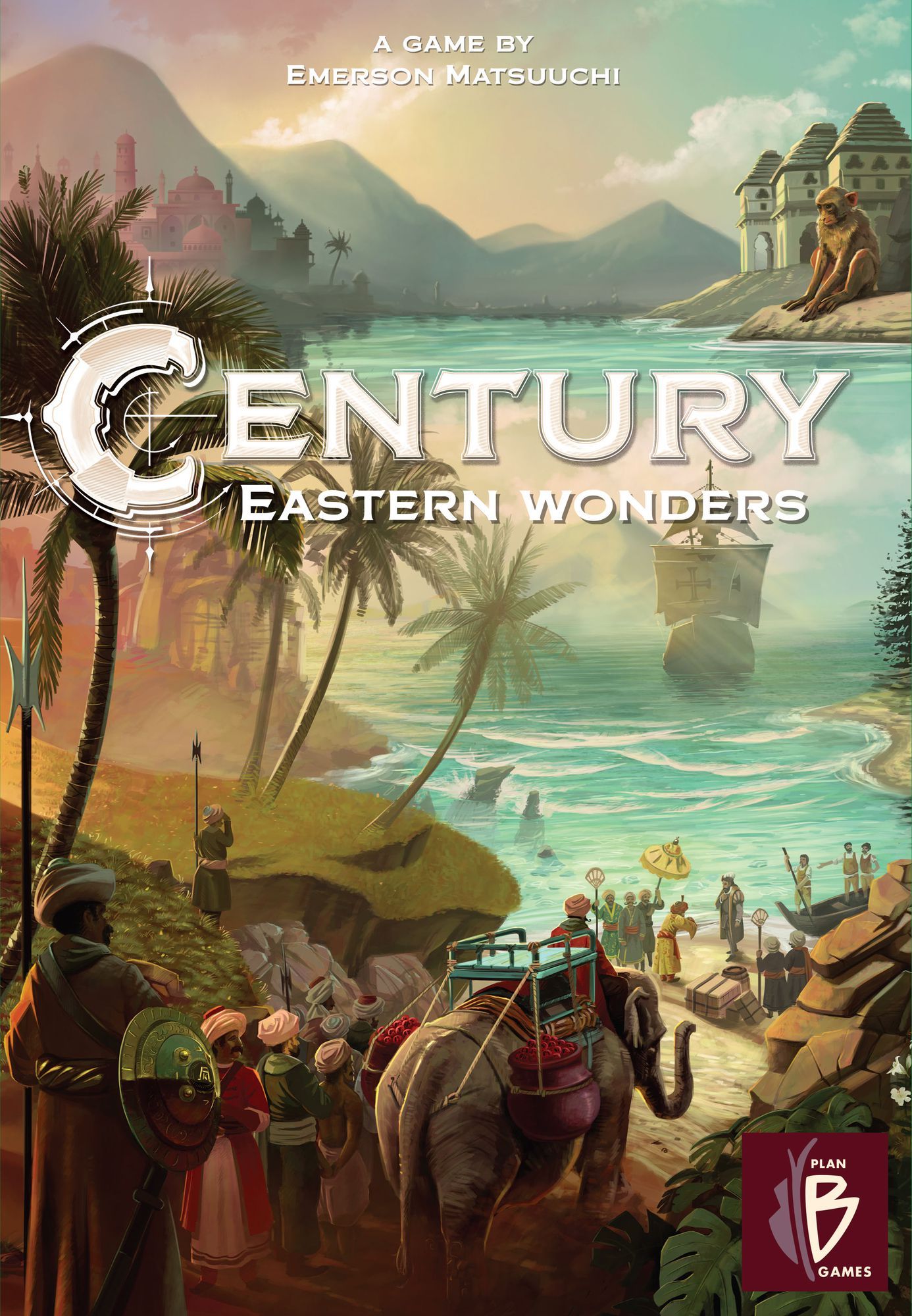
Summary
Century Eastern Wonders is a route-and-trade game set in the Age of Discovery, where players are merchant privateers sailing for control of the Far East. Players move boats across market tiles, spend cubes to place outposts and trade, and claim victory point tiles at ports. The game ends when a player claims their 4th VP tile, and the player with the most points at the end wins.
Setup
- Sort the market tiles by trade symbol and randomly remove one tile of each symbol. Shuffle the rest. In a first game, build the map following the pattern shown in the rulebook. Later, players may build a custom map.
- Place the 4 port tiles at the corners of the map.
- Shuffle the VP tiles, leaving out the Closed Port tile, into a face-down pile. Flip one VP tile face up onto each port. Shuffle the Closed Port tile face down into the top 5 tiles of the pile, then place those 6 tiles back on top. Set the pile beside the map.
- Sort the bonus tiles by type. Make a pile of the 6 VP, 5 VP, 4 VP and 3 VP bonus tiles in ascending order, with the 6 VP tile on top.
- Give each player a player board, Eastern Wonders side up. The first player is the one who was last on a boat. That player takes the board with the First Player icon.
- Each player takes a boat and all 20 outposts in their color, placing one outpost on each space of their player board.
- Place the starting cubes in the middle of the table. In reverse turn order, each player selects their starting cubes, puts them in their cargo hold, and places their boat on any market tile. When everyone has chosen, return leftover cubes to the supply.
A turn
The game is played in rounds. Each player takes one turn per round, starting with the first player and going clockwise. On a turn, a player moves their boat, then performs one action.
Move: Move your boat to an adjacent tile for free. You may then keep moving by placing one cube of your choice from your cargo hold on each tile you leave, as long as you have cubes. If you end your movement on a market tile with other boats, pay each of their owners 1 cube from your cargo. You cannot end there if you cannot pay everyone. If cubes are on the tile where you end, you take them into your cargo after paying the other players.
Action: After moving (or choosing not to), perform one of these:
- Market: If your boat is on a market tile, you may first build an outpost there, if you have none on it. The cost is 1 cube per outpost already on that tile (2 cubes per outpost in a 2-player game), so the first outpost is free. Return the cubes to the supply, then place your leftmost outpost from the row matching the market icon. If this empties a vertical column on your board, take one bonus tile from the supply and place it beside your board. Then you may trade cubes as shown by the arrow, from the supply, any number of times as long as you have the cubes. For example, 3 yellow cubes can be traded for 1 brown cube, repeatedly.
- Port: If your boat is on a port, return the cubes shown on its VP tile to the supply and take that tile, placing it face down beside your board. Then draw the next VP tile and place it face up on the port. If the drawn tile is the Closed Port, the port stays closed and no VP tile is placed there. When a VP tile is claimed at another port, first move the Closed Port to that port, then place a VP tile on the port it left.
- Harvest: Take 2 yellow cubes from the supply into your cargo hold.
At the end of a turn, if your cargo hold has more cubes than its limit, discard down to the limit. The limit starts at 10 and increases as your board allows.
End of the game
The game ends once a player has claimed their 4th VP tile. The current round is finished, and then the game ends.
Scoring
Each player adds up:
- The values on their VP tiles
- The uncovered values on their player board
- Their bonus VP tiles
- Their remaining cubes in the cargo hold, where each non-yellow cube is worth 1 point
The player with the most points wins. If players are tied, the tied player who took their turn most recently wins.
Variants
Custom maps: After a first game, players may create their own unique maps. When placing each tile, try to place it next to at least 2 other tiles where possible. The rulebook gives no solo or team variants.
Changes
- Variants, by the rulebook draft, 22 November 2026 (shown now)
- Scoring, by the rulebook draft, 22 November 2026 (shown now)
- End of the game, by the rulebook draft, 22 November 2026 (shown now)
- A turn, by the rulebook draft, 22 November 2026 (shown now)
- Setup, by the rulebook draft, 22 November 2026 (shown now)
- Summary, by the rulebook draft, 22 November 2026 (shown now)