Rules of Civolution
Summary
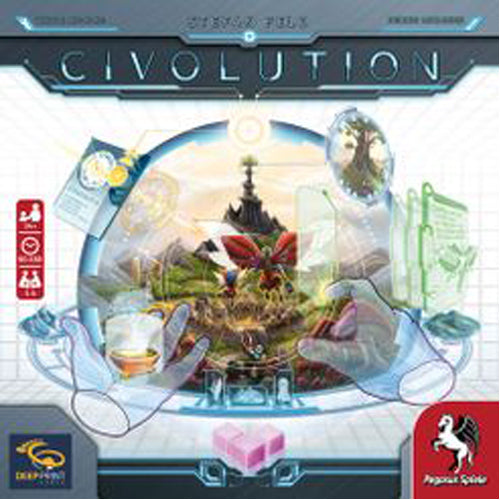
Civolution is a civilization-building game for 1 to 4 players (plus a solo mode) played over four eras. Each player is a local deity guiding a civilization on a continent, using activation dice on console modules to migrate, produce, hunt, build and install research cards. The player with the most success points after the final scoring wins.
Setup
Assemble the progress board and sequence board around the score track, and build the continent from the continent tiles inside the frame. Shuffle the event cards and the scoring tiles as the rulebook describes, fill the goal chip, attribute chip and income chip displays from their bags, and place the sites face down in the continent's recesses. Material tiles are placed on the territories, with Wood and Papyrus as the starting tiles. In 2- and 3-player games, cover some encampments, phase spaces and goal display spaces with blocking tokens as instructed. Each player takes a console, the components of their color, dice matching the player count, and starting tribes, markers, research cards and a starting chip. Determine a starting civilization and give it the starting monolith.
A turn
Each era has eight phases. Phases 1 to 3 prepare the era: reveal a new event card and research cards, choose goal chips in seating order, and make an extra find. Phase 4 is the Action phase, where players take turns in seating order. On your turn you either activate one of your modules by spending two activation dice (or planning markers, or idea markers to change values) or perform a Reset to recover your used dice. Phases 5 to 8 are post-action: sites take effect, tribes are fed, the event resolves and one scoring category is scored, and then income is gained and statues score points.
End of the game
After the Income phase of the fourth era, the game ends with final scoring. The Action phase ends once the phase indicator reaches the reset end space for the player count, with one last action round following.
Scoring
Points come from the score track, the stage partition of each console, and nine scoring categories: five progress tracks, Evolution, Prosperity, Population and Expansion. During each era one category is scored, and at the end all nine are scored along with the stage partition and point bonus cards. The player with the most success points wins. If tied, the tied player who made more module upgrades wins; if still tied, the one earlier in seating order wins.
Variants
Solo mode pits the player against V.I.C.I, an automated rival that uses action cards, a priority system and a territory roll, with its own setup and feeding rules. Difficulty levels from beginner to expert are set by choosing which half of the action cards is used in each era, and an optional harder variant repeats the Reset action's effect. The rulebook also offers two setup options for starting hands, a newcomer option with pre-made hands and an advanced option with a draft of starting cards.
Changes
- Variants, by the rulebook draft, 22 November 2026 (shown now)
- Scoring, by the rulebook draft, 22 November 2026 (shown now)
- End of the game, by the rulebook draft, 22 November 2026 (shown now)
- A turn, by the rulebook draft, 22 November 2026 (shown now)
- Setup, by the rulebook draft, 22 November 2026 (shown now)
- Summary, by the rulebook draft, 22 November 2026 (shown now)