Rules of Coffee Roaster
Summary
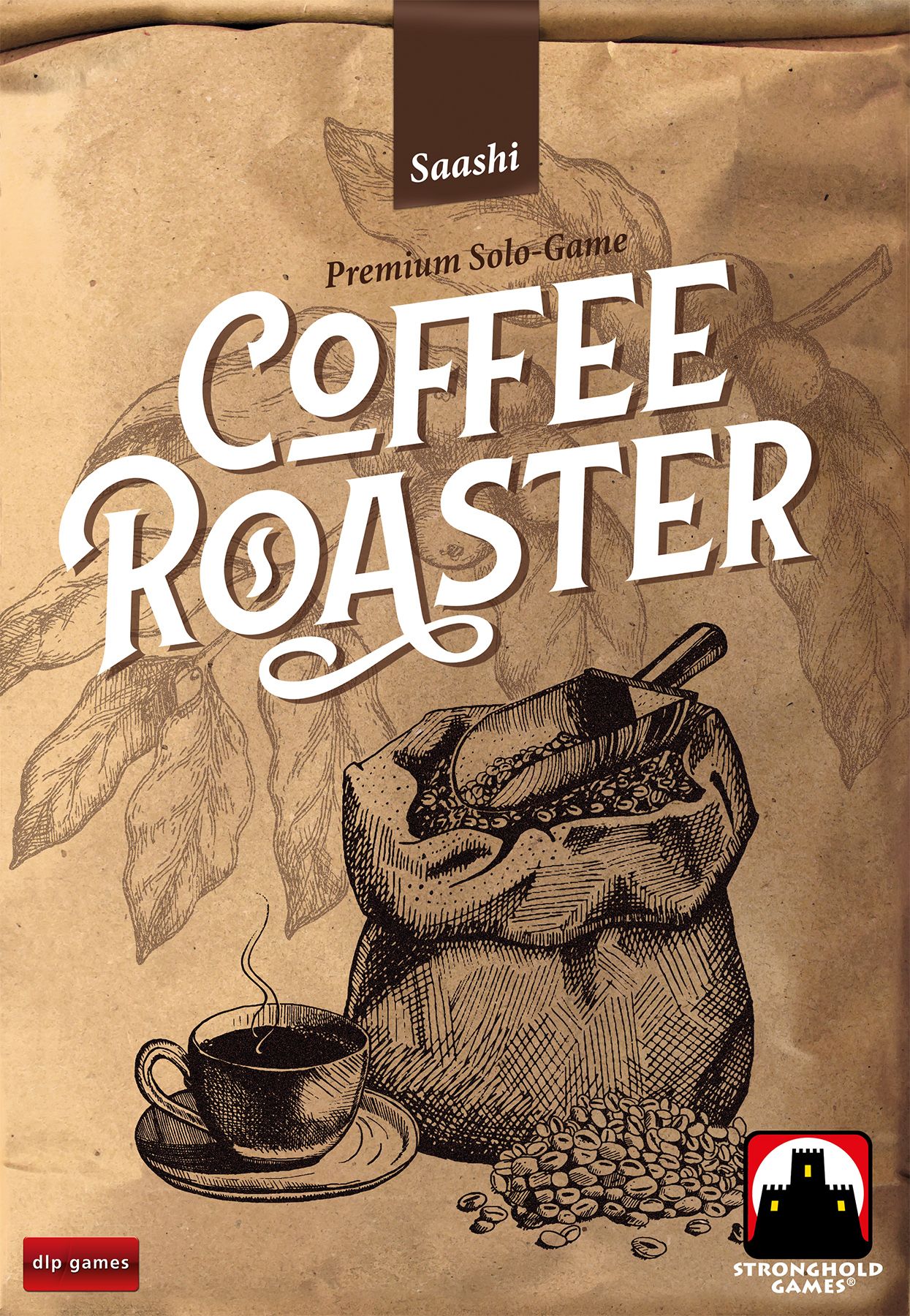
COFFEE ROASTER is a one-player game in which you act as a coffee roaster, roasting beans drawn from a cloth bag and then cup-testing them to build the best coffee. A player wins by earning the highest total score over a roast challenge of three games, which determines a roast rank from apprentice up to master roaster.
Setup
- Lay out the Roast board, the Thermostat and Roast-counter board above it, and the round Cup-testing board in the recess on the right. Put the Roast marker on "0" of the Roast-counter track.
- Shuffle the five square Cup-effect tokens face down on the empty square spaces of the Roast board, then reveal them. Place the "wild flavor" token on the central oval space.
- Place the "smoke" tokens on the highlighted red thermostat spaces as indicated (2 and 3 on the standard side).
- Choose a Coffee card for a single choice, or three different cards for a roast challenge. A first game uses a roast level group I card of beginner difficulty.
- Take the tokens listed on the Coffee card and place them face up in front of you. On the light side only, take one Flavor token each of body, acidity and aroma and place them at the top left of the Roast board; they are available as if drawn in the following rounds.
- Put the remaining tokens into the cloth bag. Set the game round marker on the thermostat at the space matching the number of "moisture" tokens in the bag, as shown on the Coffee card.
A turn
The game has two phases. In the roasting phase, you repeat roasting rounds:
- Move the game round marker one space to the right (skipped in the first round). Any "smoke" tokens on the new space go into the bag immediately.
- Mix the bag and draw the number of tokens shown on the thermostat. If fewer remain, draw them all.
- Remove any "moisture" tokens from the game.
- Optionally use effects: first immediate effects, then flavor effects. Flavor effects need an open matching cup-effect space to place the token on.
- Roast the Bean tokens drawn: each goes up one roast level, processed from highest to lowest. In a red zone the increase is two levels. Hard beans rise at most one level. Roast level 4 becomes a burned bean. Then return all unused tokens to the bag, and optionally move the Roast-counter marker.
- Decide whether to continue roasting or to move on to cup-testing.
In the cup-testing phase, draw tokens one at a time and place each in the cup or in the cardboard tray (the tray is full when no spaces remain, and then the token goes in the cup). Fill spaces from top to bottom and left to right. Moisture tokens are removed when drawn. Continue until all ten cup spaces are full or the bag is empty.
End of the game
The roasting phase must end when the game round marker can no longer advance. You may also end it after any roasting round to start cup-testing. Cup-testing ends when all ten cup spaces are filled or the cloth bag is empty, and then scoring takes place. A roast challenge ends after three games.
Scoring
For each game, add the roast points, flavor points and skill points, then subtract minus points.
- Roast points: add the roast levels of Bean tokens in the cup. The Coffee card's scale gives points for the total; outside the scale, no points.
- Flavor points: Flavor tokens in the cup are compared with the Coffee card's requirements. The "wild flavor" token matches any one type, and "sweetness" can substitute where the card allows. One match gives 1 point, two give 3, three give 6, and four give 10. Cards with three or fewer flavor requirements cap the score at 6.
- Skill points: three or more Bean tokens of the same roast level give 1 point for three, 2 for four, 3 for five, 4 for six, and 5 for seven or more.
- Minus points: each hard bean, burned bean or "smoke" token gives -1, and each defective bean gives -2. No Flavor token in the cup gives -3, and any empty cup space gives -5. Tokens in the tray are not counted.
The total of the three games determines the roast rank: 60 or more is master roaster, 53 to 59 top roaster, 47 to 52 best roaster in town, 40 to 46 chief roaster, 35 to 39 mid-level roaster, 28 to 34 journeyman roaster, 20 to 27 assistant roaster, and 19 or less apprentice roaster. The rulebook does not describe a tie-breaker.
Variants
- Simplified version: the first game can be played on the light side of the boards. It adds extra aids: the cardboard tray gives three additional spaces, and Flavor tokens are placed at the start.
- Single choice or roast challenge: a single choice uses one Coffee card, while a roast challenge uses three different cards over three games.
- Master roaster coffees: five special expert-level cards are available. A player must reach the rank of mid-level roaster before starting expert difficulty in roast level group I.
- Digital version: the rulebook mentions an app version of the game, but it contains no rules for it.
Changes
- Variants, by the rulebook draft, 22 November 2026 (shown now)
- Scoring, by the rulebook draft, 22 November 2026 (shown now)
- End of the game, by the rulebook draft, 22 November 2026 (shown now)
- A turn, by the rulebook draft, 22 November 2026 (shown now)
- Setup, by the rulebook draft, 22 November 2026 (shown now)
- Summary, by the rulebook draft, 22 November 2026 (shown now)