Rules of Concordia Venus
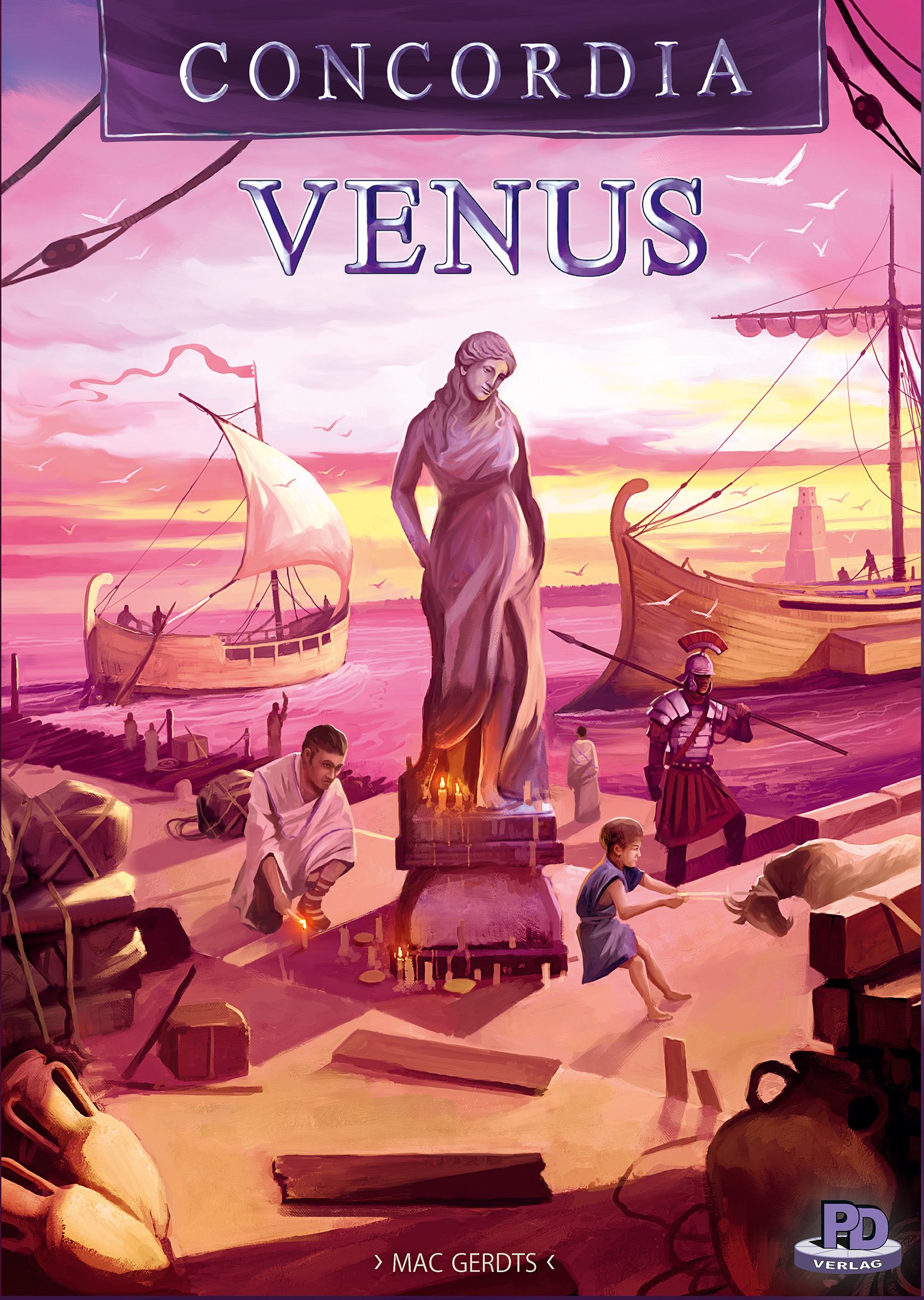
Summary
Concordia Venus is a card-driven game in which players play personality cards tied to ancient gods to gain goods, coins, colonists and houses in cities and provinces. The player with the most victory points at the end of the game wins.
A turn
Players take turns in clockwise order. On your turn, play 1 card from your hand face up onto your personal discard pile and carry out its actions. Only the last card played is visible on the pile. The Tribune lets you take back all of your previously played cards.
Common card actions include:
- Architect: move your colonists, then build houses in cities adjacent to them. Each house costs goods and coins, and the coin cost rises with each additional house in the same city.
- Prefect: either have one active province produce goods (flip its bonus marker to the coin side), or flip all coin-side markers back and take the cash bonus.
- Mercator: take 3 sestertii and trade up to two types of goods with the bank.
- Colonist: pay food and tools to place new colonists, or take 5 sestertii plus 1 per colonist you have on the board.
- Senator: buy up to two personality cards from the card display into your hand.
- Diplomat: copy the top face-up card of an opponent's discard pile.
- Magister: repeat the actions of your own previously played card (not the Senator).
The specialist cards (Mason, Farmer, Smith, Vintner, Weaver) make the houses of one goods type produce.
End of the game
The game ends when a player buys the last card from the card display, or when a player builds their 15th house. That player receives the Concordia Card, worth 7 VP.
Individual Play: every other player then takes one last turn.
Team Play: after the team's turn, every other team takes one last turn.
After the final turns, all players score their victory points.
Scoring
Each personality card is linked to an ancient god, and each god awards points in its own way. Players sort their cards by god, including cards in their discard pile, and score the gods in a set order, usually Vesta first, then Jupiter and the rest.
- Vesta: the value of goods in your storehouse is added to your cash. You receive 1 VP per full 10 sestertii.
- Jupiter: 1 VP per house in a non-brick city, with a maximum per card.
- Saturnus: 1 VP per province where you have at least one house, with a maximum per card.
- Venus: Individual Play: 2 VP per province where you have at least two houses. Team Play: 1 VP per province where both partners have at least one house.
- Mercurius: 2 VP per type of goods your houses produce, with a maximum per card.
- Mars: 2 VP per colonist on the board, with a maximum per card.
- Minerva: points per city of the related type, as shown on the specialist's card.
The Concordia Card adds 7 VP. The Legatus counts for three gods. Intermediate scoring, if used, is done when a player first plays the Tribune. The highest intermediate scorer gets 2 sestertii and second place gets 1, with ties sharing the rewards. Then all VP markers return to zero.
The player or team with the most VP wins. A team's VP is the sum of both partners' VP. A tie goes to the player or team holding the Praefectus Magnus, or else to the tied player who would receive it next.
Variants
Individual Play for 2 to 5 players, where each player acts for themselves. It is recommended for a first game. The Ionium board can be reduced to 22 cities for a tighter 2- or 3-player game.
Team Play for 4 or 6 players in 2 or 3 teams of 2 partners sitting opposite each other. Each turn, one partner plays a card and the other partner also carries out its actions. Partners may not share cards, goods or personality cards, but may give each other sestertii. The Praetor, Proconsul and Legatus are Team Play cards. A partner cannot copy a card the other partner already copied in that round, and a Diplomat cannot copy a partner's card. The Praefectus Magnus works only for its owner.
Double-choice cards (Prefect/Architect, Architect/Mercator, Prefect/Mercator) let the player choose in Individual Play. In Team Play, the player who plays the card chooses one personality and the partner must use the other.
Changes
- Variants, by the rulebook draft, 22 November 2026 (shown now)
- Scoring, by the rulebook draft, 22 November 2026 (shown now)
- End of the game, by the rulebook draft, 22 November 2026 (shown now)
- A turn, by the rulebook draft, 22 November 2026 (shown now)
- Summary, by the rulebook draft, 22 November 2026 (shown now)