Rules of Cytosis: A Cell Biology Board Game
Summary
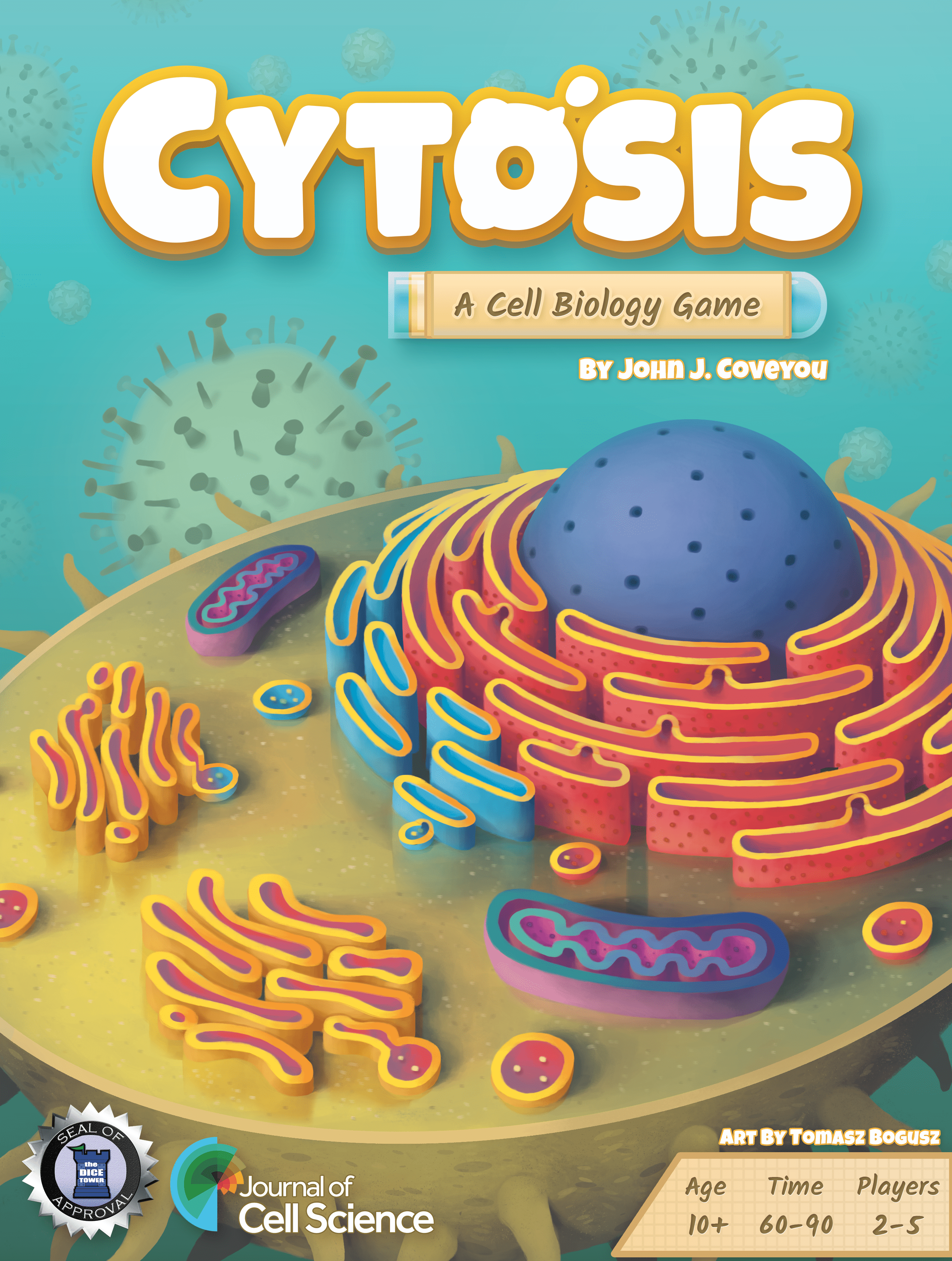
Cytosis is a worker placement game for 2 to 5 players set inside a human cell. Players place flasks on board spots to gather resources and take actions, then use those resources to complete hormones, hormone receptors and enzymes that earn Health Points. The player with the most Health Points at the end wins.
Setup
- Place the board in the center with the Base Game side up. Sort the macromolecule resources by color and the ATP tokens into piles near the board to form the general resource stock. Put the 2 Grey Flasks in the Grey Flask area.
- Shuffle the 12 Event Cards. Remove 2 at random with 2 or 3 players, 1 with 4 players, and none with 5. Place the rest face down as a deck.
- Shuffle the Goal Cards and place face up above the board a number equal to the number of players plus 1. In a 5-player base game, use all five. Return unused Goal Cards to the box.
- Shuffle the Cell Component Cards and flip four face up into the Cell Component Card Area. Deal three to each player. Each player secretly keeps two and shuffles the third back into the deck. Place the deck face down beside the area.
- Each player takes flasks, 2 Transport Vesicle Disks and 3 markers in their color. Flasks per player: 4 with 2 or 3 players, 3 with 4 players, 2 with 5 players. One marker is the Health Marker, placed on 0 of the Health Track; the other two are Goal Markers.
- The player who was most recently sick takes the First Player Marker and 2 ATP. The player to their left takes 3 ATP, the next player 4 ATP, and so on until everyone has ATP.
- Each player then adds 2 more resources of their choice (ATP, mRNA or Lipids) to their personal resource stock.
A turn
A game is played in rounds, each with two phases.
Phase 1: Flask placement. Starting with the First Player Marker holder and moving clockwise, each player places exactly one flask on an available spot and immediately collects the resources or takes the action of that spot. Each spot holds only one flask per round. Spot types include:
- Collecting resources: Nucleus, Plasma Membrane (glucose), Mitochondria (ATP), Smooth ER (lipids), Free Ribosome (trade mRNA for Protein).
- Buying Cell Component Cards: pay the ATP cost shown and add the card to your hand.
- Completing cards over several turns: the ER, then the Golgi Apparatus, then Exocytosis at the Plasma Membrane (hormones and receptors), or the Free Ribosome then Cytoplasm (enzymes).
- Laureates in Biology: take the First Player Marker, then either take 1 ATP or place one Goal Marker on an available Goal Card.
A player may also pay 4 ATP before placing a flask to place a Grey Flask on any spot, occupied or not, and take that spot's action.
Phase 2: Refresh. Return all flasks to players, leaving Transport Vesicle Disks and their resources on the board. Reveal the top Event Card; it is the only active Event. Remove the cheapest Cell Component Card to the discard pile, slide the remaining cards left, and fill the open spots from the deck. If the deck is empty, shuffle the discard pile to form a new deck.
End of the game
The game ends when the last Event Card is revealed. Play Phase 1 one final time, then skip Phase 2 and go straight to final scoring.
Scoring
Players add End Game points to their Health Points.
- Leftover resources: Before scoring, players may move resources from their Transport Vesicle Disks on the board into their personal stock. Then 1 point per 4 mRNA or Lipids, 1 point per 3 Proteins, and 1 point per 2 Carbohydrates.
- Alcohol Detox: The most gets 8 points, second 5, third 2. Totals are the ATP on completed Alcohol Detoxification Cards only. If tied, the player with more completed Alcohol Detox cards ranks higher. If still tied, the tied players share the points for their positions and the position below, rounded down. A three-way tie works the same way across all tied positions.
- Enzyme sets: A set is made of Enzyme Cards of different colors. 2 unique colors score 2 points, 3 score 5, 4 score 9, and 5 score 14. Two cards of the same color cannot be in one set, but a player may score more than one set.
- Goal Cards: Players who placed a Goal Marker score the points described on that card for their completed cards.
The player with the most total Health Points wins. A tie goes to the player with the most completed Cell Component Cards (Alcohol Detox, Enzyme, Hormone and Hormone Receptor cards count). If still tied, the tied player furthest along in turn order from the First Player Marker wins.
Variants
2-player rules:
- At setup, remove 3 random Alcohol Detoxification Cards from the Cell Component deck before dealing, and remove 2 random Event Cards.
- Each round, a placement area can hold only one flask. Exceptions: the Cell Component Card Area (all four spots may be used), two of the three Mitochondria spots, and the Smooth ER, which allows one flask on Lipid Synthesis and one on Alcohol Detox or Steroid Hormone Synthesis. Grey Flasks can still go on any spot.
- In Phase 2, discard the two cheapest Cell Component Cards instead of one.
- For Alcohol Detox, the most gets 6 points and second gets 3.
Virus Expansion (2-5 players): Use the Virus side of the board. Remove more Event Cards at setup (5 with 2 or 3 players, 3 with 4, 1 with 5) and shuffle the 3 Virus Event Cards into the rest. Add the 2 Virus Expansion Goal Cards and the 6 Virus Attack Cards to the Cell Component deck, and give each player a Player Mat and 3 Antibody Markers. Viruses trigger antibody rolls, resource gains or losses based on Antibody Response, and optional ATP purchases of antibodies. With 2 players, a third 'dummy' player mat is used.
Epigenetic Modification Cards (optional): Suggested only after players know the base game. Players draft one of seven unique abilities at setup and keep it all game. Abilities include ATP-to-resource trades, peeking at the top Cell Component Cards, bonus resource collection, cheaper Grey Flasks, an extra placement before the First Player, a start-of-round resource, and free Cell Component purchases. Can be used with the Base Game or the Virus Expansion.
Changes
- Variants, by the rulebook draft, 22 November 2026 (shown now)
- Scoring, by the rulebook draft, 22 November 2026 (shown now)
- End of the game, by the rulebook draft, 22 November 2026 (shown now)
- A turn, by the rulebook draft, 22 November 2026 (shown now)
- Setup, by the rulebook draft, 22 November 2026 (shown now)
- Summary, by the rulebook draft, 22 November 2026 (shown now)