Rules of Discoveries: The Journals of Lewis & Clark
Summary
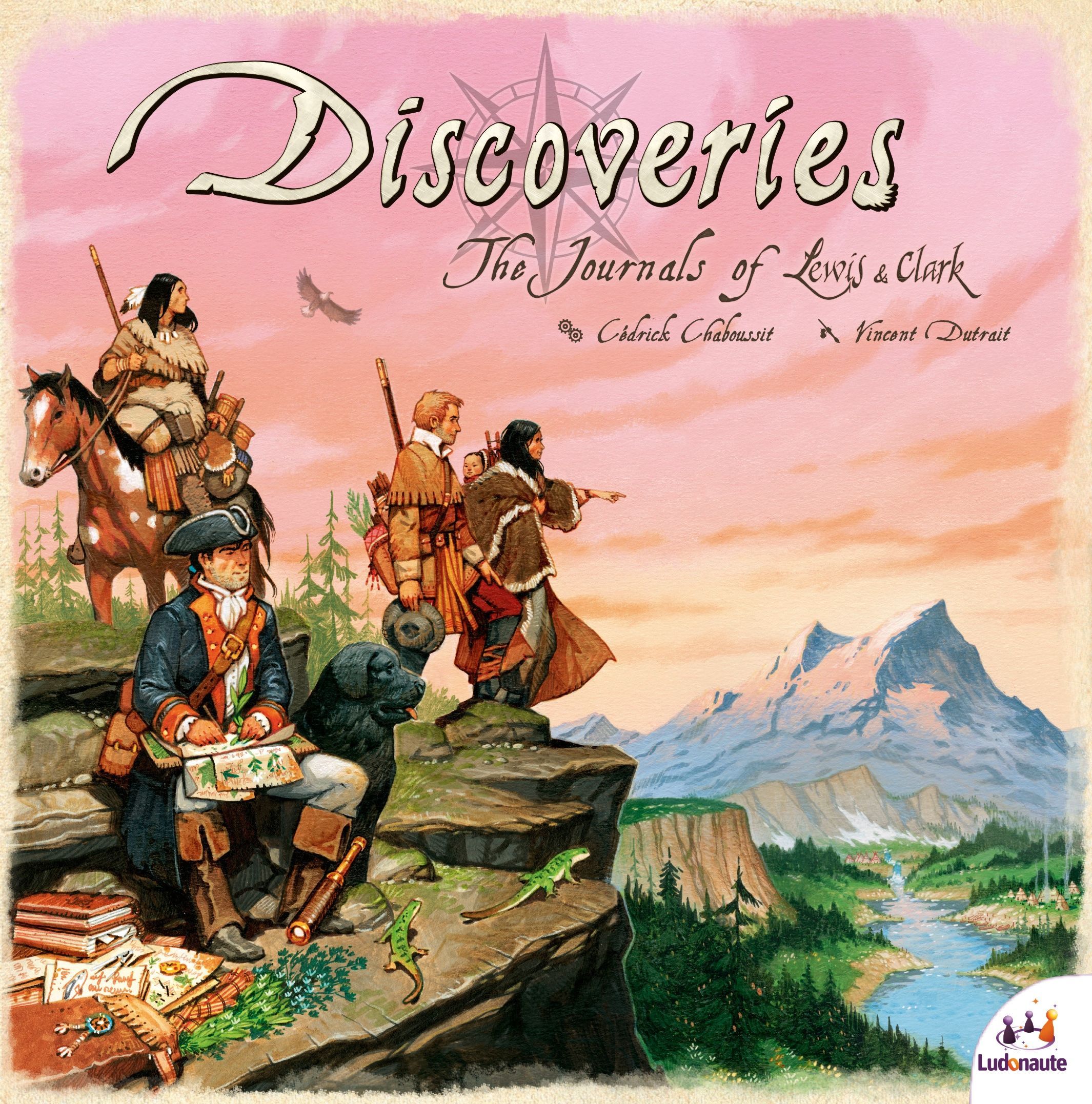
You play one of the Lewis and Clark expedition leaders (Lewis, Clark, Gass or Ordway) and try to record as much knowledge as possible in your journal through geographical, biological and ethnological discoveries. Your dice determine which Actions you can take, and you gain Tribe and Discoveries cards to build your journal. When the game ends, the player with the most Discovery points wins.
Setup
Place the Camp board in the middle of the table. Make a neutral supply of gray dice next to the Meeting Area: 6 for 2 players, 8 for 3 players, 10 for 4 players. Return the remaining gray dice to the box (4 in a 2-player game, 2 in a 3-player game).
Shuffle the 55 cards and remove unneeded cards at random to make a deck of 30 (2 players), 40 (3 players) or 50 (4 players). Players may look at discarded cards before returning them to the box.
Each player chooses a leader, takes the matching individual board, the 5 dice of their color, and a journal cover. The journal cover side depends on player count (one side for 4 players, the other for 2 or 3). Unused colored dice and boards go back to the box in 2- or 3-player games.
Draw the top 3 cards as Tribe cards, face up, into the Meeting Area. Draw the next 3 as Discoveries cards, face up, into the Reconnaissance Area.
Choose the Start Player at random. In turn order (clockwise from the Start Player), each player takes one Discoveries card from the Reconnaissance Area into their Exploration zone, and then the empty spot is refilled from the deck. Finally, every player rolls their 5 dice and places them in their Dice Stock.
In an introductory game, if the 3 starting Discoveries cards are special cards (numbered over 37), reshuffle them into the deck and draw 3 new ones.
A turn
The Start Player goes first, then play continues clockwise. On your turn you choose one of two options:
A. Action
- Choose one Action face showing on a die in your Stock. Take as many dice showing that face as you like (at least one) and play them into your Action zone. The Action triggers immediately.
- You may only use one die face type per turn, and the same Action can be done only once per turn.
- Actions can be done in any order. Dice shown with a discard symbol go to the matching bank on the Camp (Left Bank for Walk and Ride, Right Bank for Journal and Negotiate).
- Exploration Actions need prerequisite dice placed on an earlier turn, then a Journal die on a later turn to trigger exploration. The path must match the terrain icons, read from the bottom of the card to the top, and a move cannot be split or rearranged. Unused moves are lost.
- Exploring two cards in one turn gives you a bonus turn after this one.
- When the turn's Actions are done, take back all remaining dice from your triggered Actions, then refill the Meeting Area and Reconnaissance Area to 3 cards each. Re-roll dice returned to your Stock.
- A gray die cannot be used on the turn you get it.
- Changing the dice, Change of plans and taking Tribe cards are Actions that are handled as the card and rule text describe. Taking a Friendly Tribe needs one Negotiate die, and a Wary Tribe needs two. You get a gray die from the neutral supply and roll it into your Stock. If the supply is empty, the player with the most gray dice in their Stock and Action zone gives you one, and ties are resolved by you choosing the tied player.
B. Rest
- Take all dice from the Right Bank or all from the Left Bank, or take all or some of your own dice wherever they are (your board, Tribe cards, the Camp, or other players' boards). Roll them and place them in your Dice Stock. There is no limit on Stock size.
End of the game
The game ends when a player cannot refill their Exploration zone after successfully exploring a Discoveries card, because the deck is empty. That player's game is over. Every other player then gets one more turn, and then the game ends.
Holding Minnetaree Tribe cards does not postpone this: you cannot move Discoveries cards from them into your Exploration zone to avoid the end. Unexplored cards left in Exploration zones do not count for scoring.
Scoring
Add up the following at game end:
- Tepees (knowledge of American Indians): Count the tepees on your Tribe cards in your Action zone and on the Discoveries cards in your journal. The player with the most tepees ranks first, and the others are ranked in decreasing order. Ranks score points as follows:
- 4 players: 1st 12, 2nd 8, 3rd 4, 4th 0.
- 3 players: 1st 12, 2nd 6, 3rd 0.
- 2 players: 1st 12, 2nd 6.
If players tie on tepees, they split the total of their rank and the next lower rank points equally (for example, in a 4-player game two tied players for 1st and 2nd would each get 10).
- Species sets: Sort your journal's Discoveries cards into sets of 1 to 4 cards, with no more than one card of each type (Mammals, Birds, Fish, Plants). Each set scores: 1 type 3 points, 2 types 8 points, 3 types 15 points, 4 types 24 points.
- Cartography: Add the numbers printed on the Discoveries cards in your journal.
The player with the most total Discovery points wins. If there is a tie, the tied player with the most dice on their individual board wins, counting dice in the Stock and Action zone (including dice on Tribe cards). If still tied, the tied players share the victory.
Changes
- Scoring, by the rulebook draft, 22 November 2026 (shown now)
- End of the game, by the rulebook draft, 22 November 2026 (shown now)
- A turn, by the rulebook draft, 22 November 2026 (shown now)
- Setup, by the rulebook draft, 22 November 2026 (shown now)
- Summary, by the rulebook draft, 22 November 2026 (shown now)