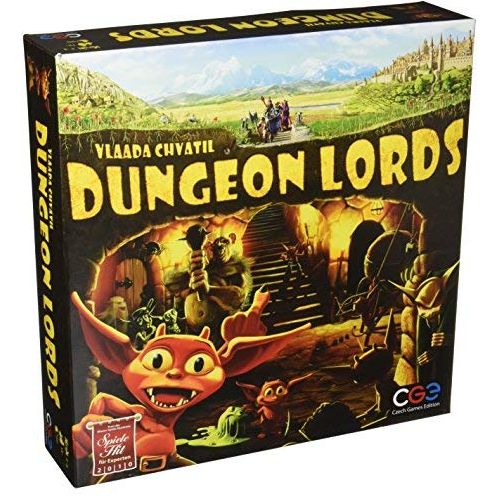
Rules of Dungeon Lords
Summary
Combat Training Dungeon Lords is a game for 2 to 4 players in which each player is an aspiring dungeon lord trying to earn a license. Over two years, players alternate Building phases (expanding the dungeon, hiring imps and monsters, buying traps, paying taxes) with Combat phases in which adventurers attack the dungeon. Points are scored at the end of the second year, and the player with the most points wins and becomes the Underlord.
Setup
Each player takes a color with a Dungeon Board, minions, an Adventuring Party Marker, an Evil Counter and Orders Cards. The Central Board, Distant Lands Board and Progress Board (Building side up) are placed where everyone can reach them as the rulebook illustrates. Shuffle the Monster and Room Tiles into silver and gold stacks, and set up the Adventurer, Event and Combat Card stacks. Place Tunnel Tiles dark side up on the Construction Site, and place the Evil Counters on the starting space of the Evilometer. In a two- or three-player game, use Non-Player Dungeon Boards and their Evil Counters and Orders Cards as the rulebook describes. Choose a starting player; the nicest player may take the Starting Player Token.
A turn
Building runs four rounds (winter, spring, summer, fall), with the Progress Marker moving through each phase. In the New Round phase, new monsters, rooms and adventurers are revealed, and the next event is previewed. In the Orders phase, each player secretly picks three Orders Cards and reveals them one at a time, placing a minion on the matching action on the Central Board; actions resolve in board order and may be paid for with Food, Gold or reputation (moving up the Evilometer). Actions include getting food, improving reputation, digging tunnels, mining gold, recruiting imps, buying traps, hiring monsters and buying rooms. In the Production and Orders Retrieval phase, rooms may produce goods using imps, and players take back Orders Cards. In the Event phase, Pay Day, taxes and any special event are resolved. In the Adventurers phase, adventurers are assigned to players by Evilometer position, and a paladin may appear if a player becomes very evil.
Combat runs four rounds. Each round, players choose the nearest unconquered tile, then secretly choose a trap and monsters or ghosts for it, then reveal the Combat Card. The battle proceeds through steps: trap, fast spell, monsters and ghosts attack, slow spell, healing by priests, and conquering with fatigue damage. Thieves reduce trap damage, priests heal only if a monster attacked, and adventurers reaching zero hit points are moved to the prison.
End of the game
The game ends after two years of Building and Combat, followed by scoring. In Combat, a dungeon's fight ends when all adventurers are eliminated, when four rounds are fought, or when no unconquered tiles remain. Between years, the Starting Player Token passes and the Second Year begins with stronger adventurers, monsters and rooms.
Scoring
Scoring is done on the Combat side of the Progress Board using the Overview Card. Players gain points for unconquered rooms, monsters (not ghosts), imprisoned adventurers, and imprisoned paladins, and lose points for conquered tiles and unpaid taxes (red marks). Point-scoring rooms in the Second Year add bonus points, and titles are awarded for the most in various categories: the exclusive title is worth 3 points, shared titles are split at 2 points each, and in a two-player game these values are lower (2 and 1). The Battlelord title goes to the player with the fewest conquered tiles. The player with the most points wins and becomes the Underlord; ties are shared. Players with more than zero points earn their dungeon lord license.
Variants
The rulebook gives a simplified first game, which leaves out the Choosing Initial Inaccessible Orders rule, the Special Event Cards, and the Second Year's full rules for the first game. Combat Training is a separate solo-style set of practice scenarios using training dungeons, with a two-player rule set that adds a non-player color, and a full game with additional rules for setup, Second Year rooms, monsters and special events. Players may choose to use the full rules once they have learned the simplified game.
Changes
- Variants, by the rulebook draft, 23 November 2026 (shown now)
- Scoring, by the rulebook draft, 23 November 2026 (shown now)
- End of the game, by the rulebook draft, 23 November 2026 (shown now)
- A turn, by the rulebook draft, 23 November 2026 (shown now)
- Setup, by the rulebook draft, 23 November 2026 (shown now)
- Summary, by the rulebook draft, 23 November 2026 (shown now)