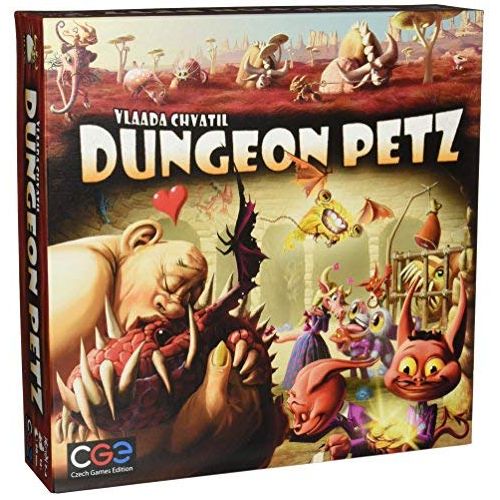
Rules of Dungeon Petz
Summary
Dungeon Petz is a game for 2 to 4 players in which you run a pet shop for dungeon lords. Over five or six rounds you send imps shopping, care for your pets by meeting their needs, show them at exhibitions, and sell them to customers. The player with the most reputation points at the end wins.
Setup
Place the Central Board in the center of the table with the side matching the player count facing up, and the Progress Board where all can see it, using the matching side. Each player takes a color set of 10 imps, 2 minions, an Achievement Tile and a Burrow Board, plus a Pet Display Board. Give the Starting Player Token to the player who most recently fed a pet, or choose one any other way.
Put the Progress Marker on space 1. Place four of each player's imps on the Progress Board's extra imp spaces. Shuffle the eight exhibition tiles, deal one face down to each exhibition space, remove the rest unseen, and reveal the round 2 exhibition. Do the same with the customer tiles, revealing the round 3 customer. Assemble the pets and place the 18 pets in a face-down pile. Set up cage, addon, artifact and pet stacks, the food market, the potion stack, four shuffled Need Card decks, and the token supplies. Each player puts a minion on space 0 of the scoring track and one on space 0 of the exhibition tent.
Each player starts with 6 imps in their quarters, 2 gold, an initial cage with 1 manure token, and 4 Need Cards, one of each color.
A turn
Each round has a setup phase followed by six phases.
- Setup: Get income. The starting player and the player to their left get 1 gold each, and the other players get 2 gold each. Reveal and add new exhibitions, customers, food, artifacts, cages, addons and pets for the round, as the board explains. Move neutral imps in 2- and 3-player games.
- Shopping: Secretly divide your imps and gold into up to six groups, with at least one imp in each group, and place them on your exits from biggest to smallest. Then reveal and send groups in turn, starting with the biggest. On your turn you may send a group to an open action space, paying any gold, or keep it home.
- Need Cards: Arrange cages and pets, one pet per cage. Draw one Need Card for each revealed colored bar on your pets. Assign one card per bar to each pet, and potions may replace a card.
- Showing Off: Each player in turn resolves their needs in order: hunger, poop, play, anger, magic, disease, and potions. Then score your exhibition and place your minion. Exhibition rewards are then given by place.
- Business: Sell pets to the current customer in player order, either on the black market or from the platform. Then discard cards, use any available imps to clean cages or earn gold, and pass the starting player token.
- Aging: Pets grow, food ages, imps return home, cards are discarded, and the Progress Marker advances.
End of the game
The game lasts five rounds in a 4-player game and six rounds in a 2- or 3-player game. After the last round's Aging phase, final scoring takes place.
Scoring
Reputation is gained in exhibitions, where the top scorers receive 8, 6, 4 and 2 points, with ties sharing the reduced award. Players with a score of zero or less get nothing. Selling pets to customers gives reputation equal to the match score times 2 on the black market or times 3 from the platform. Losing a pet costs one reputation point for every full 10 reputation points held. Achievement Tiles add to reputation at 50 and 100 points.
Final scoring has two exhibitions. Business Acumen scores food, artifacts, potions and half a point per gold, and loses 2 for each imp not at home. Pet Display scores 2 per pet, 1 per addon and cage, and loses 1 per token. Negative scores lose reputation. The player with the most reputation wins, and tied players share the victory.
Variants
The rulebook gives a 2- or 3-player version that uses the other board sides, neutral imps as blockers, and fewer or more rounds. The Full Variant adds double-symboled Need Cards that can count as two needs, and the Advanced Meat Stand Rule for pets sent to farms. It also includes More Foresight, which reveals more exhibitions and customers at the start, and a final round order in which players act from lowest score to highest in 4-player games.
Changes
- Variants, by the rulebook draft, 23 November 2026 (shown now)
- Scoring, by the rulebook draft, 23 November 2026 (shown now)
- End of the game, by the rulebook draft, 23 November 2026 (shown now)
- A turn, by the rulebook draft, 23 November 2026 (shown now)
- Setup, by the rulebook draft, 23 November 2026 (shown now)
- Summary, by the rulebook draft, 23 November 2026 (shown now)