Rules of Dungeon Universalis
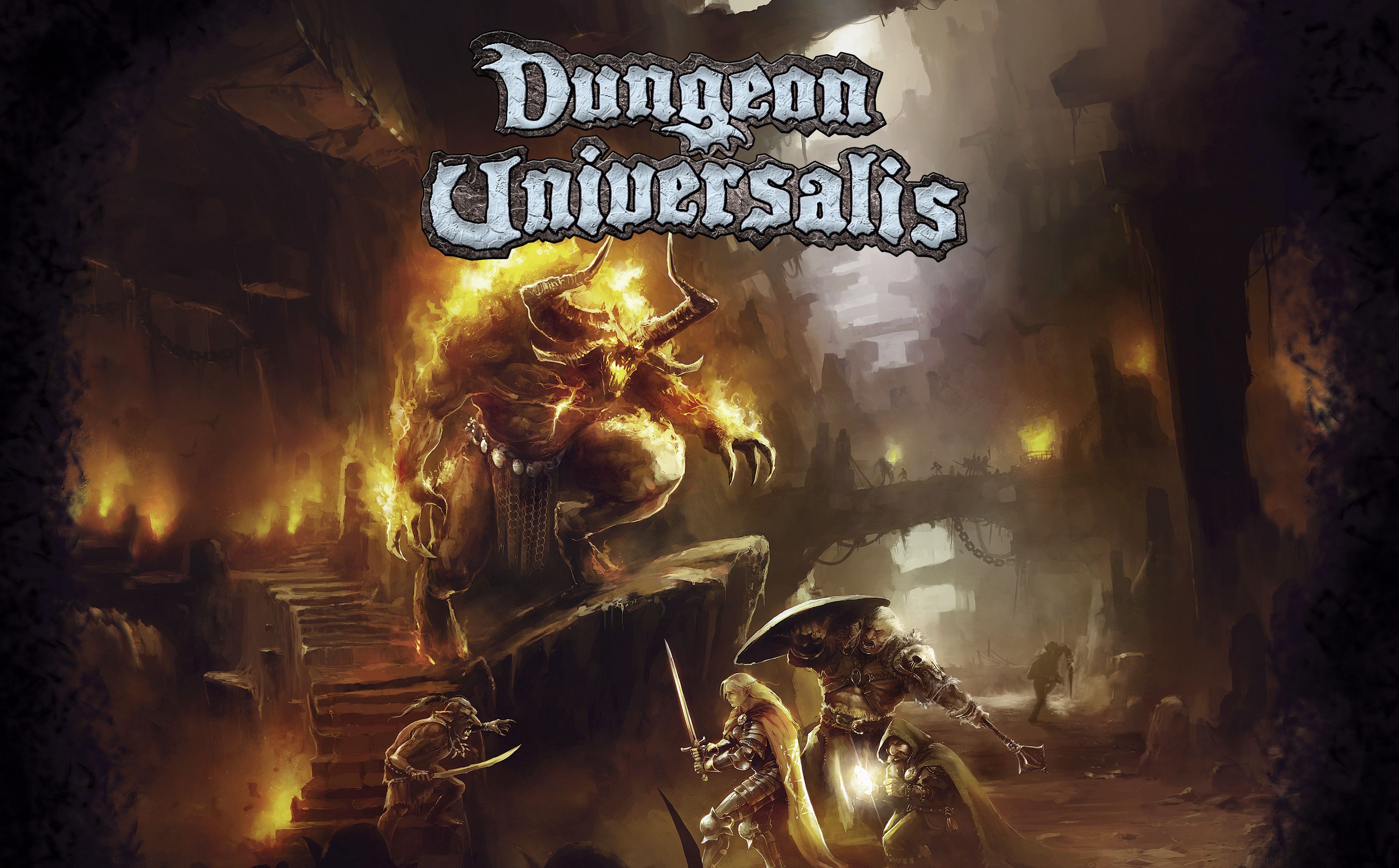
Summary
Dungeon Universalis is a dungeon exploration board game for one to six players. Heroes explore a scenario section by section to complete a quest goal, while one player takes the Dark Player role and spawns creatures, traps and obstacles against them. Quests can be played independently or as part of a campaign. The heroes win by completing the quest's mission and leaving the scenario; the Quest Sheet lists the specific victory conditions.
Dungeon Universalis is a fantasy dungeon-crawl game in which a group of heroes explores a scenario while a Dark Player controls the obstacles, traps and creatures they face. The heroes aim to accomplish the quest's mission, such as reaching a goal square. Quests can be linked into a campaign that travels across a map of the continent of Arasca. This part also gives world background on the races and kingdoms there.
Setup
- Choose a quest: an independent game or a quest from a campaign.
- Pick the Dark Player, either at random or by agreement. They should read the Quest Sheet before starting.
- Place the markers within reach, shuffle the Treasure, Magic Objects and Relics decks, and sort the other card decks without shuffling.
- Place the Dark Player and heroes markers and the Achievement card next to the Achievement Counter.
Heroes: each player picks a predesigned hero or creates one. With three or more heroes, include at least one Fighter, Explorer and Spellcaster, and avoid repeating classes. Choose skills and spells, avoiding duplicate professional skills and spells among heroes. Buy equipment within budget.
Dark Player: read the Quest Sheet and choose a Quest Leader if none is named. Set the Reserve Points to the total Value Points (VP) of the heroes, their mercenaries and animals, and any Special Objects, Magic Objects and Relics they carry. Add 2 points for each hero if the group has entered that scenario before. Pay for the Leader, and optionally buy one Magic Object or Relic for them. Shuffle the Obstacles and Power cards, draw five per hero as a face-down deck, and draw one card from it. Set aside a Special Creature card in hand, then shuffle the Encounter cards and draw two per hero as a second face-down deck, keeping one card from each deck in hand.
Heroes: choose the heroes, with one of each type (Fighter, Explorer, Spellcaster) if there are three or more, and no two of the same class. Hand out skill cards, spells, equipment and any mercenaries or animals, then add up the group's Value Points (VP), including companions and magic objects. Place the heroes off the board, then reveal the first section and start them on the starting squares.
Dark Player: read the Quest Sheet and choose a Leader. Set the Reserve Point counter to the group's VP (add 2 if the group has entered this scenario before). Pay the Leader's VP, and optionally one magic object for the Leader at its VP cost. Build the decks: take the Obstacle and Power cards, draw 5 per hero, and place them face down on the left. Draw 1 Special Creature card and keep it in hand, then draw 2 Encounter cards per hero and place them face down on the right.
Campaign: the heroes' setup is the same as for a standard game. The group starts at a specific location on the map.
A turn
The heroes take their turn first unless the Quest Sheet says otherwise. The group agrees on an order and each hero activates in turn, with any companions he controls. Each activation has these steps:
- Recovery: a Stunned character rolls 1D6 and recovers on a 4 or more. A Knocked Down character may stand, and if an enemy is adjacent he must pass an Agility test first.
- Actions and moves: one Action and one move, in any order. A Quick Action costs nothing and can be used at any point, and one Action may be swapped for a second Quick Action.
When a move reveals unexplored space, the Dark Player shows the new section before the move ends. Exploration Actions cannot be used in combat.
The Dark Player's turn follows. They draw a card, activate cards from hand by paying the Reserve Points shown, and activate their creatures in turn.
A combat turn begins when an enemy is in an explored area within 12 squares of a character. Enemies spawn at least 2 squares from the heroes, and an Initiative roll decides who acts first.
Dark Player's turn: draw one card from a deck (not while heroes fight enemies from the Main Room). Activate cards in hand by paying their Reserve Point cost, and activate creatures one at a time. Discarded cards earn Reserve Points. A hand holds up to the number of heroes times 2, with a minimum of 4 and a maximum of 10.
Heroes' turn: each character first recovers from Stunned or Knocked Down. Then he may take one Action and one move in any order, plus any free Quick Actions. Exploration Actions such as opening doors and searching are not allowed during combat turns, except opening unexplored doors. A combat turn starts when an enemy is within 12 squares of a hero in an explored area. When a new section is revealed and enemies are seen, an Initiative roll is made against the nearest enemy.
Campaign turn: the group chooses to stay in a territory, enter a settlement, or cross to an adjacent one, and may travel by sea or river or along a road. Each hero may visit up to 3 Places and Services per turn in a settlement. Each time the heroes enter or stay in a territory or settlement, a Travel Event roll is made. Campaign turns alternate with the Dark Player's turn.
End of the game
The quest ends when the mission is accomplished and the heroes have left the scenario, when the heroes choose to leave without finishing, or when all heroes are Knocked Out. A hero leaves by stepping onto a starting square and declaring it. The heroes have left once all of them have reached a starting square.
A quest ends when the mission is accomplished or failed, and the Dark Player keeps acting until the heroes leave the scenario. Heroes normally get two attempts at a mission. In a campaign, after a first failure they choose between following the narrative thread and trying again. After a second failure they must follow the narrative thread, even if that is fatal. Epic Events allow no second attempt. A campaign quest cannot be played more than twice.
Scoring
Heroes earn Achievement points for certain Actions and feats, listed on the Achievement card, and these are counted for the whole group on the Achievement Counter.
The Dark Player scores points from the Fortune points the heroes spend, from each hero Knocked Out (counted once per hero even if knocked out more than once), and one point per turn, which pushes the heroes to finish quickly.
After the quest, each hero gains experience. Standard quests award +1 XP for completing the mission on the first attempt, +1 XP if the group scored more Achievement points than the Dark Player, and +1 XP for a hero who was never Knocked Out, provided the group discovered at least twice as many sections as heroes. The rulebook section covered here does not state how the winner is decided or how ties are broken.
The group earns Achievement points that are compared against those of the Dark Player. In the Artificial Dark Player mode, the Dark Player earns 1 Achievement point at the start of each of his turns. Rewards in coins and experience points are given for merits earned, and usually only if the mission succeeds.
In competitive play, each hero may track his own Achievement points with a marker. The hero with the most gains 1 extra experience point. If at least 3 heroes play, the one with the fewest loses 1 experience point, but never below zero.
In time-limited games, the Dark Player gains 1 Achievement point each time a hero exceeds his time.
This part gives no tie-breaking rule.
Variants
- Artificial Dark Player: a cooperative mode for 1 to 4 players (up to 5 allowed), where an AI-like Dark Player is run by the deck, the Scenario Die and the Creature Behavior cards.
- Classic Dark Player: a human Dark Player who places pre-chosen cards and creatures on a non-random basis, like a gamemaster.
- RPG mode: the Dark Player improvises the story and pays for each element from a fixed budget, without gaining Reserve Points during his turns. Heroes may spend experience points to learn secondary skills.
- Time-limited games: each hero gets 1 minute per turn, and the Dark Player gets 2 minutes in large combat turns, using a timer.
- Gridless scenarios: one square equals one inch (or 2.5 cm), with separate rules for area effects, melee range, facing and line of sight.
- Advanced rules, mounts: characters may ride animals with the Mount or Raging Mount skill, with rules for movement, combat, falls and runaway mounts.
- Campaign mode: quests and Epic Events are linked across the Arasca map, with optional Epic Events in place of simple event results.
Changes
- Variants, by the rulebook draft, 22 November 2026 (shown now)
- Scoring, by the rulebook draft, 22 November 2026 (shown now)
- End of the game, by the rulebook draft, 22 November 2026 (shown now)
- A turn, by the rulebook draft, 22 November 2026 (shown now)
- Setup, by the rulebook draft, 22 November 2026 (shown now)
- Summary, by the rulebook draft, 22 November 2026 (shown now)