Rules of DVONN
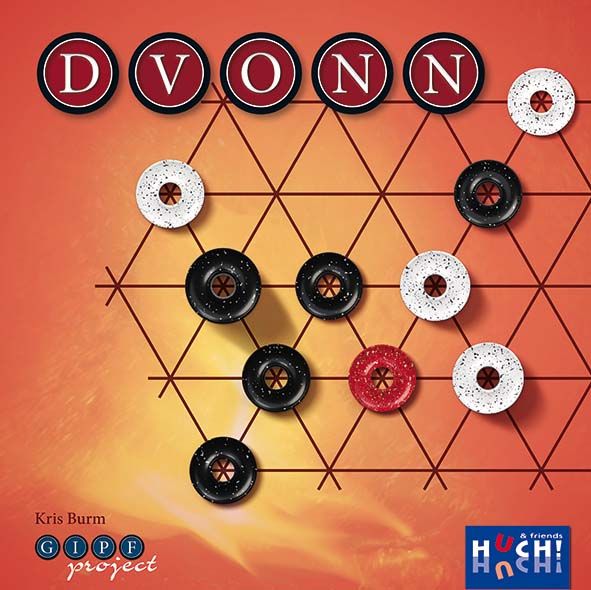
Setup
Draw lots to decide who starts. The starting player takes 2 DVONN pieces and the 23 white pieces; the other player takes the remaining DVONN piece and the 23 black pieces. Place the board horizontally between the players so each has 9 spaces on their side. Play begins with an empty board in the first phase, placing pieces one at a time: White places the first DVONN piece, Black the second, White the third, then the players alternate placing their own colored pieces, starting with Black's first and White's first piece, and so on, with a piece allowed on any vacant space until the board is full.
A turn
First phase: players take turns placing pieces on any vacant space, starting with the DVONN pieces, until all spaces are occupied.
Second phase: the player who started the first phase starts again immediately after placing the last piece, then players alternate turns. On a turn, a player must move one single piece or one stack of their own color. A stack's color is set by its topmost piece.
- A single piece moves one space in any direction, but only onto an occupied space.
- A stack moves as a whole in a straight line, exactly as many spaces as it has pieces, and may not end on an empty space. Empty spaces may be passed over and count toward the distance.
- A piece or stack surrounded on all six sides may not move.
- A single DVONN piece cannot be moved, but other pieces may be moved onto it. A stack containing a DVONN piece may be moved by its controlling player.
- Moving onto an opponent's piece or stack neutralizes it by placing your stack on top.
- Passing is not allowed unless no move is possible.
After each move, any piece or stack not linked, directly or through a chain of pieces, to at least one DVONN piece is removed from the board and out of the game, regardless of who made the move. All three DVONN pieces stay in play even if isolated.
End of the game
The players keep playing as long as they can. If one player can no longer move, the other continues until they have made their last possible move. If a player who had to pass gets a move available again, they must make it. The game ends when the last move is made.
Scoring
Each player stacks together all the stacks they control. The player with the highest stack wins, regardless of the colors of the pieces in it. If both players have equal stacks, the game is a tie. If the stacks are equal or differ by only one piece, count the pieces to be sure, since piece thickness may vary slightly.
Changes
- Scoring, by the rulebook draft, 23 November 2026 (shown now)
- End of the game, by the rulebook draft, 23 November 2026 (shown now)
- A turn, by the rulebook draft, 23 November 2026 (shown now)
- Setup, by the rulebook draft, 23 November 2026 (shown now)