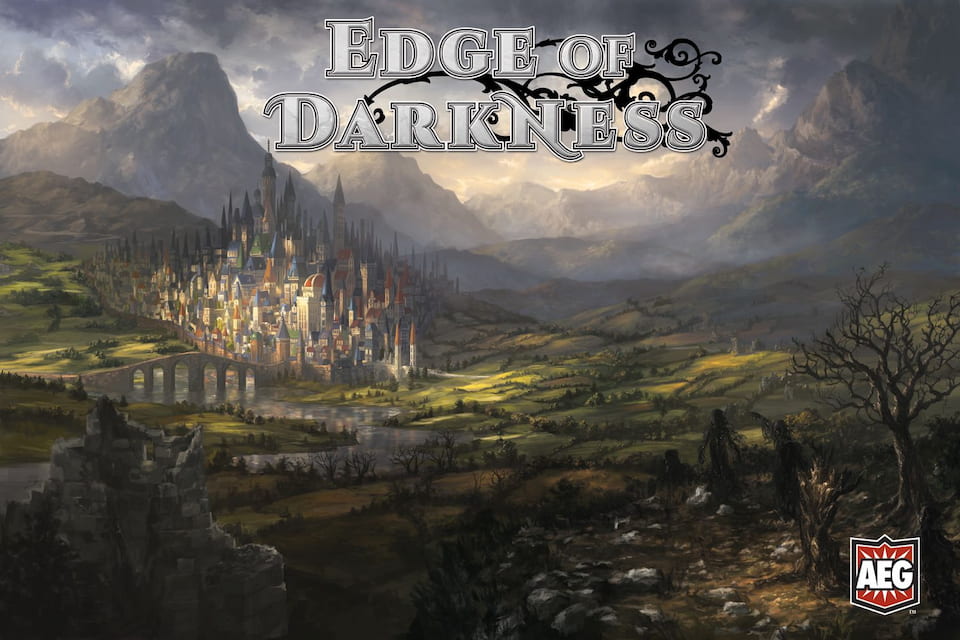
Rules of Edge of Darkness
Summary
Edge of Darkness is a shared-deck, card-crafting game for 1 to 4 players, who lead Guilds defending the city of Aegis from the Forsaken Lands while gaining influence and wealth. All players draw from one common deck, and their actions change the cards in it. The game lasts eight rounds after a prologue, and the player with the most Victory Points wins.
Setup
Place the Game board in the center, with Coins, Influence and Reputation tokens on their spots. Each player takes a Player board, 7 Allegiance slips, 4 Guild Starter cards (3 Citizens, 1 Patrician), 10 Agents, 10 Player Aid tokens, a Defense Track token and 2 Reference cards. Put 4 Agents in the Trained Agents pool and the other 6 beside your board. Place your Coins and Influence in their coffers and your Defense token on the top space of the Defense track.
Assemble the Threat tower. Put the 15 black cubes and each player's 15 colored cubes into the bag. Each player draws 2 cubes into their Threat Zone, then 4 random cubes go into the tower. Leave out the colors of Guilds not in play.
Shuffle the Neutral cards in use and place 3 random ones on the tower with the Blight side up. Set the rest aside in the Discard pile space. Place 10 Location boards with their advancements, 5 above and 5 below the Game board, or use the Extension boards if there is room. Put the Round marker on the Prologue space and give the First Player marker to a random player.
With fewer than 4 players, remove Neutral cards marked with a 4 for 3 players, and marked with a 3 or 4 for 2 players.
A turn
The prologue: in turn order, each player sleeves one advancement onto one of their Starter cards. Players then draft in reverse order, so each ends with two advancements. Effects that need a regular round cannot be used in the prologue. Unclaimed advancements go onto Neutral Citizens in the Discard pile. Each player then keeps one Starter card without an advancement in their Guild Hall, and the rest of the Discard pile forms the deck.
Each regular round has two phases.
Assembly Phase: every player moves all cards from their Guild Hall into their hand, and moves their cubes from the Threat Zone onto the hand. In turn order, each player drafts from the Street until they hold 3 cards. You may spend 1 Influence per card you skip, and you can never skip the top deck card. Then count the cube icons on the cards in hand, draw that many cubes from the bag into your Threat Zone.
Action Phase, in clockwise order from the First Player: drop your cubes into the tower. Resolve any Blight attacks. Sleeve an advancement onto a card in your hand. You may then use location abilities and resolve contact effects on cards in hand, paying 1 Coin to the owner for each effect on another player's card. You may also discard one unresolved card to return one Agent to your pool, or discard two unresolved cards to resolve one effect from a Street card. Finally, discard all cards in hand.
Blight attacks happen when a tray reaches 8 cubes with 4 players, 7 with 3, or 6 with 2. The attacking card hits the player with the most cubes of that tray. Ties hit every tied player, and black cubes hit every player. Damage that is not fully defended costs one space on the Defense track. Fully defending gains 1 Reputation.
At the end of the round, pass the First Player marker and advance the Round marker.
End of the game
The game ends after the eighth round, once every player has finished their Action Phase.
Scoring
Before scoring, each player gains 1 Goodwill for each filled slot on cards in their Guild Hall or in the Street. Then Reputation is awarded in this order, 2 to the leader in each category: most Reputation tokens, most trained Agents, most Guild cards, and highest on the Defense track. Ties in a category give each tied player 1 Reputation instead.
Victory Points are counted as follows: 1 per trained Agent, 1 per Reputation, 1 per filled slot on your Guild cards (including the Citizen or Patrician), 1 per space on the Defense track, and 1/4 per Coin, Influence or Goodwill.
The player with the most Victory Points wins. Ties are broken by most Guild cards, then most trained Agents, then combined Coins and Influence. If still tied, the tied Guilds share the victory.
Variants
The rulebook gives no solo, team, or short-game rules. Solo icons are mentioned, but solo play is covered only in the Player Handbook. The rulebook does include player-count changes. In a 2-player game, the prologue draft is altered so each player gets three advancements, drafted in the order 1, 2, 2, 1, then 2 and 1. Fewer players also use fewer cubes and Neutral cards. The Player Handbook provides further recommended setups and random setup rules.
Changes
- Variants, by the rulebook draft, 22 November 2026 (shown now)
- Scoring, by the rulebook draft, 22 November 2026 (shown now)
- End of the game, by the rulebook draft, 22 November 2026 (shown now)
- A turn, by the rulebook draft, 22 November 2026 (shown now)
- Setup, by the rulebook draft, 22 November 2026 (shown now)
- Summary, by the rulebook draft, 22 November 2026 (shown now)