Rules of Eight-Minute Empire
Summary
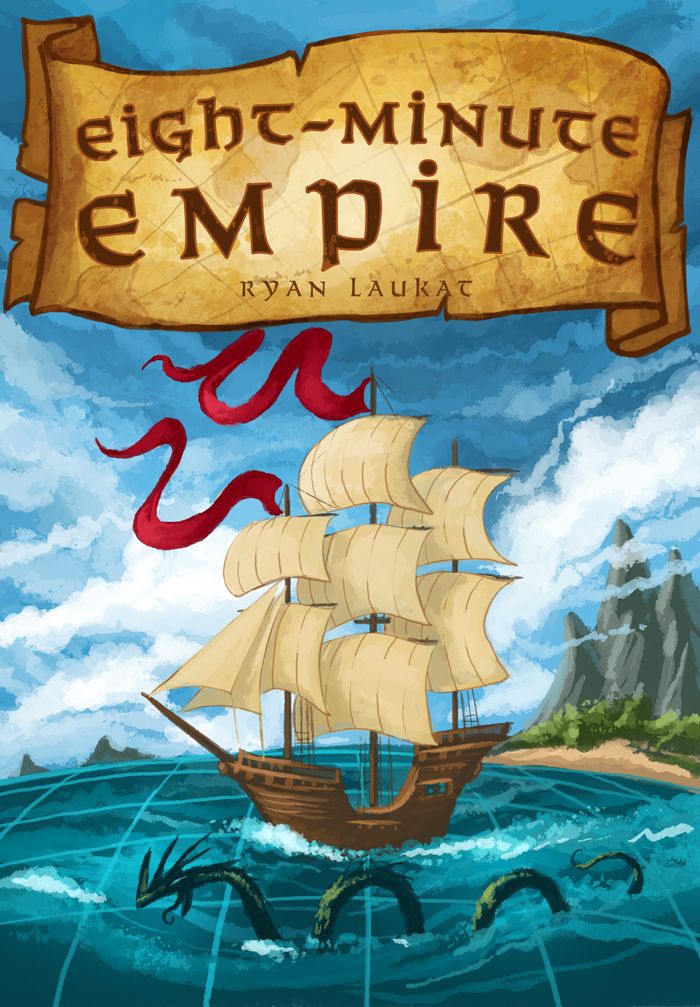
Players build empires by placing armies and cities on a board and collecting cards that give goods and actions. The winner is the player with the most victory points from regions controlled, continents controlled, and goods collected.
Setup
- Place the board on the table.
- For 2, 3, or 4 players, remove the five cards marked with a small 5 in the top right corner. Shuffle the rest into a face-down deck beside the board, then draw six cards and place them face up in a row along the top of the board.
- Each player takes one color of cubes (14 armies) and discs (3 cities) and places 3 armies on the starting region. In a 2-player game, a neutral third color is placed one army at a time, taking turns, in any regions until ten armies are on the board.
- Place the coin tokens beside the board as the supply. Each player starts with 8 coins (5 players), 9 (4 players), 11 (3 players), or 14 (2 players).
A turn
Bidding (once per game): each player secretly holds a number of coins in a closed fist, and all reveal at once. The highest bidder pays those coins to the supply and chooses the first player. Losing bidders pay nothing. If the top bids are tied, the youngest of the tied players wins and pays. If all bids are zero, the youngest player wins without paying.
On a turn, a player takes one face-up card and pays its cost, which depends on its position in the row: 0, 1, 1, 2, 2, and 3 coins from left to right. The player places the card face up in front of them and performs its action immediately, or may ignore the action. Possible actions:
- Place armies, only in the starting region or in regions where you have a city.
- Move armies over land, moving one or more armies a total distance shown on the card. Dotted water lines cannot be crossed.
- Move over land and water, as above but dotted lines count as adjacent.
- Build a city where you have an army. Any number of cities from any players may share a region.
- Destroy an army of any player in any location.
- Where a card shows two actions joined by 'or', choose one; joined by 'and', perform both.
Then slide the remaining cards left, fill the empty space with a new card on the right, and pass play to the next player as the rulebook directs.
End of the game
The game ends when a player owns a set number of cards, based on player count: 13 cards (2 players), 10 cards (3 players), 8 cards (4 players), or 7 cards (5 players). Players then count their victory points.
Scoring
- Regions: 1 point per region you control. You control a region if you have more armies there than any other player, with cities counting as armies. A tie for most means no one controls it.
- Continents: 1 point per continent you control. You control a continent by having more regions in it than any other player. A tie for regions means no one controls it.
- Goods: points for each goods type depend on how many cards of that good you hold, shown on the card in four amounts. Wild goods cards can be counted as any good you already own, adding one extra of that good per Wild card. Players decide where to place Wilds before counting.
The player with the most total points wins. Ties are broken by the most coins, then the most armies on the board, then the most controlled regions.
Variants
- Full game: play three games in a row. The player with the highest total victory points across all three wins.
- Goods tokens: during setup, randomly place one goods token on each region marked with a triangle. The controller of that region has one extra of the depicted good.
- Alternate bidding tie breaker: instead of the youngest player, roll a die to decide the first-player bid when tied.
Changes
- Variants, by the rulebook draft, 23 November 2026 (shown now)
- Scoring, by the rulebook draft, 23 November 2026 (shown now)
- End of the game, by the rulebook draft, 23 November 2026 (shown now)
- A turn, by the rulebook draft, 23 November 2026 (shown now)
- Setup, by the rulebook draft, 23 November 2026 (shown now)
- Summary, by the rulebook draft, 23 November 2026 (shown now)