Rules of Fearsome Floors
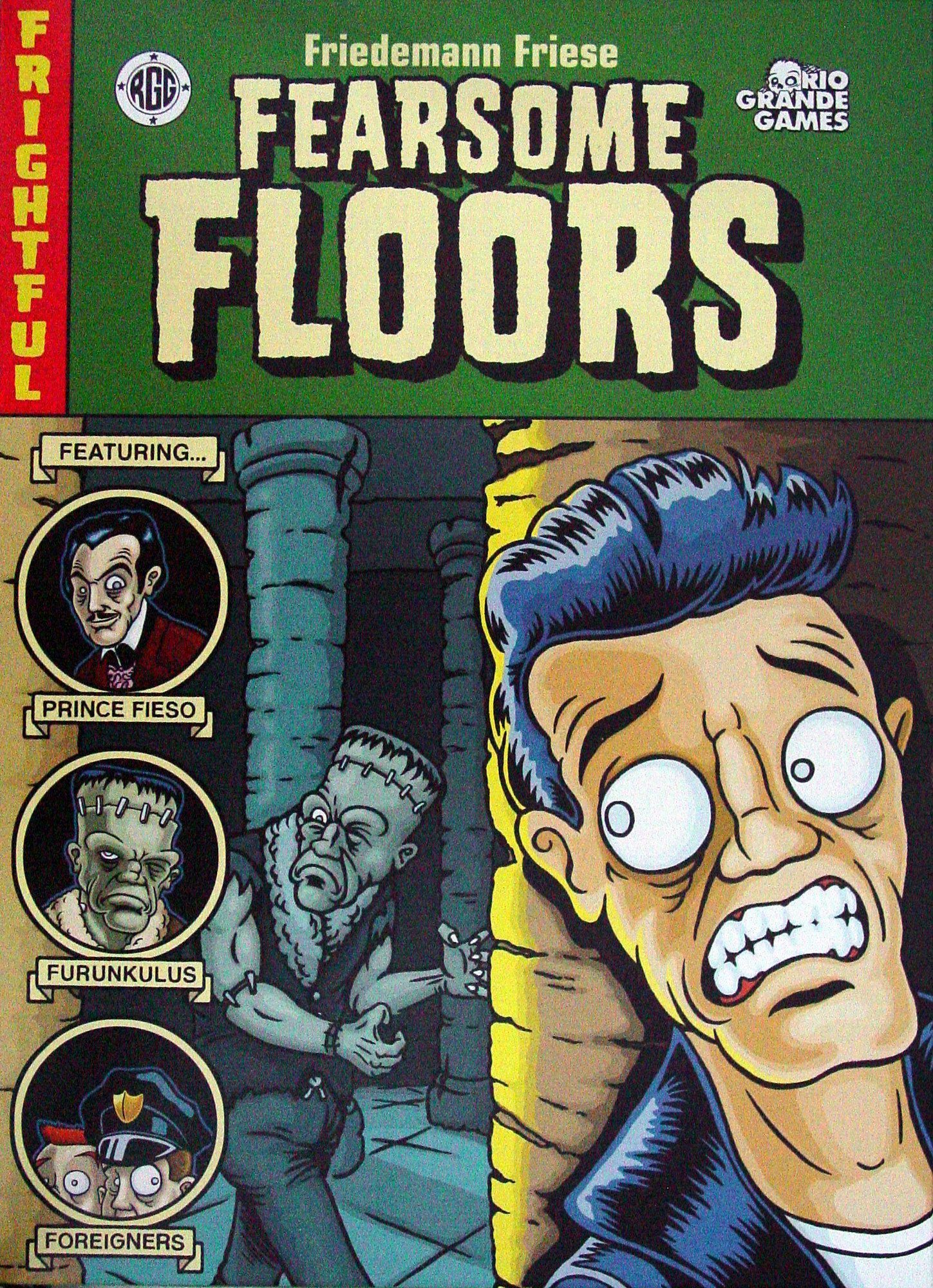
Summary
A game of escape in which players move their figures through a fortress while a monster tries to eat them. Figures are moved one at a time in turn order, and the monster then moves automatically. The first player to get enough of their figures out of the fortress wins: three with 2 to 4 players, two with 5 to 7 players.
Setup
Place the board in the middle of the table and shuffle the monster movement tiles face down beside it. Each player takes one color set of figures, which is four figures each, or three each with 5 to 7 players, and places them by the entrance with the colored side up. Build the monster from its pieces on the corner space next to the exit, facing the letter M on the edge, and return unused pieces to the box. Remove the teleporters. Use the two blood pools and the stones (stone-backed tiles) and place them on the board as shown in the picture, with the stone floor tiles face down so they act as plain stones. The player who looks most like the monster starts, or the group may pick a starting player any way it likes. That player takes the starting player tile.
A turn
A turn has two phases. First, players in turn order each move one of their figures up to the number shown on it. A figure's first step onto the board counts the entrance corner as its first space. Figures can move in any straight direction, change direction freely, and pass over occupied spaces, but must end on an empty space. A figure may also stay put. Leaving the fortress costs one extra point after the exit corner. A figure may push a stone only if the space behind it is empty, and stones cannot be pushed off the board. A stone pushed onto the entrance or exit corner is removed from the game. Figures cannot push other figures. Moving onto a blood pool makes a figure slide straight across it for one point, and pushed stones slide the same way. After moving, each figure is turned over to show its new maximum move. In the first turn each player only enters two figures, and the rest are just turned over. Second, the monster moves automatically, using the top monster movement tile, which sets its distance. Each step, the monster looks straight ahead, left and right, but never back or diagonally. If it sees no figure, it keeps going forward. If it sees one or more figures, it turns toward the nearest one. If two are equally near, it keeps its direction and moves forward. The monster cannot see through stones. It eats any figure it moves onto, and it pushes anything in front of it, except blood pools, which are immovable. Pieces it pushes off the board are removed, and figures pushed off count as eaten. If the monster leaves one edge it re-enters from the matching letter on the opposite side, and it never moves more than 20 spaces. The 1 hit and 2 hits tiles make it keep moving until it eats that many figures, but such a tile cannot be the first drawn in a game. After the monster moves, the next player to the left takes the starting player tile.
End of the game
The game has two stages. In the first stage, figures eaten by the monster return to the entrance and re-enter on the next turn. The second stage begins once the second-to-last monster movement tile has been drawn and executed; the tiles are then reshuffled, and eaten figures are removed for good. A player wins as soon as they have moved enough figures out of the fortress, which is three with 2 to 4 players or two with 5 to 7 players. That can happen during the first stage, in which case there is no second stage. The game also ends in the second stage if every figure has been eaten or has left the fortress. The game likewise ends if all tiles are used up again in the second stage without a winner.
Scoring
In the normal win, the first player to get the required number of figures out of the fortress wins. If the game ends without that, the player who moved the most figures out wins. If players are tied on that count, the player who first reached that number wins.
Variants
For 6 or 7 players, the rulebook suggests changing the monster movement tile marked 5 into a 3 hits tile to make the game longer, since with that many players a short game can happen by chance. For experienced players, use the front sides of the stone floor tiles, the blood pools and the teleporters. Shuffle the floor tiles, and place them on the board in turn order, starting with a random player. Each player puts one tile on any space, with three exceptions. No tile may go on the entrance or exit corner or on the spaces orthogonally next to them. Tiles must sit exactly on spaces and cannot overlap. Two teleporters cannot be placed directly next to each other. After placing the last tile, the next player takes the starting player tile and the game begins under the basic rules. Crystals work like stones for figures, but the monster can see through them. Turning stones work like stones for figures; when the monster steps onto one, it does not push it. Instead it turns right or 180 degrees and moves one space, but only if it cannot see a figure first. Teleporters are like the board edge for figures, but the monster can see over them. When the monster steps onto a teleporter, it jumps to the matching teleporter and faces the visible arrow, and it may turn right away before moving again.
Changes
- Variants, by the rulebook draft, 23 November 2026 (shown now)
- Scoring, by the rulebook draft, 23 November 2026 (shown now)
- End of the game, by the rulebook draft, 23 November 2026 (shown now)
- A turn, by the rulebook draft, 23 November 2026 (shown now)
- Setup, by the rulebook draft, 23 November 2026 (shown now)
- Summary, by the rulebook draft, 23 November 2026 (shown now)