Rules of Fossilis
Summary
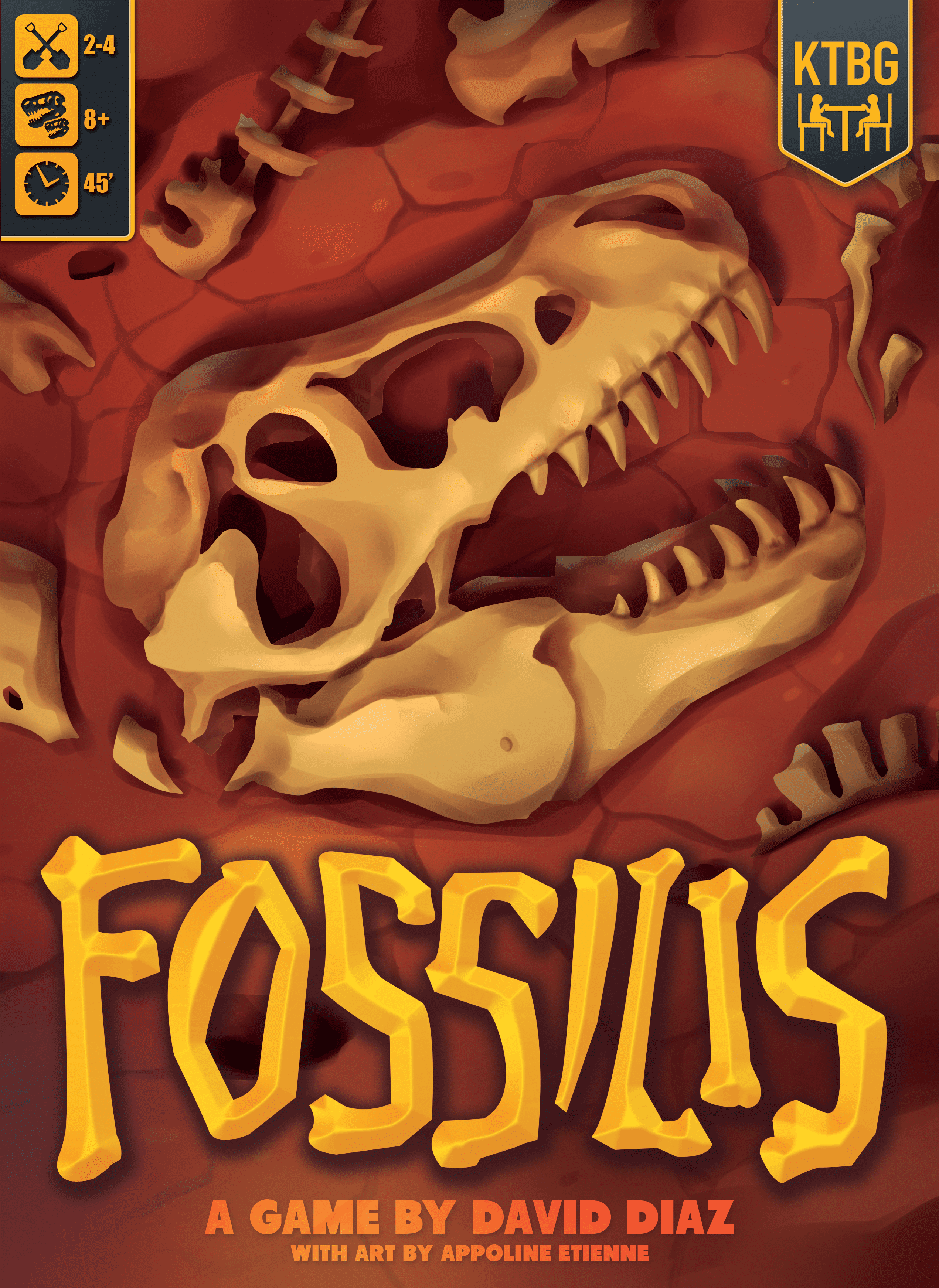
Fossilis is a game for paleontologists digging a layered site for dinosaur bones. Players spend Energy to move, dig, and slide terrain tiles, gather Plaster to extract bones, trade collected Fragments for Tools and Supplies, and complete Dinosaur cards. The player with the highest score after the final round wins.
Setup
- Set three Sand tiles aside as a face-up discard pile, one for each Fragment type: amber, egg, and footprint.
- Put all bones and hammers into the dig site pits, put the lid on, and shake gently so they spread out. Remove the lid.
- Build the terrain in two layers using the site map: the bottom layer has 25 tiles with Stone on the four marked spaces and Clay or Sand elsewhere; the top layer has 10 tiles placed anywhere except the four corners, with no Stone on Stone. Then remove the site map and use the blocker and flipped board as player aids and the score track.
- Shuffle the Events, draw three face down, and keep them unseen. Make a supply of 40 Plaster, then place 4 per player on the Event stack as the Plaster Pool.
- Shuffle the Skill tokens, place 9 face up as the Skill display, and return the rest to the box.
- Shuffle the Dinosaur deck and reveal 4 as the display. Shuffle the Tool and Supplies decks separately and reveal 2 of each as the Market.
- Each player takes a player mat and pawn of one colour and places a scoring marker at the start of the score track.
- Give the Start Player marker to a player. In reverse turn order, players place pawns on corner tiles, with no sharing. In a 5-player game, the centre tile may also be chosen.
A turn
Each turn you start with 4 Energy and spend it on actions in any order and combination. Unspent Energy is lost. Using Tools is free.
Actions include:
- Gain Plaster: take 1 Plaster from the Pool, or the supply if the Pool is empty.
- Move up to 2 spaces, orthogonally or diagonally. You may pass through pawns but not end on one. Moving up or down a layer is free.
- Climb back on after being pushed off the site, from the same edge you fell from, for 1 Energy.
- Place a Sand tile from the discard pile for 1 Energy, adjacent to you or along your edge if off the site. Stacks cannot exceed 2 tiles.
- Dig an adjacent tile, costing Energy by weight (Sand, Clay, or Stone). Tiles that fall off the site are claimed for their Fragments.
- Slide an adjacent tile one space in any direction for 1 to 3 Energy depending on its weight. It may push tiles of equal or lighter weight.
- Extract a bone from an open pit next to you by spending the Plaster shown on your mat. You may extract at most one hammer per turn, and it costs no Plaster. A hammer lets you swap it for a Skill token from the display.
After spending Energy, the turn has two further steps:
1. Buy 1 card from the Market using Fragments on your collected tiles. Overpaying gives no change. Refill the empty Market slot from its deck.
2. Claim 1 Dinosaur from the display into your lab if your lab is empty and your storage has at least one bone it needs. Assign a bone to it right away.
You may score a Dinosaur from your lab, or from the display if you hold all its bones, at any point on your turn.
End of the game
The game ends after the fourth and final Plaster Pool runs out. Each Pool runs out and triggers an Event. Once the final Pool runs out, the current round is completed, then each player takes one more turn. Then final scoring happens.
Scoring
During the game, you score points by completing Dinosaurs. Perfect scores are higher than partial scores, which count only the bones assigned to the card.
At the end, score in this order:
1. Any Dinosaur still in your lab, scored perfectly or partially.
2. Empty Skill slots showing points, and any points granted by your Skill tokens.
3. Leftover bones in storage, as shown on your mat. Skulls are worth points only at this stage.
4. 1 point for every 2 leftover Plaster, ignoring remainders.
5. Points printed on your purchased Tools and Supplies cards.
6. 12 points if your collection includes at least one of all nine characteristics.
7. Set values for each characteristic where you have at least 3 scored Dinosaurs.
8. Majorities: for each of the nine characteristics, the player with the most Dinosaurs with that symbol gets 3 points. If tied for most, nobody scores in that category.
The player with the most points wins. A tie goes to the tied player with more Dinosaurs in their collection. If still tied, the tied players share the victory.
Variants
The rulebook suggests simpler play for younger players by removing some elements:
- Tool cards, which need private reading and add tactical complexity.
- Card purchasing and Fragment collection, which involve spending and saving.
- Skill tokens and hammers, which create differences in player capability.
- Different Energy costs for digging tiles, which speeds up the game.
- Characteristic set scoring and all-nine scoring, which reward long-term planning.
- Majority scoring, which involves direct competition.
If the directly aggressive Skill tokens do not suit your group, replace them with other tokens during setup.
Changes
- Variants, by the rulebook draft, 22 November 2026 (shown now)
- Scoring, by the rulebook draft, 22 November 2026 (shown now)
- End of the game, by the rulebook draft, 22 November 2026 (shown now)
- A turn, by the rulebook draft, 22 November 2026 (shown now)
- Setup, by the rulebook draft, 22 November 2026 (shown now)
- Summary, by the rulebook draft, 22 November 2026 (shown now)