Rules of Fresco
Summary
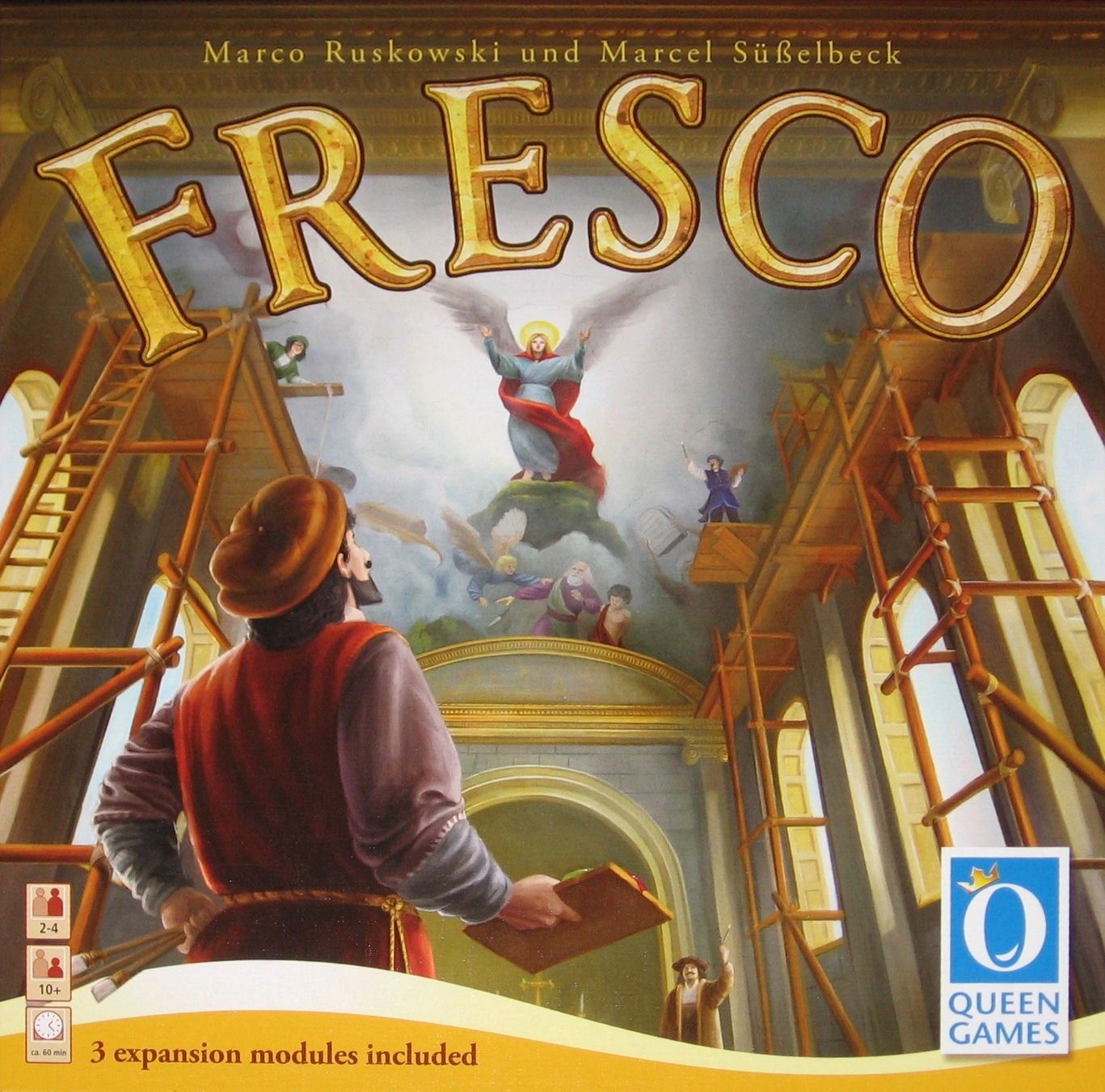
Fresco is a family game for 2 to 4 players aged 10 and up, set in Renaissance times. Players are master fresco painters who restore a large cathedral fresco by buying paints, restoring segments, and managing their workday, and the player with the most victory points wins.
Setup
Place the double-sided game board in the middle of the table, using the 4-player side (starting spaces S1 to S4) for four players or the 3-player side (S1 to S3) for three players. Place the bishop in the center of the fresco. Put the 25 fresco tiles face up on the fresco segments, with the 11-valued tile in the center space. Put all coins in the studio as a common supply sorted by value, and place all paint pieces on the workshop spaces sorted by color. Each player takes a master painter for the starting spaces and places one master painter on a space above the hostel. Place the market tiles in the linen bag, draw the appropriate number for each booth, and remove the tiles shown for the player count. Each player takes a small screen, a large screen, an action sheet, a set of master painters, and apprentices, and places their master painter on the mood display and a natural-colored apprentice above each mood column.
A turn
Each round has two phases.
Phase 1: Choosing get up time and adjusting mood. The player with the last position on the victory point track goes first and places their master painter on a free get up space, with the other players following from second-last to first position. Each get up space changes mood, market prices and player order. Then the player adjusts their mood on the mood display, and moving onto a +1 or -1 space changes how many apprentices they have.
Phase 2: Planning and performing actions. Players secretly place their apprentices on their action sheet behind their small screen, with only one apprentice per action space. Then, the players visit the five locations in turn, and at each location the players perform their actions in order of their get up time. A player may forfeit actions, and must forfeit any action they cannot afford.
Actions:
- Market: buy paint tiles from a booth, paying the price set by get up time, or close a booth instead.
- Cathedral: restore a fresco segment by returning the required paints, gaining victory points and moving the master painter on the track, plus bonus points from the bishop; or restore the altar with basic or blended paints.
- Studio: earn 3 Thalers for each apprentice placed here.
- Workshop: blend paints up to two times for each apprentice placed here.
- Theater: move the master painter up to 2 spaces on the mood display per apprentice.
The bishop may be moved one space in any direction for 1 Thaler before restoring a segment.
At the end of each round, new market tiles are placed, income is paid, apprentices return to their sleeping spaces, and the player last on the victory point track starts the next round.
End of the game
If there are 6 or fewer fresco tiles on the board at the start of a round, that round is the final round. Players flip their action sheets to side 2. The game ends after this round even if the fresco is not fully restored, and no income is paid in the final round. The theater cannot be visited in the final round, but the cathedral can be visited twice. If the fresco is fully restored during a round, that round is the final round and final scoring follows immediately.
Scoring
Final scoring: every 2 Thalers is worth 1 victory point, awarded in player order of the final round. The player with the most victory points wins and is the master of all fresco painters. If a master painter lands on an occupied space during final scoring, it moves forward to the next free space. Master painters still on starting spaces swap places as explained in the rules. The rules do not specify a tie-breaking method.
Variants
Supplement modules (can be combined with the basic game in any way):
- The portraits: portrait cards are placed in the studio, and a player visiting the studio may take one of the two open portraits for one apprentice. Permanent cards stay face up for the owner's benefit, and one-time cards pay a reward and are then removed. The game also ends when the last 2 portrait cards are revealed.
- The bishop's request: request tiles are placed in the workshop. An apprentice may fulfill one request per round instead of blending paints. General requests are fulfilled with 3 fresco tiles, special requests with 3 tiles showing the same color splash. Request cards give once-only or permanent benefits.
- Special blend colors: 12 new paint pieces (pink and brown) and 13 to 24 valued fresco tiles are added, with pink and brown replacing green, orange and purple in altar restoration for extra points. Pink is made by blending purple and red, and brown by blending orange and green.
Two-player game: an imaginary third player named Leonardo is used, with his own master painters and apprentices. The players alternate controlling Leonardo each round. Leonardo never buys paints but closes market booths, and restores one fresco tile per round by moving one space orthogonally or jumping to the lowest-valued tile. The supplement also describes module-specific rules for Leonardo.
Changes
- Variants, by the rulebook draft, 23 November 2026 (shown now)
- Scoring, by the rulebook draft, 23 November 2026 (shown now)
- End of the game, by the rulebook draft, 23 November 2026 (shown now)
- A turn, by the rulebook draft, 23 November 2026 (shown now)
- Setup, by the rulebook draft, 23 November 2026 (shown now)
- Summary, by the rulebook draft, 23 November 2026 (shown now)