Rules of Gaia Project
Summary
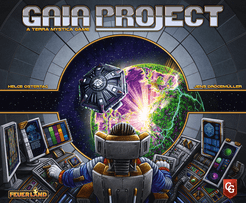
Gaia Project is a six-round game in which each player leads a faction that colonizes a galaxy of planet types. Players build mines, upgrade structures, start Gaia projects, form federations, and research technologies. The player with the most victory points (VP) at the end of the game wins.
Setup
Assemble the board from sector tiles: all 10 for 3 or 4 players, or tiles 01 to 07 for 1 or 2 players, with the tile sides specified in the rulebook. Place the research board, then place the standard tech tiles and advanced tech tiles on it. Set up federation tokens by type. Put one round scoring tile on each numbered space of the scoring board and one final scoring tile on each final scoring space. Create a round booster supply of the number of players plus three, and place the general supply of tokens nearby.
For the first game, each player takes a faction board in clockwise order from a set list, then places their structures, Gaiaformers, starting resources, and player tokens according to the board. Each player also takes the satellites of their color, placing one on each zero space of the scoring board. Choose a first player, who takes the first player marker. Starting with the last player and moving counterclockwise, each player chooses a round booster.
A turn
The game has six rounds, each with four phases in order:
- Income: Gain resources and charge power from your faction board, round booster, tech tiles, and research levels.
- Gaia: Move power from your Gaia area into your power cycle. Transdim Planets with your Gaiaformers become Gaia Planets.
- Actions: Starting with the first player and moving clockwise, each player takes one action per turn until all have passed.
- Clean-Up: Remove action tokens, flip round boosters faceup, and remove the used round scoring tile.
Action options on your turn:
- Build a Mine: Pay two credits and one ore to colonize an empty, accessible, habitable planet. Terraform first if needed.
- Start a Gaia Project: Place an available Gaiaformer on an accessible Transdim Planet by paying power. It completes in the next round's Gaia phase.
- Upgrade a Structure: Replace a structure with a stronger one by paying the listed cost. Upgrades can grant tech tiles or a planetary institute ability.
- Form a Federation: Connect colonized planets with total power value of at least seven. Build satellites by discarding power if needed, then take a federation token.
- Research Progress: Spend four knowledge to advance one level in a research area.
- Power or Q.I.C. Action: Pay the marked cost on a research board action space. Each one can be used once per round.
- Special Action: Use an orange action space on your faction board, tech tile, or round booster once per round at no cost.
- Pass: Take a new round booster and end your participation in the round.
Free actions may be taken before or after your action, not during. They include exchanging resources and converting power. Passive charging lets opponents charge power when you build or upgrade near their structures, by spending VP.
End of the game
The game ends after the action phase of round 6. Skip the Clean-Up phase and proceed directly to final scoring.
Scoring
Final scoring includes the following:
- Final scoring tiles: The highest-ranked player on each track gets 18 VP, second gets 12 VP, third gets 6 VP, and fourth gets 0 VP. Tied players add the VP for the ranks they share and divide that total equally.
- Research scoring: Gain 4 VP for each research level 3, 4, or 5 you have reached or passed in any area.
- Resource scoring: Gain 1 VP for every three credits, knowledge, or ore you have, in any combination.
The player with the most VP wins. If players are tied, they share the victory.
Variants
- Advanced setup: Choose factions from all available faction boards, place starting mines differently, use variable turn order with the turn order card, and assemble a variable game board. Details are on page 19 of the rulebook.
- Solo play: Follow the separate Automa rulebook.
- One or two players: Add a neutral player made of two satellites placed on the ranking tracks, which count as opponents during final scoring.
Changes
- Variants, by the rulebook draft, 22 November 2026 (shown now)
- Scoring, by the rulebook draft, 22 November 2026 (shown now)
- End of the game, by the rulebook draft, 22 November 2026 (shown now)
- A turn, by the rulebook draft, 22 November 2026 (shown now)
- Setup, by the rulebook draft, 22 November 2026 (shown now)
- Summary, by the rulebook draft, 22 November 2026 (shown now)