Rules of Gandhi: The Decolonization of British India, 1917 – 1947
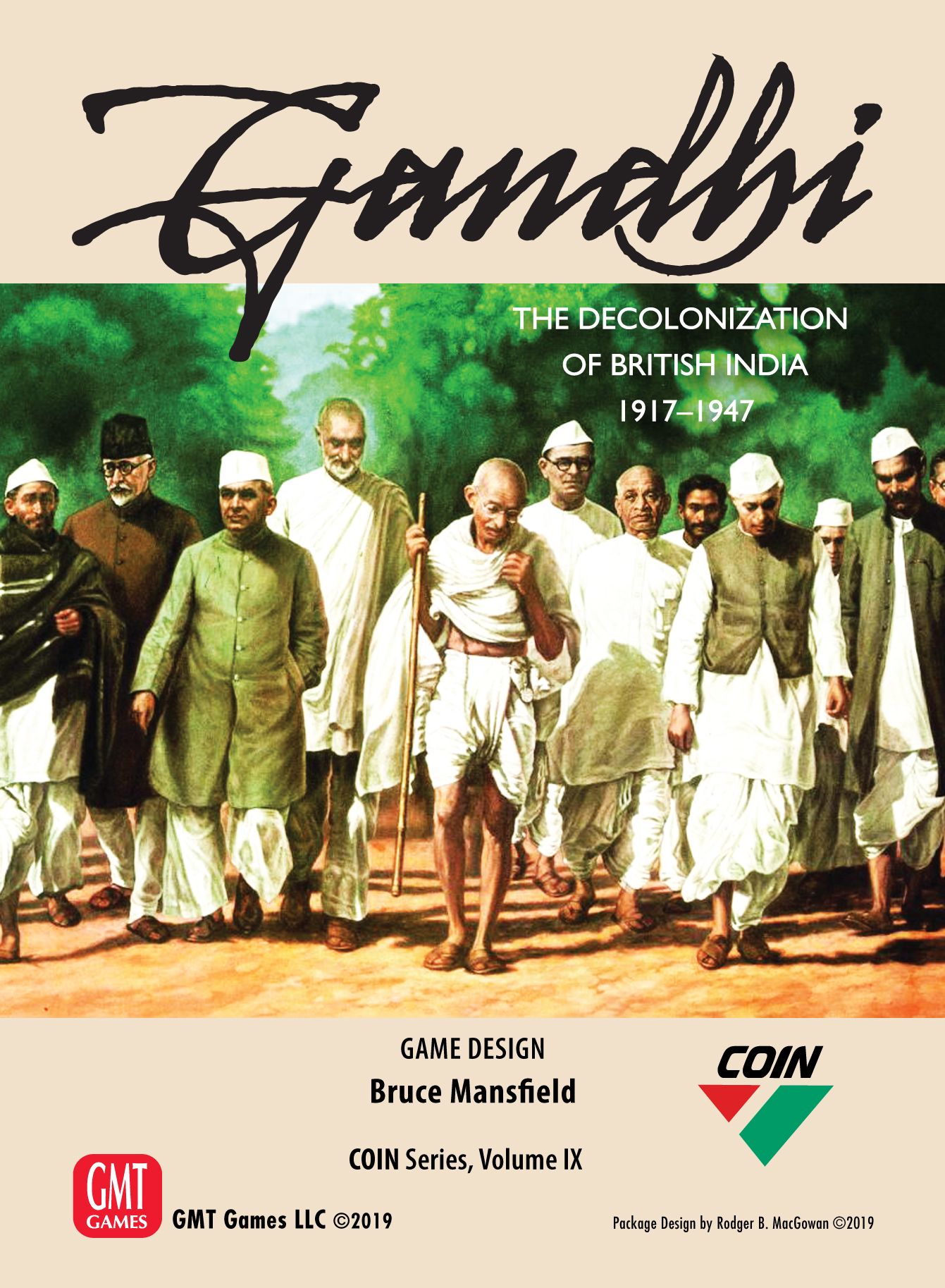
Summary
Gandhi is a 1- to 4-player game of insurgency and counterinsurgency in British India from 1917 to 1947, up to the creation of India and Pakistan. Four Factions (the British Raj, Congress, the Muslim League, and the Revolutionaries) each pursue a unique victory goal through forces, Operations, Special Activities, and Event cards. The game ends at a victory check or after the final Campaign, and the Faction that most exceeds its goal wins.
Setup
Choose a scenario (Short 1930-1947 or Main 1917-1947) and set up the board, forces, and markers exactly as that scenario lists. Assign Factions to players (2 players: Raj and Revolutionaries versus Congress and Muslim League; 3 players: one player runs Congress and Muslim League or Raj and Revolutionaries; 4 players: one Faction each). Leftover Factions are run by Non-player rules.
Build the draw deck as the scenario specifies, with Campaign cards shuffled into certain piles and the piles stacked into one deck. Randomly choose a starting Viceroy from the unused Campaign cards and place it in the British Viceroy of India box. Set aside unused cards unseen. If using Non-player Factions, shuffle their Arjuna cards together face up.
A turn
Each turn, the top card of the draw deck is played. Its icons show which two Factions act and in what order. Each Eligible Faction in that order either executes an Operation (optionally with a Special Activity) or the card's Event, or Passes. Factions that did not act on the previous card are Eligible; those that did are Ineligible.
The 1st Eligible Faction may do one Operation, an Operation with a Special Activity, or the Event. The 2nd Eligible Faction may do a Limited Operation (one space, no Special Activity), or depending on what the first Faction did, an Operation with Special Activity or the Event. Passing gives Raj 3 Resources or Revolutionaries 1 Resource, and lets a Nonviolent Faction move one of its Activists from Out of Play to Available.
When a Campaign card is revealed, play stops and a Campaign Round is conducted immediately.
End of the game
The game ends when a Faction meets its victory condition at a victory check at the start of a Campaign Round. Otherwise the game ends after the final Campaign Round is completed, and the winner is decided by victory margin.
Scoring
Each Faction's victory condition is checked at the start of each Campaign Round. Raj: Total Support plus the Population of Raj-Controlled spaces must exceed 38. Congress: Total Opposition must exceed 20. Muslim League: Total Muslim Opposition plus twice the Population of Muslim States must exceed 14. Revolutionaries: Population of spaces with Unrest plus the number of Revolutionaries Bases must exceed 14.
If the game reaches the final Campaign Round without a victory check win, each Faction's victory margin is its total minus its threshold, so margins may be negative. The Faction with the highest margin wins, and the others are ranked by margin in order.
Ties go to the Muslim League first, then Congress, then Revolutionaries. If a Non-player Faction passes a victory check, all players lose equally. A player running two Factions uses the lower of the two margins.
Variants
Non-player Factions: with fewer than four players, leftover Factions are run by the Non-player system (Arjuna cards, Non-player aid tables), which governs their eligibility, Operations, Special Activities, Events, and Campaign Round phases.
Solo (1-player): the player must avoid any Non-player exceeding its victory threshold and have the highest margin at the final Campaign Round. Victory is graded by the margin over the highest Non-player margin, with a 1 to 5 margin meaning costly independence and 6 or more giving Faction-specific outcomes.
Two- and three-player groupings: the rulebook gives alternative pairings of Factions among players, as described in setup.
A Quick Start Guide is also provided for experienced COIN players, using a shortened setup and the Main Scenario.
Changes
- Variants, by the rulebook draft, 22 November 2026 (shown now)
- Scoring, by the rulebook draft, 22 November 2026 (shown now)
- End of the game, by the rulebook draft, 22 November 2026 (shown now)
- A turn, by the rulebook draft, 22 November 2026 (shown now)
- Setup, by the rulebook draft, 22 November 2026 (shown now)
- Summary, by the rulebook draft, 22 November 2026 (shown now)