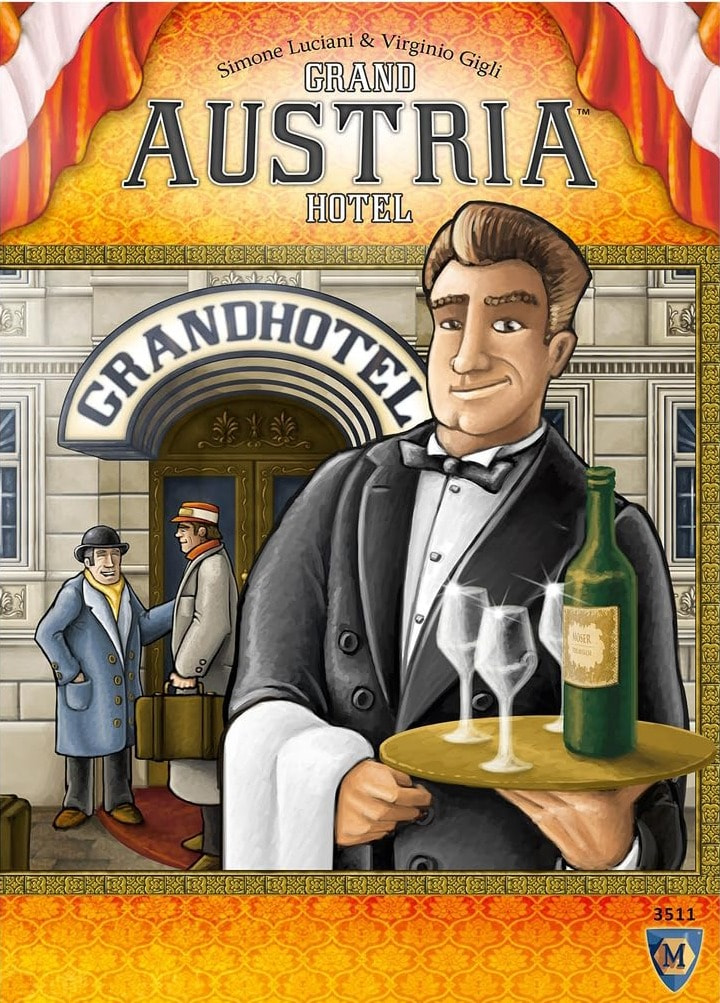
Rules of Grand Austria Hotel

Summary
Players run hotels in early 1900s Vienna, attracting guests, preparing rooms, and earning Victory Points (VP) over seven rounds. The player with the most VP at the end wins.
Setup
- Place the game board and action board, with the dustbin and VP markers beside them. Sort the dishes and drinks by type.
- Shuffle the Guest cards, then draw 5 face up onto the guest spaces on the game board.
- Shuffle the Staff cards into a face-down stack. For the first game, use the recommended sets.
- Choose one Politics card each from A, B, and C, and one Emperor tile each from A, B, and C.
- Sort the Room tiles by color.
- Roll the dice onto the first action space: 10 dice for 2 players, 12 for 3, 14 for 4.
- Give each player the Turn Order tiles matching the player count.
- Each player takes an Overview card, a Hotel board, and 6 wooden disks in one color. Place one disk on 0 of the Emperor track, one on 0 of the VP track, and one on 10 of the money track. Put one coffee, wine, cake, and strudel in your Kitchen.
- Each player draws 6 Staff cards and keeps them hidden. Place the round marker on round 1.
Preparations: Choose a Hotel board side together; the front is recommended for a first game. A random start player takes Turn Order tile 1, and the others take the next numbers clockwise. Starting with the last player and going counterclockwise, each player takes one face-up guest into their Café for free, refilling the guest row after each choice. Each player then prepares up to 3 rooms, starting with the bottom left room, paying costs on the money track, and placing each new room next to an existing one.
A turn
At the start of each round, the start player takes all dice, rolls them, and places them on the matching action spaces.
On your turn:
1. Optionally, take one of the face-up guests into your Café, paying its cost and refilling the row. If the Café is full, you cannot take one.
2. Mandatory: take one die from an action space that still has dice and carry out that action. Then move the die to the lowest visible number on your Turn Order tile.
The action depends on the chosen space and the number of dice on it:
- 1: take strudel or cake, one per die; you may not take more cake than strudel.
- 2: take wine or coffee, one per die; you may not take more coffee than wine.
- 3: prepare a room per die, following placement rules and paying the cost of its row. Top-right rooms give their printed VP immediately.
- 4: advance on the Emperor track or money track, one space per die, split however you like.
- 5: play one Staff card, reducing its cost by 1 per die. Pay the rest, but never gain money from a negative cost.
- 6: pay 1 krone and take one of actions 1 to 5, using the number of dice on space 6 rather than the chosen number.
Dishes and drinks you receive can go straight onto a guest's order; the rest go to your Kitchen.
Additional actions, any number of times per turn except the first action:
- Pay 1 krone to add 1 to the number of dice on the chosen action space (once per turn only).
- Pay 1 krone to move up to 3 dishes and drinks from your Kitchen to guest orders.
- Place a wooden disk on a Politics card whose requirement you meet.
- Use a played Staff card with a once-per-round effect, then turn it face down.
- Move a guest whose order you completed into a free room of matching color. Turn that room over, collect the guest's VP and reward, and discard the guest. If the room completes a group, you get the occupancy bonus.
After your turn, the player with the lowest visible number on their Turn Order tile goes next. Passing: you may pass instead of taking a turn. Once every other player has passed or used both numbers on their tile, the player with the lowest visible number takes all remaining dice, removes one, re-rolls the rest, and sorts them onto the action spaces. Play continues until all players have used both numbers or no dice remain.
End of the game
The game lasts 7 rounds. At the end of rounds 3, 5, and 7, an Emperor Scoring takes place. After round 7 and its Emperor Scoring, the Final Scoring follows.
At the end of each round, you may turn your face-down Staff cards face up again. The start player then passes the Turn Order tile to the next player clockwise, that player takes all dice, and the round marker moves forward one space.
Scoring
Emperor Scoring: each player gains VP equal to the value printed under their disk's space on the Emperor track. Then disks move back 3 spaces after the first scoring, 5 after the second, and 7 after the third. Ending on space 3 or higher gives the Emperor tile bonus. Ending on 0 gives the penalty. Ending on 1 or 2 gives neither.
Final Scoring:
- VP from Staff cards that score at game end.
- VP for occupied rooms by row: 1 per room in row 1, 2 per room in row 2, 3 per room in row 3, and 4 per room in the top row.
- 1 VP per krone and per leftover dish or drink in your Kitchen.
- -5 VP for each guest still in your Café.
The player with the most VP wins. If tied, the tied player with the most dishes, drinks, and krones left wins.
VP also come from guests, occupancy bonuses, top-right rooms, Politics cards, and some Staff cards during play.
Variants
Introductory variant: before the first game, sort the Staff cards into sets A, B, and so on, and give each player one set. The start player takes set A, the next player set B, and so on. Shuffle the leftover cards to form the draw pile.
Variant for experienced players: each player receives 6 Staff cards in turn. Everyone picks one card from a hand of cards, passes the rest to the left, and repeats until each player has 6 cards.
The back sides of the Hotel boards are described as more difficult to play and differ from each other; they are an alternative to the front sides.
Changes
- Variants, by the rulebook draft, 22 November 2026 (shown now)
- Scoring, by the rulebook draft, 22 November 2026 (shown now)
- End of the game, by the rulebook draft, 22 November 2026 (shown now)
- A turn, by the rulebook draft, 22 November 2026 (shown now)
- Setup, by the rulebook draft, 22 November 2026 (shown now)
- Summary, by the rulebook draft, 22 November 2026 (shown now)