Rules of Guilds of London
Summary
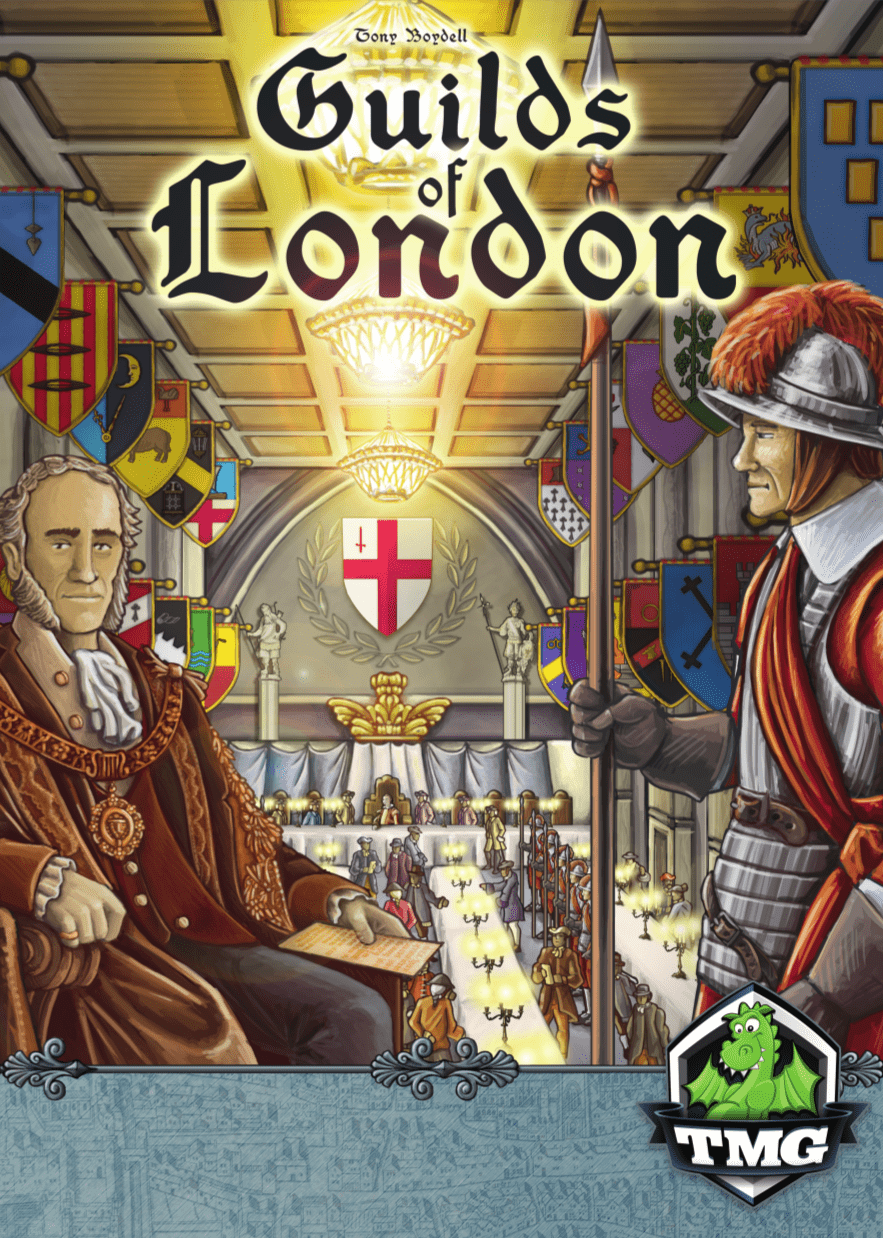
Guilds of London is a game set in late medieval and early modern London. Players hire and move their liverymen into guilds and special buildings to win control of each tile, and gain victory points from the rewards and control they earn. The player with the most victory points at the end becomes Lord Mayor and wins.
Setup
- Place the two Guildhall tiles together in the centre to form one picture, and put the compass rose token on the Guildhall, pointing North.
- Mix the 2nd place reward tokens face down, then place a random one face up on each guild and special building tile around the Guildhall, skipping the Guildhall tiles.
- Place the beadle piece on the guild tile with the lowest guild number.
- Shuffle the remaining special building tiles and guild tiles into stacks. Then draw tiles at random to form a row to the left of the Guildhall, four tiles in a row above it and four below it. Place the Church of St Lawrence Jewry tile to the right of the Guildhall. All tiles start on their starting side up.
- Choose a side of the plantation tile and place it on the matching ship space on the scoreboard.
- Determine a random starting player. Place the first player's disc in the bottom-left space of the scoreboard's turn order track, then the others in order. Each player keeps their second disc in their play area to track victory points.
- Shuffle the mayoral reward cards and deal 3 to each player. Each player keeps 1 secretly and returns the other 2. Shuffle the returned cards and place them face down on the scoreboard as the mayoral reward deck.
- Shuffle the action cards and deal 6 face down to each player. Place the rest face down as the action deck, with space beside it for a discard pile.
- Place the round marker on space 1 of the round track.
- Each player places 4 of their liveryman pawns on the Guildhall and keeps the rest in general supply.
- Place two neutral black pawns on the board for each player (4, 6 or 8 in total). Return any others to the box.
A turn
A round starts by moving the round marker forward, except in round 1. Players then take turns in order of victory points, highest first. A tie is broken by the player whose disc is higher in the stack.
On your turn you may play any number of action cards from your hand, one at a time, placing each face up in front of you. Each card gives one of three actions:
- Hire a liveryman: place one of your pawns from general supply onto the Guildhall.
- Move a liveryman: move one of your liveryman or master pawns from the Guildhall or any guild or special building tile to another face up tile that matches a suit on the card.
- Use a special ability: instead of hiring or moving, pay the cost shown in the card's top-left corner, usually by discarding other action cards, and then carry out the ability.
When you are finished playing cards, place the played cards in the discard pile. Then draw cards: 4 if you played no cards this turn, otherwise 2, adjusted by any card abilities you paid for. Your hand limit is seven cards, or eight if you are master of the University of London tile. Extra cards are only discarded at the end of your turn, not during a round.
After all players have had a turn, resolve the tiles that are ready.
End of the game
The game lasts a set number of rounds depending on the number of players: 16 rounds for 2 players, 15 for 3 and 12 for 4.
A Growth phase happens at the end of certain rounds marked with grey spaces on the round track. In a 3 or 4 player game, the growth phase adds new tiles. The game ends when the round marker reaches the final space of the track. In a 2 player game, the game also ends immediately when the last unresolved tile is resolved. Once the game ends, final scoring takes place.
Scoring
Victory points are added to your total, and your disc moves along the scoring track. If you tie with another player, your disc goes on top of theirs and you take your turn first.
When a tile resolves, the winner receives its 1st place reward and resolution bonus, and the second-highest player receives the 2nd place reward. Ties for second place earn nothing.
For the plantation tile, the most liverymen on it gain the left-hand reward and the second most gain the right-hand reward. Ties follow the rules in the rulebook.
At final scoring, remove all pawns and chits from unresolved tiles. Players then reveal their mayoral reward cards in turn order and add those bonuses. A guild may be used for more than one scoring bonus. Each player also scores 1 point for each pair of orthogonally adjacent tiles where they hold a master pawn.
The player with the most victory points wins. If players tie for first, the tied player with the most mayoral reward cards wins. If still tied, all tied players win.
Variants
2-player game: Use the single Guildhall tile, placed on its reverse side. Place four special building tiles around it, and do not use the Gog & Magog tile. Arrange 20 random guild tiles in a 5 x 5 grid around the Guildhall. Use the 2-player side of the scoreboard.
During play, skip adding new tiles during the Growth phase. Tiles resolve only at the end of every two rounds, marked on the track with a laurel leaf. If the last unresolved tile is resolved, resolve the plantation tile once more and end the game with final scoring.
No solo, team or short-game variants are given in this rulebook.
Changes
- Variants, by the rulebook draft, 22 November 2026 (shown now)
- Scoring, by the rulebook draft, 22 November 2026 (shown now)
- End of the game, by the rulebook draft, 22 November 2026 (shown now)
- A turn, by the rulebook draft, 22 November 2026 (shown now)
- Setup, by the rulebook draft, 22 November 2026 (shown now)
- Summary, by the rulebook draft, 22 November 2026 (shown now)