Rules of Hannibal & Hamilcar
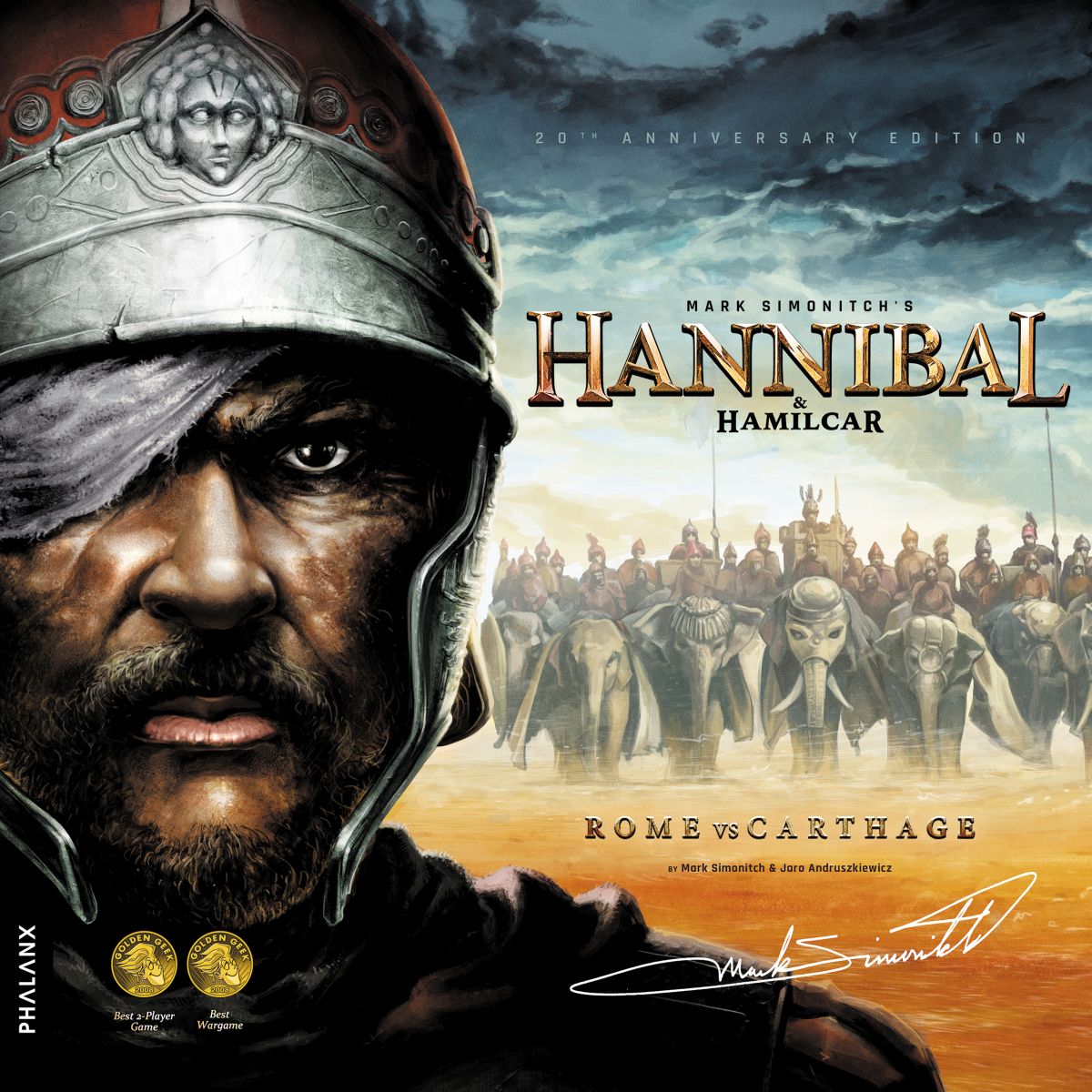
Summary
A two-player game of the Punic Wars, with one player as Rome and the other as Carthage. Players fight for control of provinces through Generals, armies, and Political Control markers. A player can win instantly with a Sudden Death Victory, or otherwise by having the most Political Points after the last turn.
Setup
Choose a scenario, since the rulebook says each one details its own setup, reinforcements, and which player goes first. New players are advised to start with a Hannibal scenario (Second Punic War) before trying the more complex Hamilcar scenario (First Punic War). Place pieces as the scenario directs.
A turn
Each turn is played in this order:
- Reinforcement Phase (skipped on the first turn): Carthage places reinforcements and may return displaced Generals. Rome places reinforcements, designates a Proconsul, removes its old Consuls, and draws two new Consuls at random.
- Deal Strategy Cards: each player receives the number of cards shown on the Turn track.
- Strategy Phase: players alternate playing one card at a time until both hands are empty. Each card is used either for its Operation Points (move a General, place PCs, or raise troops with a 3-OP card) or for its Event. A card can also be discarded for no effect.
- Winter Attrition Phase: both players roll Attrition for their CUs in spaces held by enemy PCs or hostile Tribes.
- Political Isolation Removal: Rome first, then Carthage, removes each non-Walled, non-Tribe PC that cannot trace a path to a friendly CU, Tribe, Port, or Walled City.
- Victory Check Phase: Political Points are counted and any consequences applied.
The turn then ends and the next one begins.
End of the game
The game ends immediately with a Sudden Death Victory when:
- Rome controls Carthago.
- Carthage controls Roma.
- In the Hannibal scenario, Carthage controls every Italia province except Latium during a Victory Check Phase.
- A player's opponent sues for peace, which happens when a player loses a Land Battle and cannot remove enough PCs to cover the Political Consequences, or cannot remove enough PCs after a Victory Check.
Otherwise the game ends after the last turn of the scenario, when the Victory Check Phase decides the winner.
Scoring
Each player earns one Political Point for each politically significant Province they control. There are 18 possible points. Gallia Transalpina, Massilia, Liguria, Baleares, and Mauretania (if used) are not politically significant.
At each Victory Check Phase, the player with fewer points must remove their own non-Walled, non-Tribe PCs from the map equal to the difference in points. A player with too few PCs to remove sues for peace and loses.
At the end of the last turn, the player with more Political Points wins. On a tie, Carthage wins in the Hannibal scenario and Rome wins in the Hamilcar scenario.
Variants
The rulebook gives these optional or variant rules:
- Additional Strategy Cards for Hannibal scenarios (cards 65 to 91), with an agreed option to remove them after they are played as Events.
- Messenger Intercepted variant, letting the opponent force an immediate extra card play.
- Elephant Fright variant, using card 77 in place of card 42.
- Additional Generals, including Bomilcar as a Turn 4 arrival.
- Historical options: Consuls killed in action are removed, a Consul cannot be drawn in consecutive Reinforcement Phases (except Fabius), and specific Consuls leave the pool on set turns.
- Mauretania, a hostile separate region that is not politically significant, with two port-related adjustments.
- Flexible PC Placement and Removal, allowing a 3-CU Army to place or remove PCs for extra movement points.
- Alternative Reinforcements for both sides, based on the number of their controlled Walled Cities.
- Alternate Siege Rules (Charles' Variant), where most cities fall after two siege points and the besieger may loot or show clemency.
- Vanilla Hannibal, which keeps Mauretania out and removes several Generals to match earlier editions.
The rulebook gives no solo or team variants.
Changes
- Variants, by the rulebook draft, 22 November 2026 (shown now)
- Scoring, by the rulebook draft, 22 November 2026 (shown now)
- End of the game, by the rulebook draft, 22 November 2026 (shown now)
- A turn, by the rulebook draft, 22 November 2026 (shown now)
- Setup, by the rulebook draft, 22 November 2026 (shown now)
- Summary, by the rulebook draft, 22 November 2026 (shown now)