Rules of Heaven & Ale
Summary
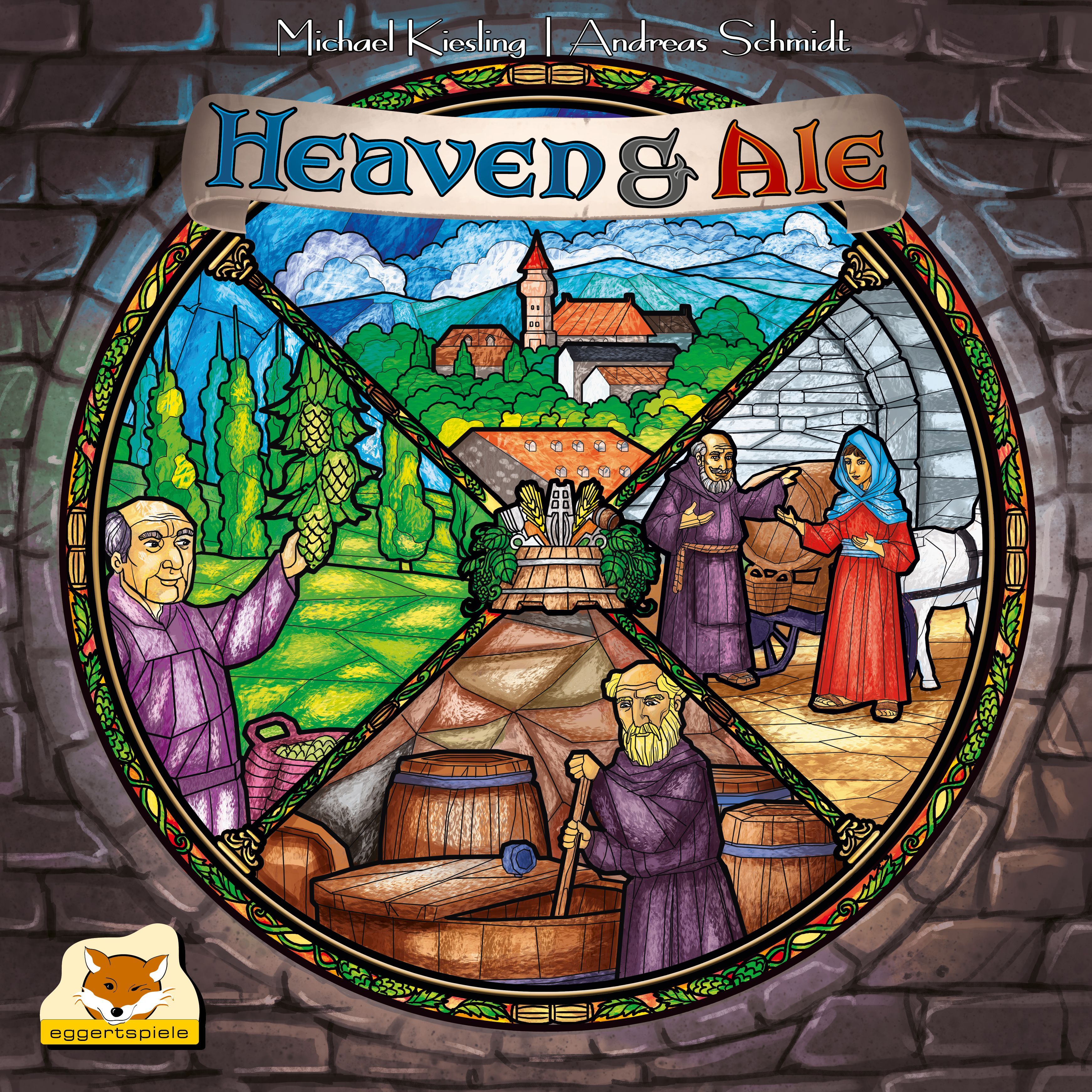
Players run a medieval monastery brewery and compete for resource tiles, monk tiles and scoring discs to build a garden and fill barrels with beer. The game lasts a set number of rounds, and the player with the most victory points at the end wins; ties share the victory.
Setup
Place the main board within everyone's reach and put the ducats, scoring discs and shed tiles beside it. Split the resource tiles into a pile marked I and a pile marked II, then place one I tile face up on each resource space. Sort the shed tiles into their five types. Split the monk tiles into I and II stacks, shuffle each, and place stacks of four on the monk spaces according to player count. Place one face-up monk tile from the leftmost stack on each of the four monk spaces. Put a scoring disc on each scoring disc space. Stack each large barrel on its matching small barrel and place them on the barrel spots.
Each player takes a player board, five privilege cards, a figure, 25 ducats (public information), a brewmaster placed on its starting spot, and five resource markers placed on their starting spots.
Choose a starting player by any house rule. That player places her figure on the first player starting space. The other players then, going counterclockwise, place their figures on the remaining starting spaces and take each space's immediate reward.
A turn
On your turn, move your figure clockwise along the common track any number of spaces, but not past the starting area. Then perform the action of the space you landed on. You may never move backwards, stay put, or land on a space whose action you cannot perform. You may share a space with other figures.
- Resource space: buy at least one resource tile there, as many as you can afford. A tile on your shady side costs its fertility number in ducats; on your sunny side it costs twice that. Place it in an empty spot of that side.
- Monk space: buy at least one monk tile in the same way, using the monk cost number.
- Scoring disc space: take one disc and place it on an empty tile-scoring spot on your board, then carry out that spot's action. A disc from space A goes on the fertility spot and lets you nominate a fertility number 1 to 5 and activate matching resource tiles (shady tiles give ducats, sunny tiles move their marker). A disc from space B triggers all monk tiles of that type, which activate adjacent resource tiles. A disc from space C activates all resource tiles of the matching type. A disc from a shared A/B/C space may go on any matching empty spot.
- Barrel space: take every remaining barrel whose goal you have achieved. Take the large barrel if available, otherwise the small one if you do not already own its large counterpart.
- Starting area: place your figure on any empty starting space and take its immediate reward. Once in, you are out of the round and skip your turns until the round ends.
When a resource or monk tile is placed so that a shed spot is fully surrounded, resolve the shed procedure immediately. Sum the fertility numbers of adjacent resource tiles, move your brewmaster by the amount on the reward table, and place the shed tile from the reserve, which activates adjacent tiles. When you complete a privilege pair (both tile-scoring spots hold discs), you may place one privilege card beside it for its reward, or return any unplaced privilege card to the box to take 3 ducats.
At the end of a round, once every figure is in the starting area, prepare the next round: add the next monk tile stack to the monk spaces, refill resource spaces (I tiles first, then II), refill scoring discs, and place a second disc on each B and C space (and on the first A/B/C space in 3-player games). The player who holds the first player starting space begins the next round.
End of the game
The game lasts 3 rounds in a 2-player game, 4 rounds in a 3-player game, and 6 rounds in a 4-player game. The game ends after the last round, as soon as the last player has entered the starting area and taken its immediate reward. Then each player works out her victory points.
In 2- and 3-player games, the final round is set up differently: the final round is the one for which the last monk pile was taken, and scoring discs may stack up on some spaces.
Scoring
Each player calculates her score as follows.
- Production score: apply your unlocked resource exchange rate, moving resource markers closer together by trading steps. You may also return ducats to the reserve to move a marker one step for every 10 ducats. Then find the marker furthest behind on your production track. Multiply its spot number by the victory point value your brewmaster has unlocked. If any marker has not reached a brown production spot, this score is 0. The exchange rate and point value depend on how far your brewmaster has advanced: the further it has gone, the better the rate and the higher the value.
- Barrels: add 4 points for each large barrel and 2 points for each small barrel collected. If you placed your barrel privilege card beside a completed privilege pair, add 1 point per barrel collected.
- First player: if your figure is on the first player starting space, add 1 point.
The player with the most victory points wins. If several players are tied for most points, they share the victory.
Changes
- Scoring, by the rulebook draft, 22 November 2026 (shown now)
- End of the game, by the rulebook draft, 22 November 2026 (shown now)
- A turn, by the rulebook draft, 22 November 2026 (shown now)
- Setup, by the rulebook draft, 22 November 2026 (shown now)
- Summary, by the rulebook draft, 22 November 2026 (shown now)