Rules of Holland '44: Operation Market-Garden
Summary
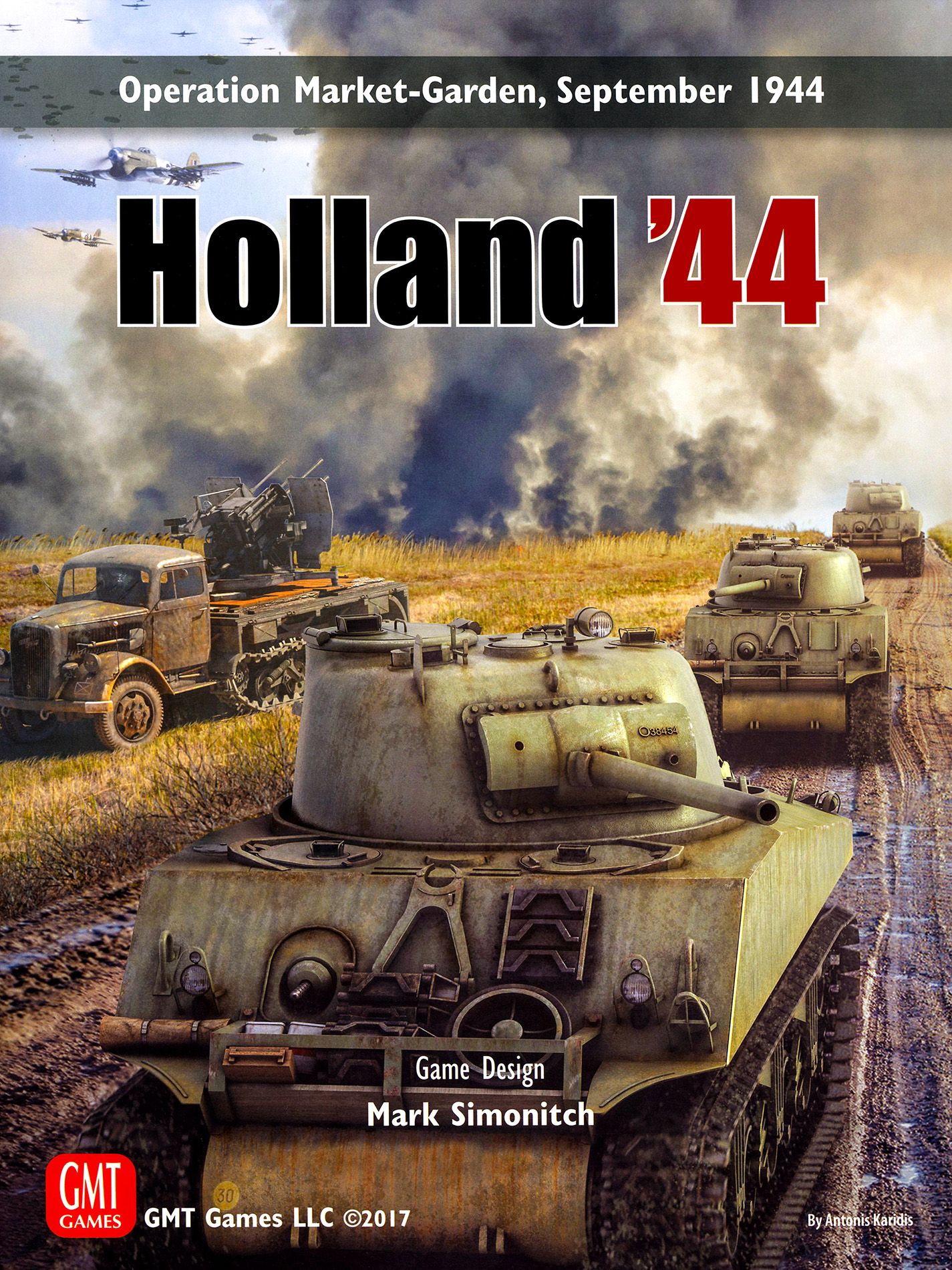
Holland '44 is a two-player wargame of the Allied airborne and ground attack in the Netherlands in 1944 (Operation Market-Garden). One player commands the Allies and the other the Germans. Each side tries to occupy territorial objectives and destroy the opposing forces, with victory points awarded for captured cities and towns and for Allied non-airborne units across the Lower Rhine.
Setup
Set up using the Setup Card. Place the Turn marker on Turn 1 of the Turn Record Track and set the two Weather markers to Clear. Place all other markers aside. Place the Unknown units on their unrevealed side in their starting hexes, without looking at their backs. Use the Entry Area and arrival information on each counter to place the units that start in play.
A turn
Each game-turn has an AM turn and a PM turn, then a night turn in some cases. The Allied player takes the first player-turn, then the German player takes his. Each player-turn runs through these phases in order:
- Artillery Resupply Phase: flip eligible Artillery units back to their Ready side.
- Bridge Phase: the German player may attempt to blow or rewire bridges, and the Allied player may start or finish bridge repair.
- Airlanding Phase (Allied only): place airborne units on Drop Hexes and roll on the Airlanding Table.
- Movement Phase: move units, form Breakdown and Merging units, and resolve attacks on Unknown units and Automatic DS results.
- Combat Phase: attack adjacent enemy units, resolve results, retreats and advances.
- Recovery Phase: recover Disrupted and Full Retreat units and remove temporary markers.
- Supply Phase: check supply and mark or unmark Out of Supply units.
- Traffic Marker Phase (German only): place and remove Traffic markers.
At the start of each AM turn the Allied player rolls for weather, which affects air support, airlanding points and airborne artillery resupply.
End of the game
After each turn's Victory Check Phase, if neither player has won an automatic victory, the Turn marker advances and a new turn begins. The game ends after the final turn or when a player achieves an automatic victory.
Scoring
Automatic victory is checked in each Victory Check Phase. The German player wins automatically if he eliminates or forces off all Allied units north of the Lower Rhine, or accumulates 12 VPs. The Allied player wins automatically if he has at least 10 VPs and at least one non-airborne unit north of the Lower Rhine that can trace a Supply Path to a western map edge Supply Source; German VPs are then ignored.
If no one wins automatically by the end of the game, the player with the most VPs wins. Ties go to the German player.
Allied VPs come from controlled City hexes (1 each), the Towns of Overloon and Venray (1 each), and each non-airborne, non-Breakdown Allied unit north of the Lower Rhine that can trace a Supply Path (1 each). German VPs come from each Allied 3-step unit eliminated (1 VP, counted when its Remnant is eliminated) and each other Allied unit eliminated (1/2 VP), excluding Breakdown units and Airborne Supply Heads.
Variants
The rulebook gives these optional or alternate rules and scenarios:
- Disengagement (optional rule 27.1): a unit that does not attack may try to pull back two hexes using a die roll, if both players agree.
- Isolation Attrition (optional rule 27.2): on night turns, units that are isolated and were already Out of Supply may lose steps, if both players agree.
- Short Game (S1): 11 turns, with the Allied side needing at least four steps of non-airborne units north of the Waal River by the end of Turn 11; otherwise a German victory. Specific starting markers and blown bridges are set out for this scenario.
- Campaign Game (S2): 20 turns, using the standard victory conditions. The rulebook suggests a play-balance adjustment for competitive play, letting the German player move one Unknown unit before the game starts.
Changes
No change yet.