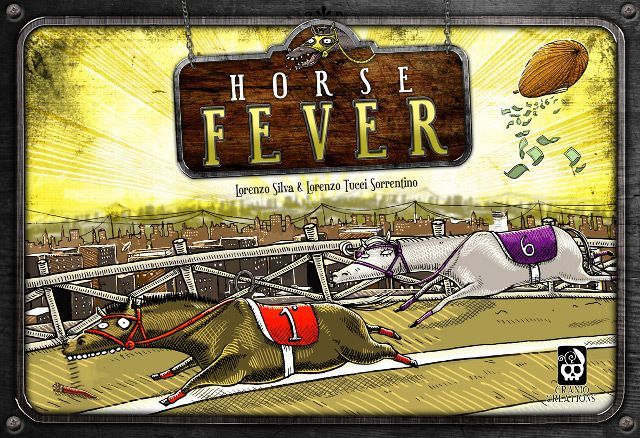
Rules of Horse Fever

Summary
Horse Fever is a horse-race betting game for several players. Over a fixed number of rounds, players place bets on horses to earn Victory Points (VP) and Danari (D), the in-game money. The player with the most VP at the end wins.
Setup
Family Game: Place the racetrack in the center and put the banknotes nearby as the Bank. The player closest to the Bank becomes the Banker. Put all VP tokens nearby as the VP pool, and each player takes one starting VP.
Remove all starred cards. Shuffle the Action, Movement, Stable Owner and Character decks separately. Place the Movement cards face down on the Blackboard and the Action cards face down beside the racetrack.
Put the Bet tokens, by color and in the amount shown on the Bet Tokens table for your player count, in a common pool. Shuffle the 6 Stable tokens and place them one at a time on the Blackboard's Odds spaces, starting at 1:7 and ending at 1:2.
Each player draws a Character card, places it face up, and takes the starting Danari listed for that Character in the rulebook. Return unused Characters to the box.
Roll a Sprint Die and check the Tie-breaker table to choose the First Player. That player takes the First Player card and both Sprint Dice. Place the Hourglass on the first space of the Turn Indicator and put the six Horse pawns on the track in their matching lanes.
Board Game: Use the same setup with these changes. Place the Action, Assistant, Horse, Stable Owner, Goal and Loan decks face down beside their spaces on the board and shuffle each one. Starred cards are optional, and the rulebook suggests removing them for your first few games.
A turn
The game runs clockwise from the First Player for the set number of rounds. The First Player passes to the left at the end of each round. Each round has four phases in the Family Game.
- Deal Phase: The First Player deals two Action cards face down to each player. Players keep them hidden.
2. Betting Phase: Starting with the First Player and going clockwise, each player places a bet on a horse of at least their Minimum Bet, which equals their current VP multiplied by 100 D. Players take a Bet token of the horse's color, put their stake in front of them, and place the token with the chosen bet side up.
- Bet to Win pays if the horse finishes first. The payout is 3 VP plus the stake multiplied by the stable's odds.
- Bet to Show pays if the horse finishes first, second or third. The payout is 1 VP and the stake doubles, regardless of odds.
- If a player cannot cover the Minimum Bet, they lose 2 VP. If they have no VP to lose, they forfeit.
Fixing the race: Starting with the First Player and going clockwise, each player must play all of their Action cards face down on horses. They may play several on the same horse and cannot save them for later.
Second bets: Starting with the player to the First Player's right and going counterclockwise, players may make one more bet or pass. The First Player chooses their stake last. A player may bet twice on the same horse only if one bet is to Win and the other is to Show.
- Race Phase: Reveal all Action cards and apply their effects before the race. Then run race rounds until every horse has finished. Each race round, the First Player reveals the top Movement card and places it on the matching Blackboard space. Horses move by the number matching their odds. Then the First Player rolls both Sprint Dice and applies the results. After each race round, horses that have reached the Finish Line are placed on the Ranking in order. Only horses still on the track keep moving.
Payoffs: Starting with the First Player and going clockwise, the Banker collects lost stakes for the Bank and pays winners. Winners receive their Danari gains and VP. Stable owners receive 600 D for first place, 400 D for second and 200 D for third.
New order of odds: Compare each stable's finishing horse with its token. A horse that finished higher moves its token up one odds row. A horse that finished lower moves its token down one row. Otherwise the token stays put. Work from first place down.
- End of Round Phase: Shuffle the Action and Movement cards back into their decks and reset the horse pawns to their starting spaces. The First Player card and Sprint Dice pass to the left, and the Hourglass moves forward one space. A new round begins with the Deal Phase, unless the last round is over.
Board Game round: Each round has five phases instead of four. The Deal Phase is replaced by a Purchase Phase (two steps where players buy, sell, take loans or pass). An Auction Phase follows the Race Phase. The Betting, Race and End of Round phases follow the Family Game with the changes noted in the rulebook. Before racing, players place their owned Horse cards on matching stables they own.
End of the game
The game ends after the last round. In the Family Game, play stops once that round's End of Round Phase is complete.
In the Board Game, after the last round the End of the Game steps are carried out. Players must repay any Loan cards to the Bank, including interest. A player who cannot repay a loan loses automatically, and that player's VP and cards are not counted. Players then reveal their completed Goal cards.
Scoring
The player with the most VP wins.
Tie-breaking in the Family Game: The tied player with the most Danari wins. If still tied, roll the Sprint Dice and compare the result with the Tie-breaker table.
Tie-breaking in the Board Game: Danari is not used. Players roll the Sprint Dice and compare the result with the Tie-breaker table.
Board Game VP: Each completed Goal card scores VP. If you are the only player to complete it, you score 2 VP. If other players also complete it, you score 1 VP. Duplicate Goal cards only score once. Unfulfilled and duplicate Goals stay face down. Each Stable Owner card you own is worth 1 VP, and you also keep the VP you gained during play.
Variants
The rulebook gives two versions of the game.
The Family Game is the simpler version for newer players. Players bet, fix races and collect VP.
The Board Game is the complete version. It adds a Purchase Phase where players can buy Action, Goal, Assistant and Horse cards, buy Stable Owner cards, take Loans, buy cards from other players, or sell cards to the Bank. Players can also bid in two auctions in the Auction Phase. Its Betting, Race and End of Round phases follow the Family Game with changes. Players also place their own Horse cards in a starting lineup and use the Character card abilities.
The rulebook does not describe solo or team play.
Changes
- Variants, by the rulebook draft, 23 November 2026 (shown now)
- Scoring, by the rulebook draft, 23 November 2026 (shown now)
- End of the game, by the rulebook draft, 23 November 2026 (shown now)
- A turn, by the rulebook draft, 23 November 2026 (shown now)
- Setup, by the rulebook draft, 23 November 2026 (shown now)
- Summary, by the rulebook draft, 23 November 2026 (shown now)