Rules of Hues and Cues
Summary
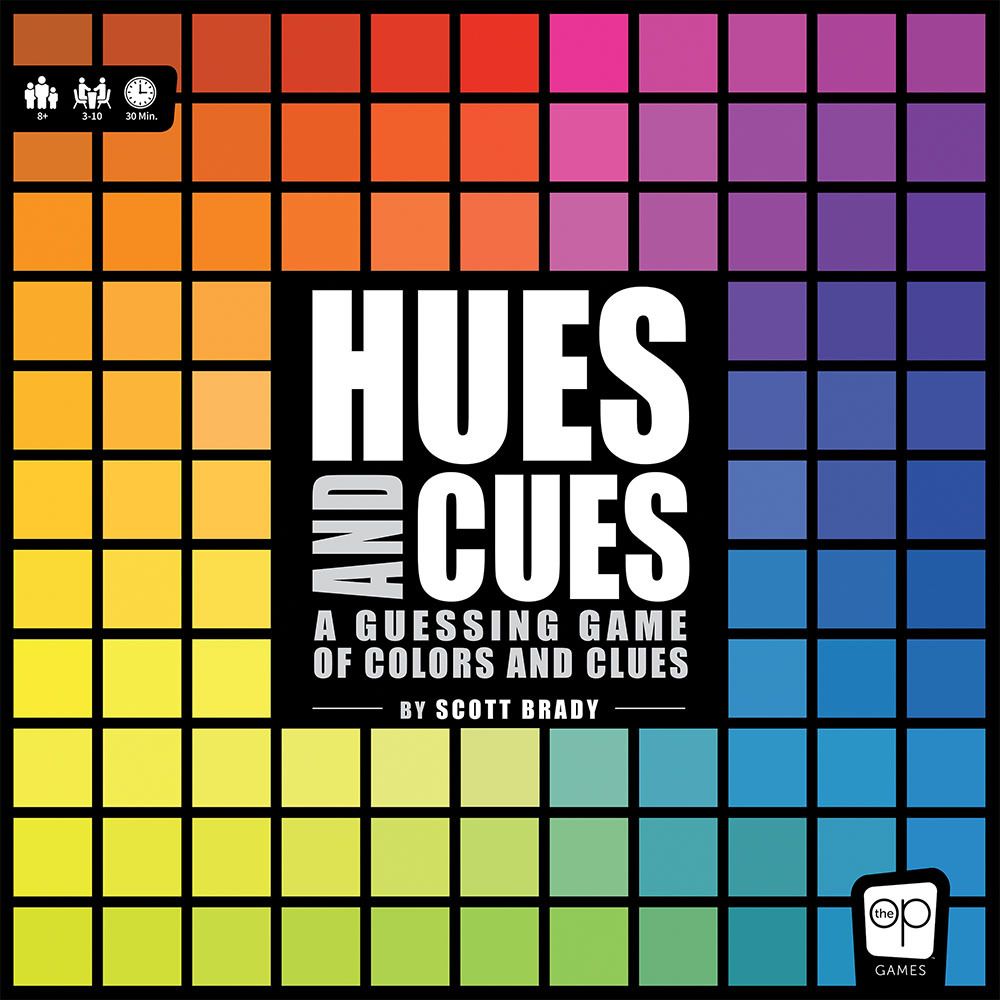
Hues and Cues is a guessing game about describing colors. On each round, one player, the cue giver, secretly picks a color from a card and gives one- and two-word clues so the other players can place pieces on the matching color on the game board. Players score by how close their guesses land, and the cue giver scores by how accurate the guesses are. The player with the highest total score after everyone has given clues wins.
Setup
- Place the game board in the center of the play area.
- Give each player three pieces of the same color. Each player places one piece on the left of the score track and keeps the other two.
- Shuffle the color cards into a face-down draw pile.
- Set the scoring frame aside.
- If this is your first game, assemble the scoring frame from pieces A, B, C and D as the diagram shows. Once assembled, it can be stored in the game box that way.
- The player wearing the most colorful outfit is the cue giver for the first round.
A turn
Each round the cue giver does the following:
- Draws the top card and looks at it without letting the other players see. They choose one of the colors on the card. The card's coordinates matter later for scoring.
- Gives a one-word clue for the chosen color. The clue may not be a basic color name (purple, blue, green, red, pink, yellow, orange, brown, white, black or grey). Abstract color names such as chartreuse or lavender are allowed. The clue may not refer to the color's position on the board, to letters or numbers, or to any object in the room. It may not repeat a clue used earlier in the game.
- In clockwise order, each other player places one of their pieces on the square they think matches the clue. Each color can be guessed only once, and a color counts as guessed once a piece is on it.
- Once all players have placed a piece, the cue giver gives a two-word clue under the same restrictions. It may also not use words like lighter or darker to point to a spot relative to the first guesses. The cue giver may instead pass or give another one-word clue.
- In counterclockwise order, each guesser places their remaining piece on any unoccupied space on the board.
To start a new round, all guessing pieces return to their owners, and the next player in clockwise order becomes the cue giver and draws a new card.
End of the game
With 3 to 6 players, play continues until each player has been the cue giver twice. With 7 or more players, each player is the cue giver once. After the last turn as cue giver, the game ends.
Scoring
After all guessers have made their second guess, the cue giver reveals the color by placing the scoring frame on the board so the chosen color is in the center. The card's coordinates help align it.
- The cue giver earns one point for each piece inside the frame. In a 3-player game, the cue giver earns two points per piece inside the frame.
- Guessers score by how close their piece is to the correct color:
- An exact match earns 3 points.
- Another piece inside the frame, but not on the exact color, earns 2 points.
- A piece on a space just outside the frame, including diagonally adjacent spaces, earns 1 point.
Move each player's piece along the score track to match their points. The cue giver can earn at most nine points in a round, and an individual guesser can earn at most five. The player with the highest total score after the game wins. If players are tied, they play additional rounds, skipping tied players as cue giver, until one of the tied players takes the lead.
Variants
- Additional rule: after the first round of placing pieces, if the cue giver is happy with their score, they may pass on their second clue. This stops the other players from placing their second piece, and scoring happens immediately.
- Younger players: the rulebook recommends letting players pick any color on the board for their clues. Before giving the first clue, the cue giver secretly writes down the coordinates of their chosen color and keeps them hidden from the other players. This makes clues easier for certain colors.
Changes
- Variants, by the rulebook draft, 23 November 2026 (shown now)
- Scoring, by the rulebook draft, 23 November 2026 (shown now)
- End of the game, by the rulebook draft, 23 November 2026 (shown now)
- A turn, by the rulebook draft, 23 November 2026 (shown now)
- Setup, by the rulebook draft, 23 November 2026 (shown now)
- Summary, by the rulebook draft, 23 November 2026 (shown now)