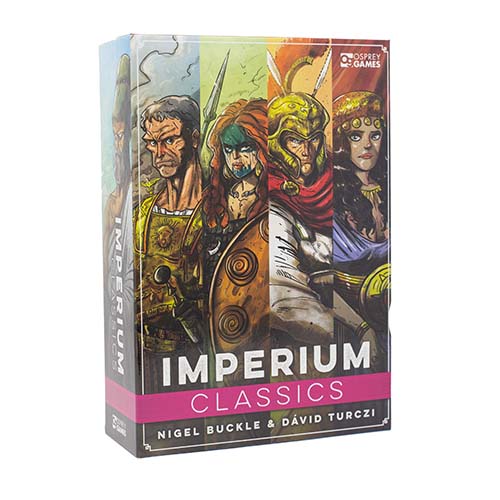
Rules of Imperium: Classics
Summary
Imperium is a deck-building game in which each player leads a nation from early history toward becoming an empire. Players acquire cards from a shared market, play them, and develop their decks. The game ends on scoring or collapse, and the player with the most victory points wins, or the player with the fewest cards if collapse ends the game.
Setup
Each player chooses a nation and takes its cards. Place the nation's power card in front of you, then put the accession card (or the nation's equivalent) above it. Shuffle the nation deck, place it perpendicular on the accession card, and set out the development area cards to its left. Place your state card to the left of your card area, on the side shown for your nation. Add any extra nation cards to the commons, then shuffle the remaining cards into your draw deck and draw five cards as your starting hand.
For the shared supply, place the materials, population, progress, action, and exhaustion tokens, plus the die and slot markers, where everyone can reach them. Give each player their starting tokens. Place the market board in the middle. Sort the commons cards by suit. Remove some commons cards depending on player count: with three players, remove cards marked for four-player use; with two players, remove cards marked for three- and four-player use. Place the unrest cards face up as the unrest pile, then put King of Kings face up on the fame deck spot, with the fame deck placed on top of it. With three players remove one card from the top of the fame deck unseen, with two players remove two.
Build the region, uncivilised, and civilised decks with a number of cards set by player count (six for two players, seven for three, eight for four). Build the main deck from the remaining suited cards. Fill the market with one card from each of the three special decks and two cards from the main deck. Tuck an unrest card under each market card that has the matching icon, and place a progress token on each market card without an icon. Place the solstice card between two players at random. The player to its left takes the first turn.
A turn
The game is played in rounds. On your turn, you activate, innovate, or revolt, then clean up.
- Activate: Take actions and use exhaust abilities in any order. To take an action, remove an action token from your state card, play a card from your hand into your play area, resolve its effect, and then discard it unless it stays in play. You can only play cards whose icon matches your state card. Exhaust abilities need an exhaust token placed on the card, which must not already have one.
- Innovate: Discard your whole hand, then break through for a card. You cannot take actions or use exhaust abilities this turn.
- Revolt: Return any number of cards from your hand to the unrest pile. You cannot take actions or use exhaust abilities this turn.
Clean up: add one token from the supply to a market card (Carthaginians and Qin follow their power card instead). Then remove tokens from your state card and your cards, reset your state card to its starting tokens, optionally discard any cards from hand, and draw up to your hand size of five. Once you place the market token, the next player can begin while you finish cleaning up.
If your draw deck runs out, reshuffle your discard pile into a new one, and handle any state-card icon as the rules describe. When the solstice card's turn comes up, each player resolves the solstice keywords in their play area and on their power card before the next round begins.
End of the game
The game ends when either scoring or collapse is triggered.
Scoring is triggered when any of these happens: the main deck is empty; a player develops the last card in their development area; King of Kings is flipped face down; the Viking player discards Harald Hardrada; the Arthurian player plays Graal; or the Utopian player has at least 24 tokens and triggers the solstice on their journey card.
Collapse is triggered when the unrest pile is empty. If scoring has already been triggered, collapse is resolved instead.
Scoring
When scoring is triggered, finish the current round and play one more full round, including its solstice. Then add up victory points. Cards that stay where they were when the game ended score as follows: every token counts for 1 point, and cards in your hand, play area, draw deck, discard pile, history or flooded pile, and power card score. Cards in your nation deck and development area do not score. Cards with a fixed value score that value. Cards with a conditional value score only if the condition is met. Variable-value cards score as stated on the card, but never more than 10 points. The player with the most points wins, and tied players share the victory.
When collapse ends the game immediately, count the cards in your hand, play area, draw deck, discard pile, and history. The player with the fewest cards wins. Tied players proceed to scoring.
Variants
Combining Classics and Legends: If you own both boxes, you can play with any of the sixteen nations. When setting up the commons, use commons cards from either box. Any commons card that shares a name with a chosen nation is replaced with a random commons card from the other box. A replacement that is not allowed for your player count, or that matches a chosen nation, is redrawn.
Player count: The rulebook gives different commons card removals and fame-deck removals for two, three, and four players, as described in setup. No separate solo or short-game rules are given.
Changes
- Variants, by the rulebook draft, 22 November 2026 (shown now)
- Scoring, by the rulebook draft, 22 November 2026 (shown now)
- End of the game, by the rulebook draft, 22 November 2026 (shown now)
- A turn, by the rulebook draft, 22 November 2026 (shown now)
- Setup, by the rulebook draft, 22 November 2026 (shown now)
- Summary, by the rulebook draft, 22 November 2026 (shown now)