Rules of Indian Summer
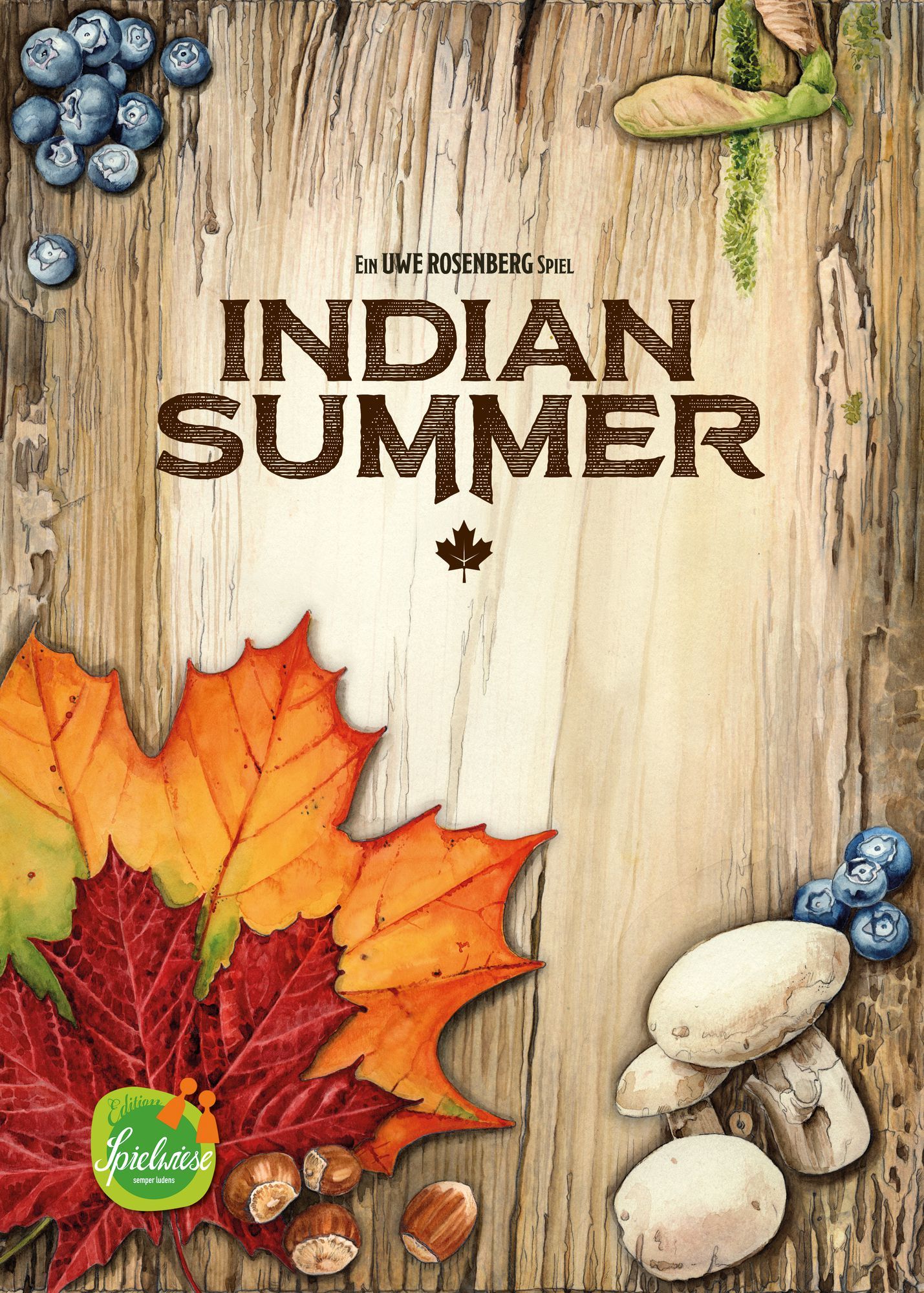
Summary
Indian Summer is a tile-placement game in which each player fills their own Forest Floor board with Leaf tiles. The first player to completely cover their Forest Floor wins the game. Treasures are not victory points. They are used as resources for special actions and to break ties.
Setup
- Each player takes a Forest Floor board and a Backpack, and places the Backpack at the bottom left corner of the board. Unused Forest Floors and Backpacks go back in the box.
- Set up the two game boards in the middle of the table, using the multiplayer side.
- Sort the Animal tiles onto their spaces on the game board. Place the matching Treasures on the Racoon, Fox and Badger tiles.
- Put the Treasures and Squirrels next to the short sides of the board as the common supply.
- Shuffle the Leaf tiles. Each player draws 5 and lays them left to right along the bottom edge of their Forest Floor, starting next to their Backpack. This row is the Player Path.
- Arrange the remaining Leaf tiles in a circle around the game board with one empty space. This circle is the Common Path. Place the Berry Bush in the empty space.
- Set the other remaining Leaf tiles aside within reach.
- Each player gets 1 Berry, 1 Nut and 1 Mushroom and places them above their Backpack.
- The player who most recently walked in the forest becomes the start player and takes the Hiking Shoes.
A turn
Players take turns clockwise, starting with the start player. On your turn, you take exactly one Main Action and may use any number of Special Actions before and/or after it.
Normal Main Action: take one Leaf tile of your choice from your Player Path and place it on your Forest Floor.
Alternative Main Action (instead of the normal one, once per turn): spend a Mushroom or a Feather.
Leaf tile placement: a tile must go on empty spaces or Treasure spaces, and may be rotated or flipped. It may not overlap other tiles, cover Animal tiles or Squirrels, or extend past the Forest Floor edge. Its Hole may cover empty spaces or Treasures. Once placed, a tile never moves. Covering a Treasure with a Hole gives you a Treasure of the same type from the common supply.
Areas: when you complete an Area (all its spaces covered by tiles, Squirrels, or Holes), take all Treasures from that Area into your supply immediately.
Refilling your Player Path: when your last tile leaves the Path, refill it right away from the Common Path. Move the Bush clockwise one tile at a time, and take the tile next to the Bush each time until you have 5 tiles. The order of the tiles is kept.
Special Actions:
- Berry: return a Berry to the supply to refill your Player Path to 5. If it is already full, you may take a sixth tile, but never hold more than 6.
- Nut: return a Nut to the supply and place a Squirrel on an empty space of your Forest Floor.
- Mushroom (Alternative Main Action): return a Mushroom to the supply, then take the first tile next to each of two opponents' Backpacks and place them on your Forest Floor in any order. If an opponent runs out, they refill their Path. If there is no room, you may skip one tile.
- Feather (Alternative Main Action): return a Feather to the supply and place 2 tiles from your Player Path on your Forest Floor, in any order. You need at least 2 tiles on your Path.
Exchanging Treasures: at any time during your turn, you may trade Treasures with the common supply. Values from highest to lowest are Feather, Mushroom, Nut, Berry. You may trade 1 for 1 Treasure of a lower value, or 2 identical Treasures for 1 of the next higher value.
End of the game
The game ends as soon as one player completely covers their Forest Floor with tiles and/or Squirrels. The round is finished up to the player to the right of the start player, so all players have had the same number of turns.
Then each player exchanges all Treasures for Nuts, using the exchange rules, and uses the Nuts to place Squirrels on their remaining empty spaces. Completed Areas award their Treasures, which can be exchanged again for more Nuts.
Scoring
The player who completely covered their Forest Floor wins. If more than one player covered theirs, they compare their remaining Nuts, and the player with more Nuts wins.
If the Nut count is tied, the tie goes to the player who still has a Blue Berry remaining, as the rulebook states.
If the tie remains, the players share the victory. The other players then count their empty spaces, and the player with fewer empty spaces ranks higher.
Variants
Solo game:
- Use one Forest Floor, one Backpack and the solo game board halves. Leave out the Bush and the start player marker.
- Split the Leaf tiles into three random stacks of 25. Each game uses one stack. Set up 5 tiles on the Top Path and 5 on the Bottom Path, 10 tiles on the marked X spaces, and 5 tiles in front of you as your Player Path. There is no Common Path.
- The game lasts exactly 10 turns. At the start of each turn, move the tile on the X space matching the current turn number to the far right of the row of tiles. Afterwards, any tiles on lower-numbered spaces are moved to the far right as well.
- Leaf tiles are refilled from the outermost tile on the Top or Bottom Path. Paying an extra Berry lets you take missing tiles from the other Path.
- A Mushroom takes the 2 tiles on the Mushroom spaces, or just 1 if only one remains.
- After 10 turns, continue by exchanging Treasures for Nuts and Nuts for Squirrels. If you do not cover the whole Forest Floor, you lose, and each uncovered space counts as minus 1 point. If you cover it, you win and score points for leftover Treasures: Berry 1, Nut 2, Mushroom 3, Feather 4. A score of 0 counts as a success.
- Over three games: if you won at least two, add your two best winning scores. If you won only one, add your two worst losing scores. If you lose your first two games, the third is forfeited.
Changes
- Variants, by the rulebook draft, 22 November 2026 (shown now)
- Scoring, by the rulebook draft, 22 November 2026 (shown now)
- End of the game, by the rulebook draft, 22 November 2026 (shown now)
- A turn, by the rulebook draft, 22 November 2026 (shown now)
- Setup, by the rulebook draft, 22 November 2026 (shown now)
- Summary, by the rulebook draft, 22 November 2026 (shown now)