Rules of Iron Curtain
Summary
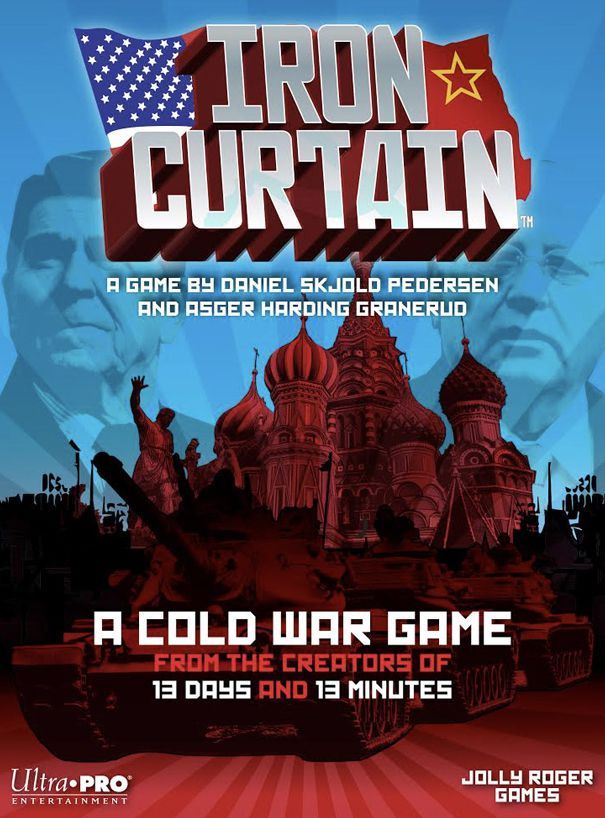
Iron Curtain is a two-player Cold War game in which the US and USSR place Influence cubes on strategy cards to dominate regions and gain Ideology points. A player wins by reaching the final space of the Ideology track, which is effectively an 8-point lead, or by having the most points when the game ends.
Setup
- The US player takes the 24 blue cubes and the USSR player takes the 24 red cubes.
- Place the starter card in the middle of the table and set the scoring card aside. Put one blue and one red cube on the starter card.
- Place the yellow scoring marker on the yellow spot in the middle of the Ideology track on the scoring card.
- Shuffle the 18 strategy cards and deal 5 face down to each player. Set the remaining 8 aside face down.
- In round 1, the USSR chooses the starting player. In round 2, the player behind on Ideology points chooses (the USSR if tied).
A turn
Players alternate turns. On your turn, play exactly one strategy card from your hand and resolve these three steps in order:
- Place the card. Put it face up next to a card of the same region that is already on the table. Only orthogonal neighbors count, never diagonals. If no matching neighbor is available, you may place it next to any card on the table.
- Check for regional scoring. A region scores when the card you just played is the last card of its region on the table. Region sizes include the starter card, for 19 cards in total. When a region scores, each card you dominate gives you 1 Ideology point. You dominate a card if you have more cubes on it than your opponent. Ties score nothing. The player who dominates the most cards in that region also gets the region's bonus points. A tie for the bonus scores nothing. All parts of a regional scoring are calculated at the same time, and either player may score.
- Event and/or Command. If the card bears your opponent's flag, your opponent decides whether its Event is activated. If it bears your own flag, you choose between the Event and the Command.
Command: Place up to the number of cubes shown on the card. You may place fewer, and you may split them between cards. Cubes may only go on cards where you already have a cube, or on cards neighboring such a card. Cubes placed during this action cannot be used to reach further cards.
Control: You control a card if you have at least 2 more cubes on it than your opponent. To add a cube to a card your opponent controls, you must spend 2 cubes, and the second is returned to the supply. Adding cubes one at a time can end your opponent's control partway through.
Infiltrate: Some Events let you place cubes freely. Infiltrated cubes ignore neighbor access and control. If you run out of cubes, you may take your own cubes from any card and place them where your current action allows.
Rounds: Round 1 lasts 4 turns each. Each player plays 4 of their 5 cards and sets the fifth aside face down for aftermath scoring. In round 2, each player is dealt 4 new cards and plays all of them.
End of the game
The game ends immediately if a player's Ideology marker reaches that player's final flag space at the end of the track, at any time.
Otherwise, the game reaches end-game scoring once both players have played all their cards in round 2. Resolve the aftermath scoring, then the final regional scoring. If either step moves the marker to a final flag space, the game ends at once and that player wins.
Scoring
Aftermath: Reveal the two cards set aside in round 1. Count only the cubes on US and USSR Events of these two cards, regardless of who played them. The side with more cubes gains Ideology points equal to the difference, up to a maximum of 3.
Final regional scoring: Score every region in this order: Europe, Middle East, Asia, Africa, South America, Central America. Each region scores even if not all of its cards are on the table, so some regions score twice in a game and others only once.
The player with the most Ideology points wins. If tied, the US wins.
Changes
- Scoring, by the rulebook draft, 22 November 2026 (shown now)
- End of the game, by the rulebook draft, 22 November 2026 (shown now)
- A turn, by the rulebook draft, 22 November 2026 (shown now)
- Setup, by the rulebook draft, 22 November 2026 (shown now)
- Summary, by the rulebook draft, 22 November 2026 (shown now)