Rules of Kahuna
Summary
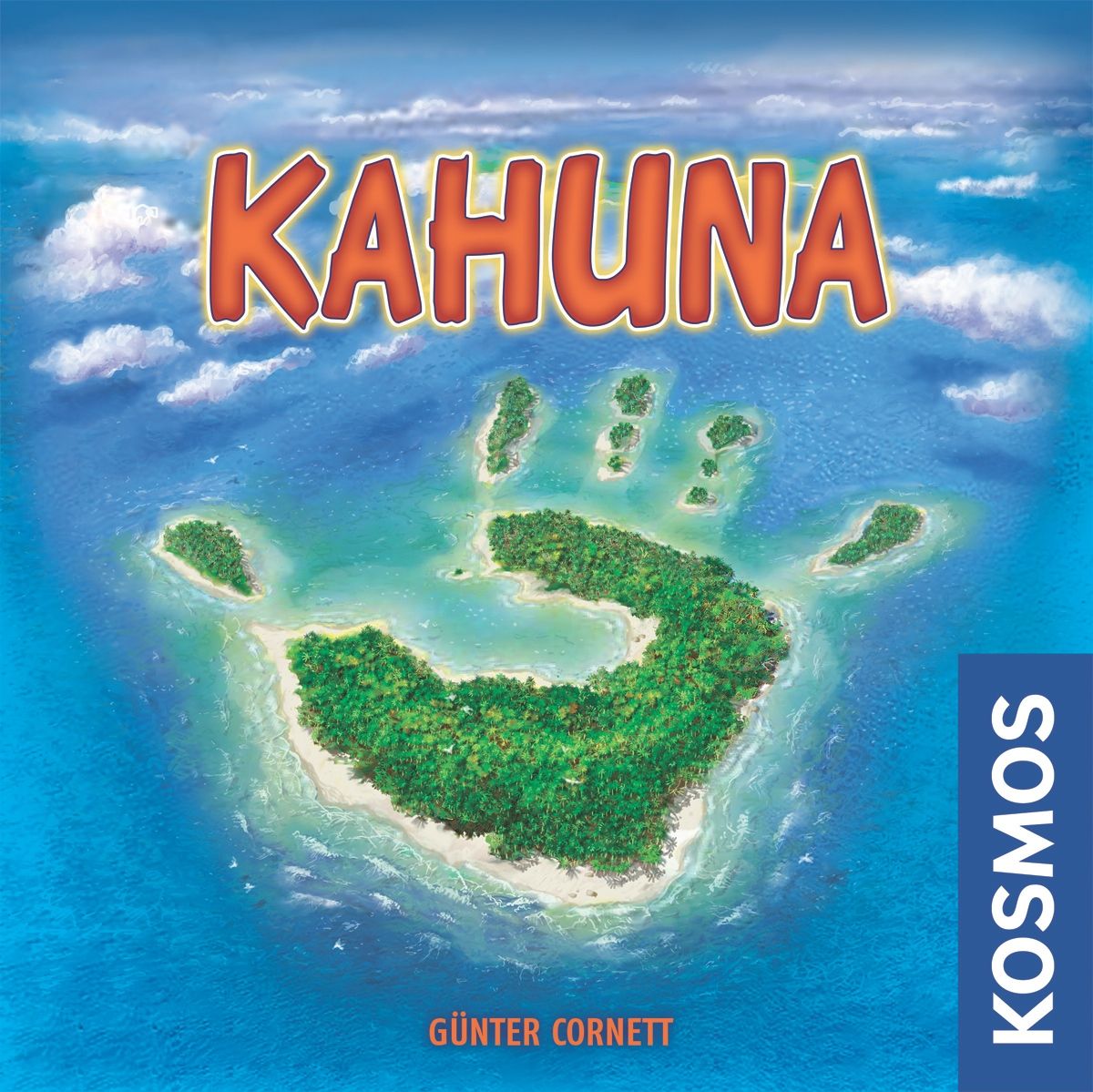
A two-player game in which each player, as a Kahuna sorcerer, builds bridges between twelve islands to win control of them. Holding more than half of an island's bridge lines lets you place a token there. Points are scored at three scoring points during the game, and the player with the most points overall wins.
Setup
Place the game board between the players. Each player takes 25 bridges and 10 tokens of one color.
Shuffle the island cards and deal three face-down to each player as a hand, oriented to match the board. Place three cards face up beside the board, and put the rest face down as the draw pile next to them.
The player who most needs a vacation starts, and players then alternate turns.
A turn
On your turn you may play any number of island cards, or none. Then you draw one card.
- Placing a bridge: A played card lets you place one of your bridges on a free line from the island shown on the card to a neighboring island. Cards are played one at a time and then go to the discard pile.
- Gaining control: If your bridges now cover more than half of an island's lines, place one of your tokens there and remove all of your opponent's bridges connected to that island. This can cost your opponent control of neighboring islands, so they must remove those tokens too.
- Removing an opponent's bridge: Play two cards that each show one of the two islands joined by the opponent's bridge. The two cards may show the same island. If you then play another suitable card, you may place your own bridge on the freed line.
- Hand limit: Your hand may hold at most five cards. If you hold five and do not play, you must discard one card face down under the discard pile before drawing.
- Drawing: Take one of the three face-up cards, replacing it from the draw pile, or take the top card of the draw pile. You may draw only one card, and you may skip drawing unless your opponent skipped on their immediately previous turn. With five cards in hand you cannot draw, so you must play or discard first if your opponent skipped. Your turn ends once you have drawn.
End of the game
The game has two interim scorings and one final scoring.
- The first interim scoring happens when the draw pile is empty and the last face-up card has been drawn. The discard pile is then shuffled to form a new draw pile, three new cards are placed face up, and play continues with the other player's turn. Hands are kept.
- The second interim scoring happens the same way when the new draw pile is empty for the second time.
- After the draw pile is empty for the third time and the last face-up card is drawn, each player takes one more turn. The final scoring follows.
Premature end: if during the second or third scoring a player has no bridges left on the board, the game ends immediately and the other player wins.
Scoring
Each interim scoring counts the tokens each player has on the board. A tie gives no points.
- First interim scoring: the player with more tokens gets 1 point.
- Second interim scoring: the player with more tokens gets 2 points.
- Final scoring: the player with more tokens gets points equal to the difference between the two token counts. A tie gives no points.
The winner is the player with the highest total from all three scorings. If the totals are tied, the player with the higher final scoring wins. If both players have zero points after all three scorings, the player with more bridges on the board wins. If that is also tied, there is no winner.
Variants
Variant 1 (fewer surprises, more strategy): A bridge may only be placed on a free line if neither of its two islands is under the opponent's control. The same restriction applies when you place a bridge on a line freed by removing an opponent's bridge with two cards.
Variant 2 (more tactics, less luck): If you draw a card from the face-up row, place it face up in front of you. You may play it like a card in your hand, and it counts toward your hand limit.
Handicap play: When players differ in experience, the less experienced player may, after dealing, place one, two, or three of their bridges on any lines of their choice, as agreed beforehand.
Changes
- Variants, by the rulebook draft, 23 November 2026 (shown now)
- Scoring, by the rulebook draft, 23 November 2026 (shown now)
- End of the game, by the rulebook draft, 23 November 2026 (shown now)
- A turn, by the rulebook draft, 23 November 2026 (shown now)
- Setup, by the rulebook draft, 23 November 2026 (shown now)
- Summary, by the rulebook draft, 23 November 2026 (shown now)