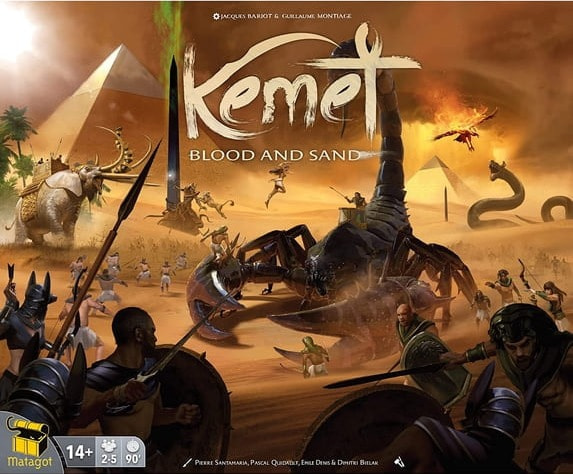
Rules of Kemet: Blood and Sand
Summary
Kemet: Blood and Sand is a game for 2 to 5 players where each player controls an Egyptian god and builds armies, raises Pyramids, buys Power tiles, and fights battles over the land of Kemet. The goal is to reach 9 or more Fame Points (FP) while holding the most FP, which wins the game immediately.
Setup
Place the board in the center using the layout for your player count. Pick the Power tile colors for the game: 2 colors for 2 players, 3 for 3 or 4 players, and 4 for 5 players. Put all Power tiles of those colors face up at the top of the board, grouped by color and ordered by level. Place the Special Battle cards near them if used. Put each Creature on its matching Power tile. Place the Divine FP tokens on the Domination and Sphinx tiles if used, and one Temple FP token on each Temple in play. Keep the remaining tokens, Action tokens and Veteran tokens as a general supply. Each player takes one Diversion DI card, and the other DI cards are shuffled into a face-down deck.
Each player chooses a City and its color, then takes the matching components: an Individual board, Buy a Power Tile tokens for the colors in play, an Order marker, a Prayer marker set on 7, 5 Action tokens, 12 Units, 8 Battle cards, and Pyramid parts. Each player draws 2 DI cards. Players then place their Order markers randomly on the Turn Order track. Each player puts 5 Units into 2 of their Districts and the other 2 into supply. In turn order, each player places 3 Pyramid levels into Districts, with no more than 2 levels in one District, and adds a Buy a Power Tile token for each new color. In reverse turn order, each player takes the Level 1 Power tile matching one of their Pyramids.
A turn
A game is played in Rounds. Each Round has a Day Phase followed by a Night Phase.
Day Phase: In turn order, each player places one Action token on an empty space of their Individual board and resolves that action immediately. Each player does this 5 times. The actions are:
- Pray: gain 2 Prayer Points (PP).
- Buy a Power tile: pay PP equal to the tile's level. The tile must match a Pyramid you control, and you can buy only one tile of a given color per Day Phase.
- Raise a Pyramid: pay PP to raise an existing Pyramid, or pay for a new one in a District of your City.
- Recruit: pay 1 PP per Unit placed in your own Districts. Recruiting into an opponent-held District starts a Battle.
- Move: move one Troop using Land moves and/or Teleportation.
Silver and Gold Action tokens can be played alongside a normal action for a bonus action. The Equilibrium rule applies at the end of the Day Phase: each player must have at least one Action token on each of the three Pyramid levels of their board.
Night Phase: resolved in 9 steps. Offering, Delta Temple control, Temple control, Adoration, Prayers, Divine Intervention, Conscription, Awakening, and Destiny. Among these, players gain FP and PP from Temples and the Sanctuary, draw DI cards, recover Action tokens, and set the Turn Order for the next round.
Battle: triggered when a Troop enters an opposing Troop's zone. The attacker and defender each keep one Battle card, may hide DI cards under it, then reveal and compare Strength. The higher Strength wins, with ties going to the defender. Losses are applied through Unblockable damage and Damage minus Defense. Rewards, recall or retreat, and aftermath follow.
End of the game
The game ends immediately when a player, at the start of their turn before playing an Action token, has at least 9 FP (Permanent plus Temporary) and no other player has more FP than them.
Scoring
Fame Points are the score. Permanent FP (square tokens) cannot be lost and come from battles, certain Power tile purchases, and the Night Phase when a player controls at least 2 Temples or the Sanctuary of All Gods. Temporary FP (round tokens) can be lost and come from controlling each Temple and each level 4 Pyramid. Divine FP is also awarded in the Night Phase for the Sanctuary and for controlling 2 or more Temples.
The player with the most FP wins. A player who reaches 9 FP and is not behind any opponent wins, so an equal total does not prevent a win. The rulebook gives no other tie-breaking rule for the final result.
Variants
The rulebook gives a 2-player setup. Use only 2 Power tile colors, with 26 Power tiles total. Remove the Act of God tiles and keep only one copy of each remaining tile. Each player takes 6 Pyramid parts, 2 of each level, instead of 9. The rulebook does not give solo or team variants. It mentions a future expansion that will allow up to 6 players, but this is not a variant in the base rules.
Changes
- Variants, by the rulebook draft, 22 November 2026 (shown now)
- Scoring, by the rulebook draft, 22 November 2026 (shown now)
- End of the game, by the rulebook draft, 22 November 2026 (shown now)
- A turn, by the rulebook draft, 22 November 2026 (shown now)
- Setup, by the rulebook draft, 22 November 2026 (shown now)
- Summary, by the rulebook draft, 22 November 2026 (shown now)