Rules of Kemet
Summary
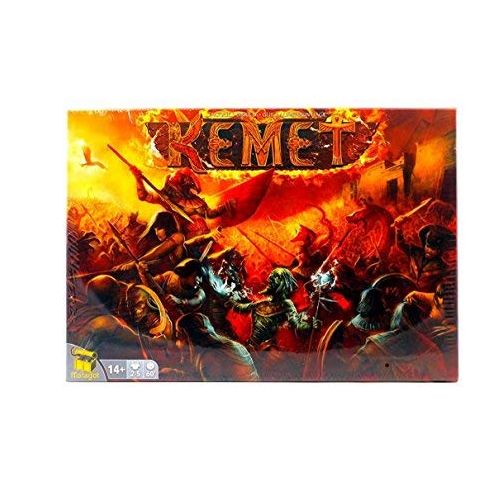
Kemet is a game set in Ancient Egypt in which gods send troops into battle, use powers, and summon creatures to gain the upper hand. Players win by reaching 8 Victory Points (VP) in the short mode or 10 VP in the long mode, checked at the end of a Day phase. The mode is chosen before the game starts.
Setup
- Choose the board side for the number of players. With 2 or 3 players, the East bank is not used.
- Place the board in the middle of the table. Put all Power tiles face up beside it, with the temple temporary VP on their tiles and the Sanctuary of All Gods permanent VP on the Sanctuary. Place the other VP beside the board.
- Each player chooses a city and takes an individual board, 5 Action tokens, and a Prayer Point marker placed on the 5th space of the Prayer Points scale.
- Each player takes 12 units. Place 10 in the city, only in districts that hold a pyramid, with at most 5 units per space. The other 2 stay in reserve.
- Each player takes 6 Battle cards and 3 pyramids. Level 0 pyramids stay in the reserve until they are raised.
- Each player is dealt one random DI card. Put the remaining DI cards face down as a draw pile.
- Set the first turn order randomly.
- In turn order, each player spends 3 points across his pyramids, using either 1/1/1 or 2/1/0.
A turn
A game is a series of Night and Day phases until a player wins.
Night (preparation):
1. Each player gains 2 Prayer Points, plus any from his Power tiles.
2. Each player draws a random DI card, in turn order. Cards can be held without limit. Playing a DI card does not use an action.
3. In turn order, resolve the effects of Power tiles with the Night symbol.
4. Determine turn order: the player with the fewest VP goes first. Ties go to the player who went earlier in the previous turn order.
Day (action phase):
In turn order, each player places one Action token on an empty action space of his individual board and applies its effect immediately. This repeats until all 5 tokens are used. At the end, each player must have at least one token in each of the first 3 levels of his pyramid area.
Available actions:
- Pray: gain 2 Prayer Points.
- Raise a pyramid: raise one pyramid, paying the new level as cost. A raise of several levels costs the sum of each level step.
- Buy a Power tile: buy a tile of the chosen color whose level is at most the level of a pyramid of that color you have. It costs its level and is kept for the whole game. You cannot buy a second tile of the same color in one turn.
- Recruit: spend X Prayer Points to recruit X units into your city.
- Move: move one troop, with each step into an adjacent space. Harbors allow crossing the Nile, and pyramids allow teleporting to an obelisk for 2 Prayer Points.
If a troop enters a space with an opponent's troop, a battle is fought. Each side secretly picks 2 Battle cards. The first is discarded and the second is played, with any DI cards placed under it. The side with the higher Battle value wins. The defender wins ties. Casualties and retreats are then resolved.
At the end of the Day phase, Prayer Points and permanent VP are distributed (see scoring).
End of the game
The game ends as soon as a player has at least 8 VP (or 10 VP in long mode) at the end of a Day phase. That player is declared the winner.
Scoring
VP sources:
- Temporary VP: controlling a temple gives a temporary VP while you keep a unit there. Raising a pyramid to level 4 gives temporary VP, and controlling an opponent's level 4 pyramid gives you that VP.
- Permanent VP: winning a battle as the attacker with at least one unit left. Controlling at least two temples at the end of a Day phase (the Sanctuary is not a temple). Sacrificing 2 units in the Sanctuary of All Gods. Gaining a VP Power tile. Controlling the Sphinx.
End-of-Day distribution:
- The player controlling the Delta temple may return one unit to his reserve to gain 5 Prayer Points.
- Controllers of the other temples gain 2 or 3 Prayer Points and keep their temporary VP.
- The Sanctuary controller may return two units to his reserve to gain one permanent VP.
Tie-breaks for the winner, in order:
1. The most VP.
2. The most Battle VP.
3. The player who played earlier in the previous Day phase.
Variants
- Short mode: the first player to 8 VP wins.
- Long mode: the first player to 10 VP wins.
- Beginner mode: during the Night phase only level 1 Power tiles are shown. Level 2 tiles are introduced at the start of the second Day phase. Pyramids can only be raised to level 2. The first player to reach 4 points at the end of a Day phase wins, instead of 8.
Changes
- Variants, by the rulebook draft, 23 November 2026 (shown now)
- Scoring, by the rulebook draft, 23 November 2026 (shown now)
- End of the game, by the rulebook draft, 23 November 2026 (shown now)
- A turn, by the rulebook draft, 23 November 2026 (shown now)
- Setup, by the rulebook draft, 23 November 2026 (shown now)
- Summary, by the rulebook draft, 23 November 2026 (shown now)