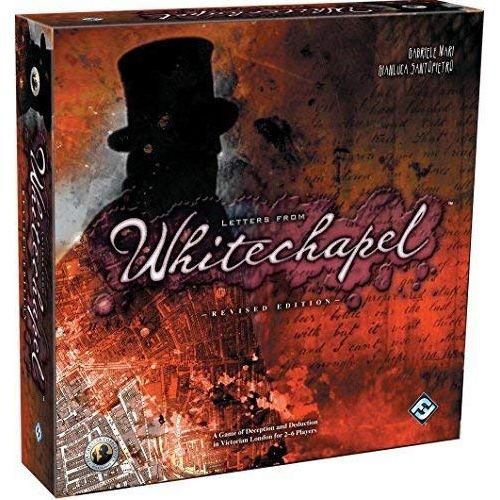
Rules of Letters from Whitechapel
Summary
Letters from Whitechapel is a deduction and bluffing game for two to six players set in London in 1888. One player is Jack the Ripper and tries to kill five victims and get back to his secret hideout without being caught. The other players are detectives who work together to catch him or stop him from reaching the hideout in time.
Setup
Place the game board in the center of the table. The most experienced player takes the role of Jack, and the detectives share the five Policeman pawns however they agree.
Jack takes a move track sheet and places it in his screen, places a Jack pawn on the first night space, and secretly chooses a hideout on any numbered circle except a red one. He writes that number in the oval at the top of his sheet. Jack also collects the Crime Scene markers, Clue markers, Woman tokens, Special Movement tokens and the Time of the Crime token. The reference sheets are handed out, and the detectives shuffle the Head of the Investigation tiles and place them facedown on the board.
A turn
The game lasts four nights, and each night has two parts: Hell and Hunting. Each part has several phases, and each phase is handled by either Jack or the police.
Hell: Jack prepares the scene and secretly places Woman tokens on red circles, some marked as real targets. The detectives flip the top Head of the Investigation tile, and that player places the Police Patrol tokens on yellow-bordered crossings. Jack then chooses victims. He may kill now or wait, and each wait lets the head of the investigation move the Wretched pawns. Jack reveals patrol tokens as needed, and when he kills, he places a Crime Scene marker and records the circle number on his sheet. The detectives then reveal the remaining patrols and replace marked ones with Policeman pawns.
Hunting: Jack moves to an adjacent circle and secretly records it. Then the detectives move their Policeman pawns up to two crossings each, starting with the head of the investigation and going clockwise. Finally each Policeman either looks for clues, which places a Clue marker if Jack's recorded route touched an adjacent circle, or executes an arrest against one adjacent circle. Jack may use a coach or alley token in place of a normal move. If Jack has not escaped or been caught, the next hunting round begins.
End of the game
Jack wins if he kills five victims and returns safely to his hideout at the end of the fourth night.
The detectives win if they arrest Jack or prevent him from reaching his hideout within the permitted number of moves. Jack also loses if he has no legal move, or if he fills the last square on his sheet without declaring his escape from the hideout.
Variants
The rulebook gives several optional rules.
- Jack's Letters: Jack can play one letter on the second, third and fourth nights to move police patrol tokens or, in one case, to pull a policeman pawn to Goulston Street.
- False Clues: For every five Clue markers revealed in a night, Jack gains a False clue marker to block a circle for the rest of that night.
- Rushing: During clues and suspicion, a detective may move an available policeman pawn to an adjacent crossing instead of acting.
- Area Arrests: An arrest announces all adjacent circles at once instead of one.
- Catch Me, if You Can: Jack's hideout cannot be a red circle or adjacent to one.
- I Know Your Address: Once per game, the Swanson or Abberline head of the investigation can make an immediate arrest on any circle.
Changes
- Variants, by the rulebook draft, 23 November 2026 (shown now)
- End of the game, by the rulebook draft, 23 November 2026 (shown now)
- A turn, by the rulebook draft, 23 November 2026 (shown now)
- Setup, by the rulebook draft, 23 November 2026 (shown now)
- Summary, by the rulebook draft, 23 November 2026 (shown now)