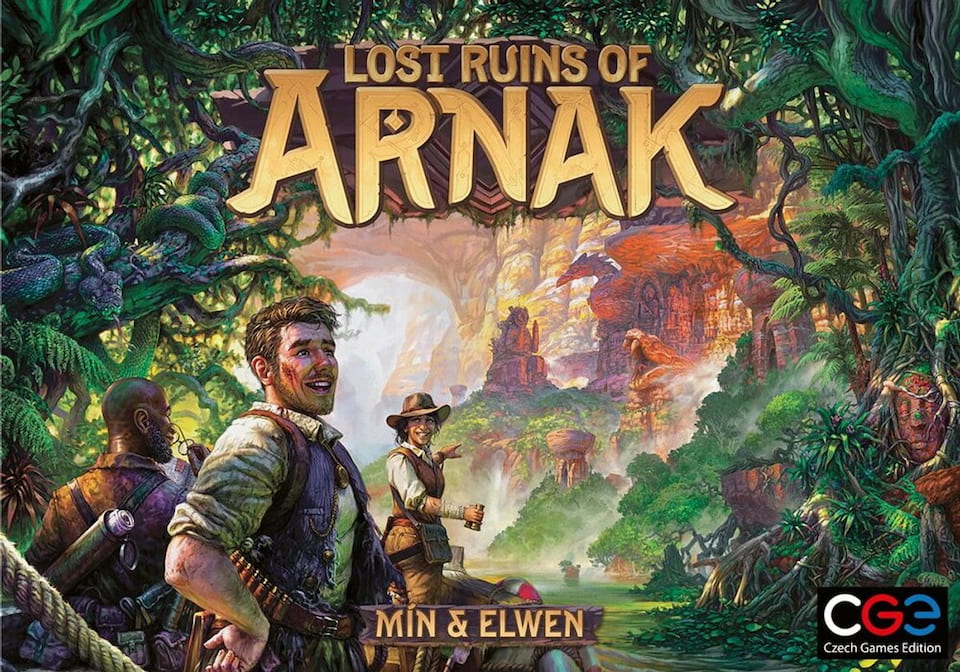
Rules of Lost Ruins of Arnak
Summary
Arnak is a worker-placement and deck-building game where players lead expeditions to explore an uncharted island, using cards, resources and research. Over five rounds, players dig at sites, discover new sites, overcome guardians, buy cards and advance research tokens. The player with the most points at the end of the game wins.
Setup
Place the main board with the Bird Temple side up for a first game. Set up the card row with separate artifact and item decks, a Fear pile, and the moon staff in round I position, dealing one artifact and five items face up beside it. Shuffle the idol tiles and place one or two face-up or face-down idols on the sites as shown on the board. In a three-player game, block three action spaces using randomly drawn blocking tiles, returning the unused two to the box. In a two-player game, block all five spaces. Use the blocking tiles only as indicated. Each player takes a color, a player board, research tokens, two archaeologist figures and four basic cards in that color, then forms a starting deck of those four basic cards plus two Fear cards, shuffled and placed face down on the player board. The starting player is the one who most recently visited a place they had never been before and receives the starting player marker. Play proceeds clockwise. Starting resources depend on play order as shown in the rulebook.
A turn
Each round has four steps. First, each player draws until holding five cards. Then players take turns clockwise, starting with the starting player marker holder. On a turn you may take one main action, plus any number of free actions before, during or after it. Main actions are: dig at a site by sending an archaeologist and paying its travel cost; discover a new site in a region by paying the cost, taking the idol, placing a site tile and awakening its guardian; overcome a guardian on a site where you have an archaeologist; buy a card from the card row; play a card for its effect; research by advancing a magnifying glass or notebook token one space; or pass. Cards can be spent for their travel value or played for their effect, but not both. Free actions are marked by a specific icon and do not count as the main action. After a main action, the card row is refilled. When you pass, you take no more turns for the round, and play skips over you until all players have passed.
End of the game
The round ends when all players have passed. Each player then returns archaeologists to their boards, gaining a Fear card for each archaeologist returning from a site that still has a guardian, and shuffles all cards in their play area to the bottom of their deck. Assistants are refreshed, the card row is adjusted by exiling the cards next to the moon staff, the moon staff moves right, and the starting player marker moves one place to the left. After round V, players take back their archaeologists, gain Fear from guardians, skip the usual setup and proceed directly to final scoring.
Scoring
At the end of the game, players add up points from these sources: research tokens according to their row, with magnifying glasses in the Lost Temple row scoring by order of arrival; temple tiles, shown on each tile; idols, worth 3 points each, including those in slots; points shown in empty idol slots; guardians overcome, worth 5 points each whether the boon was used or not; points in the lower right corner of item and artifact cards; and -1 point for each Fear card, or -2 for each fear tile. The player with the most points wins. Ties are broken in favor of the player who reached the Lost Temple first. If no one reached it, ties go to the player with the highest research score. Players who remain tied share the victory.
Variants
A solo variant is included in which a computer-free rival expedition is controlled by a set of 10 action tiles with a chosen difficulty from 0 to 5 red tiles. The solo variant uses the two-player setup with some tiles doubled, the player plays second, and the rival takes actions on its turns and is scored with the player's points. The Snake Temple side of the main board is a separate variant with different site travel costs, a different research track, an assistant rescue space and bonus tiles placed during setup, and it follows its own special rules. Some rulebook material describes a solo campaign available online, which is not part of the rules here.
Changes
- Variants, by the rulebook draft, 22 November 2026 (shown now)
- Scoring, by the rulebook draft, 22 November 2026 (shown now)
- End of the game, by the rulebook draft, 22 November 2026 (shown now)
- A turn, by the rulebook draft, 22 November 2026 (shown now)
- Setup, by the rulebook draft, 22 November 2026 (shown now)
- Summary, by the rulebook draft, 22 November 2026 (shown now)