Rules of Louis XIV
Summary
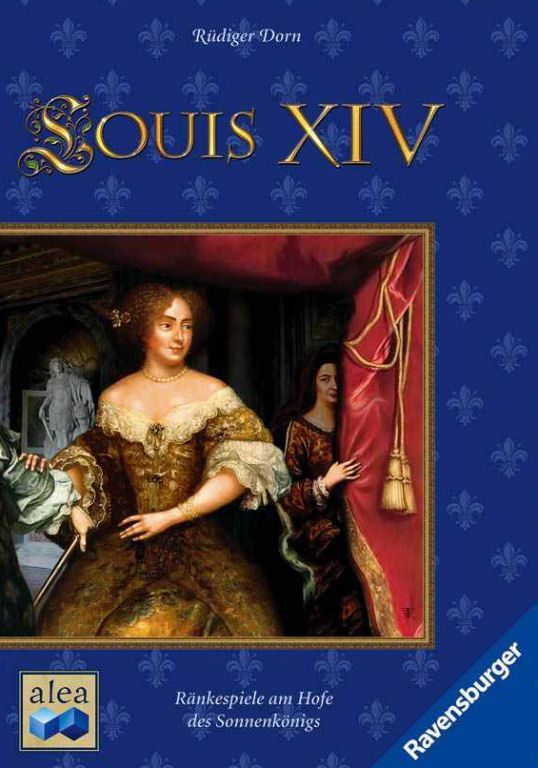
Over exactly four rounds, players place influence markers on the boards of twelve court figures to win rewards such as mission chips, gold and cards. They then use the mission chips to fulfill secret mission cards for victory points. The player with the most victory points wins.
Setup
- Lay out the twelve person boards in a spiral, with board 1 in the middle and the rest in ascending order.
- Sort the six-sided mission chips by symbol and place each type beside its matching board. Put an equal number of crowns in the corners by boards 5, 6, 9 and 10.
- Shuffle the coats-of-arms face-down as a supply, and sort the gold coins by value as the bank.
- Place Louis XIV in the stand next to the gold coins.
- Shuffle the 8 gold cards, remove 4 unseen, and keep the other 4 face-down next to the coins.
- Shuffle the 12 intrigue cards face-down between boards 11 and 12.
- Shuffle the 30 influence cards face-down beneath board 11.
- Sort the mission cards by back color into three face-down stacks beneath the boards.
- Each player takes 16 markers of one color, 5 Louisdor (kept face-up in view) and one light blue and one middle blue mission card, held secretly.
- Choose a start player and give them the Versailles tile.
- Starting with the start player and going clockwise, each player places markers on the boards: 5, 5, 6 and 7 in seat order (for four players). Those markers form the general supply between the boards, and the rest stay in each player's own supply.
A turn
Each round has four phases in this order.
- Supply: Draw the top gold card. Each player takes the shown gold from the bank. The start player puts Louis XIV on the board with the matching number. Then, in clockwise order from the start player, each player applies the supply-phase effects of their fulfilled missions. Finally, each player takes 5 influence cards into hand, unseen by others.
2. Influence: Starting with the start player and going clockwise, each player plays one influence card face-up in the middle of the boards each turn, then does one of two things:
- Place markers: for a person card, place up to 3 of your markers on the matching board. You may move some of the just-placed markers to diagonally adjacent boards, leaving at least one marker behind on each board you leave. For a joker card, place up to 2 markers on any one board, and optionally a second on the same or a diagonally adjacent board.
- Take markers: take up to 3 (person card) or 2 (joker) of your markers from the general supply into your own supply.
A player may not both place and take markers with the same card. Each player plays all but one card; the last card is placed face-down on the influence stack. Once all cards are played, the start player shuffles all influence cards into a new face-down stack beneath board 11.
- Scoring: Score boards 1 through 12 in order (see the scoring section).
- Mission: Starting with the start player, each player may fulfill mission cards from hand by returning the two required chips to the supply, and placing the card face-up in their play area. Then they draw a new mission card from any stack. They may keep fulfilling missions while able. A player keeps at most one mission chip for the next round and returns the rest, taking one coat-of-arms for each returned chip. The start player then passes the start tile to the left.
End of the game
The game ends after the mission phase of round four. Each player then trades leftovers for coats-of-arms, in this way:
- 1 unused influence card, 1 unused intrigue card, 1 unused mission chip, or 1 marker on a board each gives one coat-of-arms.
- 3 Louisdor gives one coat-of-arms.
The players then reveal and sort their coats-of-arms by symbol. The player with the most of each kind takes one more coat-of-arms; ties give each tied player one.
Scoring
Boards are scored from 1 to 12. Each board has one condition:
- Gold: the player with the most markers on the board takes the reward free, and all their markers return to the general supply. Other players with markers may buy the reward for the listed Louisdor, then take their markers back to their own supply.
- 1st place: only the player with the most markers gets the reward, free, and their markers return to the general supply. Others get nothing and take their markers back.
- Influence markers: each player with at least the listed number of markers takes the reward and returns their markers to their own supply.
Ties: for gold or 1st place boards, a tie means no free reward. Players with markers may buy the reward (gold), or nobody gets it (1st place). In both cases the markers return to their owners.
Turning boards: a gold or 1st place board is turned over when a single player had the most markers. An influence-marker board is turned when at least one player takes its reward. The condition changes on the other side.
Intrigue cards: a player holding the intrigue card for a board may play it just before scoring that board. They then place either 1 marker from the general supply or up to 2 from their own supply on the board. The card goes face-down beside board 12.
Louis XIV: on the board where he stands, the player with the most markers takes the reward and a crown, and their markers go to the general supply. The player with the second-most takes one reward chip and returns markers to their own supply. Others get nothing (1st place) or may buy a chip (gold). Louis then returns to the gold cards and the board is turned.
Final victory points: 1 point per coat-of-arms (face-up or face-down) and 5 points per fulfilled mission card. Ties on points are broken by the player with more markers left in their own supply.
Variants
Two players: Preparation is the same except the start player places 5 markers in the general supply and the other player places 6. The game uses a third, neutral color of 8 markers, placed as an imaginary player. At the start of each influence phase, place 2 neutral markers on the Louis XIV board. Then draw the top 3 influence cards, discarding any jokers and redrawing, and place 2 neutral markers on each of those boards. Discard all drawn cards. Then the two players take their influence turns as normal. In scoring, if the neutral player wins a majority, it takes no reward but blocks a real player from winning it.
Changes
- Variants, by the rulebook draft, 23 November 2026 (shown now)
- Scoring, by the rulebook draft, 23 November 2026 (shown now)
- End of the game, by the rulebook draft, 23 November 2026 (shown now)
- A turn, by the rulebook draft, 23 November 2026 (shown now)
- Setup, by the rulebook draft, 23 November 2026 (shown now)
- Summary, by the rulebook draft, 23 November 2026 (shown now)