Rules of Marvel Champions: The Card Game
Summary
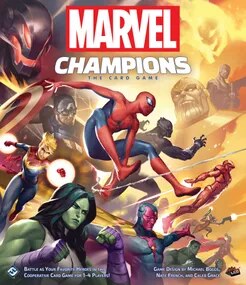
Marvel Champions: The Card Game is a cooperative card game for one to four players, where each player controls a Marvel hero and their alter-ego. The players work together to defeat a villain controlled by the game before the villain completes an evil scheme. The players win by defeating the villain's final stage, and they lose if the scheme is completed or every player is eliminated.
Setup
- Each player selects an identity card and places its alter-ego side face up. Remove that hero's identity card from the deck.
- Each player sets their hit point dial to the starting hit points on their identity card.
- The players choose a first player and give them the first player token.
- Set aside each hero's obligation card and nemesis cards.
- Each player shuffles their player deck and places it near their identity card.
- Create a pool of damage tokens, threat tokens, and all-purpose counters within reach, and place stacks of stunned, confused, and tough status cards nearby.
- Select a villain and put its villain deck and main scheme deck into play near the center. Set the villain's hit point dial to its per-player value multiplied by the number of players.
- Resolve any setup instructions on the main scheme card.
- Shuffle the set-aside obligation cards into the villain's encounter deck, along with the encounter sets for that scenario.
- Each player draws cards equal to their hand size.
- Each player may discard any number of cards from their hand, then draw back up to their hand size. Discarded cards are not shuffled back into the deck at this time.
- Resolve any setup abilities on identity cards in play.
A turn
The game is played in rounds, each made of a player phase followed by a villain phase.
Player phase: Players take turns in player order. On their turn, a player may do any of the following in any order, repeating options as often as they can pay for them, except changing form, which can be done only once per turn:
- Change form between hero and alter-ego.
- Play an ally, upgrade, or support card from hand by paying its cost in resources.
- Use their alter-ego's basic recovery (alter-ego form) or their hero's basic attack or basic thwart (hero form). Using a basic power exhausts the character.
- Use an ally they control to attack an enemy or thwart a scheme, which exhausts the ally.
- Trigger an action ability on a card in play, an encounter card, or an event from hand.
- Ask another player to trigger an action ability on a card they control.
A player may control up to three allies at once. Resources are generated by discarding cards from hand, or from cards with resource abilities. Extra resources beyond the cost are lost.
At the end of the player phase, each player may discard cards and must discard down to their hand size, then draws up to their hand size and readies all cards.
Villain phase:
- Place threat on the main scheme equal to its acceleration value, plus any from side schemes with acceleration icons.
- The villain activates once against each player, in player order. If the player is in alter-ego form, the villain and engaged minions scheme. If the player is in hero form, the villain and engaged minions attack. Each activation begins with a facedown boost card, which adds to the villain's stats based on its boost icons.
- Deal one encounter card facedown to each player.
- Reveal and resolve the dealt encounter cards one at a time, in player order. Minions enter engaged with the revealing player, treacheries resolve and are discarded, attachments attach to the villain, and side schemes enter near the main scheme.
- Pass the first player token clockwise and end the round.
End of the game
The players win as a team by defeating the final stage of the villain. The villain wins if the scheme deck's final stage is completed, meaning the villain accumulates the threat required by that card, or if all players are eliminated. A player is eliminated when their hit point dial reaches zero.
Scoring
This rulebook does not describe a scoring system or point counting. The game is won or lost by the outcome described in the end section.
Variants
Expert mode: Players may play with the expert villain stages for the chosen scenario and add the expert encounter set to the scenario. Scenario customization: Players may add or remove modular encounter sets from a scenario, either choosing one or selecting one at random without looking. Deck customization: Players may build their own decks of 40 to 50 cards, using one identity, its hero cards, one aspect, and basic cards. Solo play: The rulebook notes a setup for a single player, with the villain's hit points set to its per-player value for one player. Two-player play is also covered by the per-player scaling of villain hit points.
Changes
- Variants, by the rulebook draft, 22 November 2026 (shown now)
- Scoring, by the rulebook draft, 22 November 2026 (shown now)
- End of the game, by the rulebook draft, 22 November 2026 (shown now)
- A turn, by the rulebook draft, 22 November 2026 (shown now)
- Setup, by the rulebook draft, 22 November 2026 (shown now)
- Summary, by the rulebook draft, 22 November 2026 (shown now)