Rules of Mercado de Lisboa
Summary
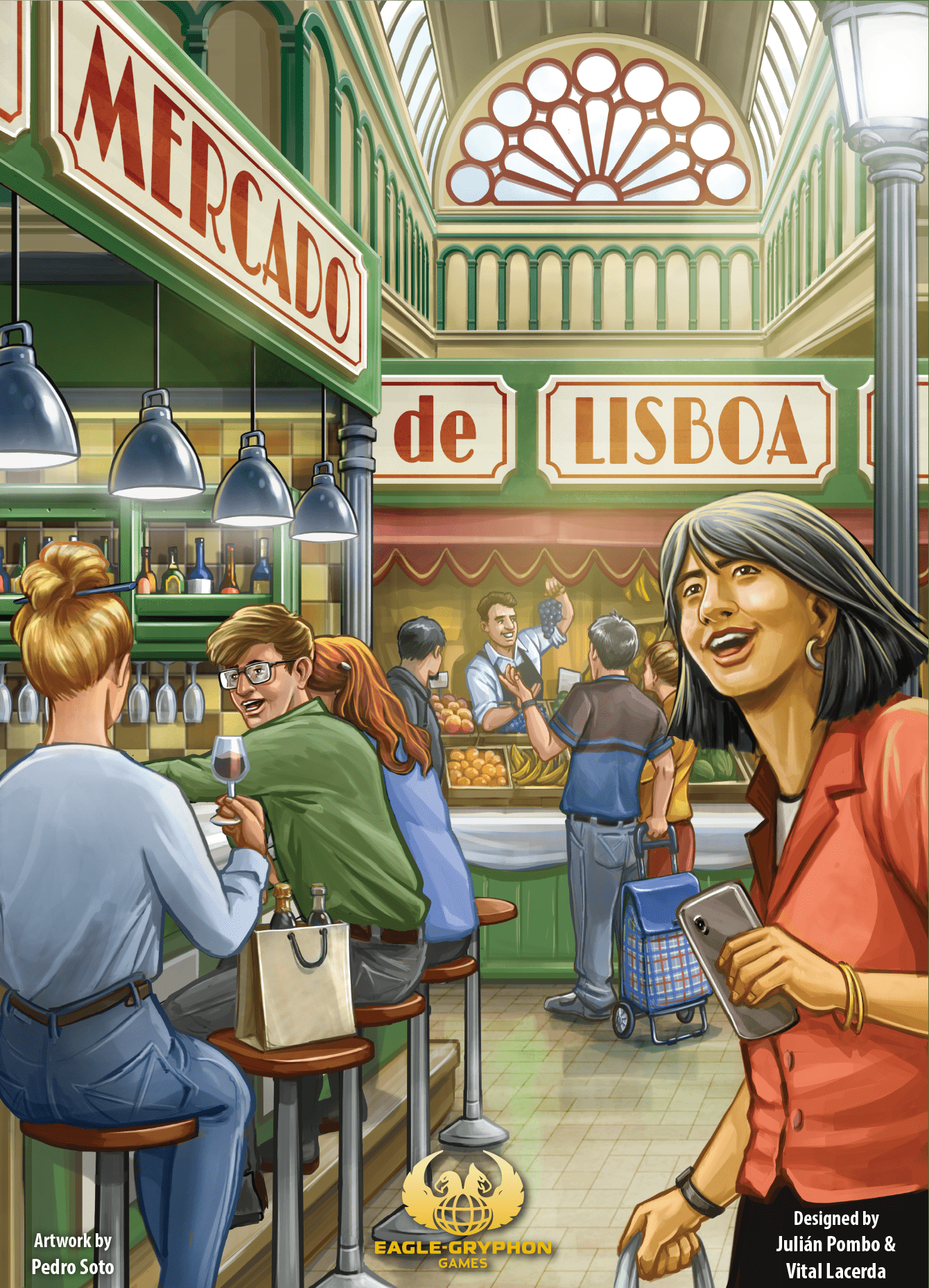
Mercado de Lisboa is a fast-paced tile placement game set in a market. Players open Stands in the market, open Restaurants that boost nearby Stands, and bring Customers to rows and columns where their Stands can earn money. The player with the most money at the end of the game wins.
Setup
Place the board in the middle of the table. Set aside one Pub Restaurant tile and put the other Restaurant tiles in the bag. Draw one at random for each marked market space and place it facedown.
Put all Stand tiles in the bag, draw 3 for the display on the board, and give each player 3 random Stand tiles to keep in front of them.
Split the Customer tiles by back, shuffle each group into a stack, and place the stacks faceup on the board. Move the top 2 tiles of each stack beside it so 3 tiles of each type are visible.
Each player takes one color of wooden Stands and 1 coin, then places one Stand on each of their Stand tiles. The player who most recently visited a market goes first. With 4 players, the fourth player starts with the extra Pub; otherwise return it to the box. Players may choose hidden or open money, and hidden money is recommended, using a money screen.
A turn
Players take turns clockwise. On your turn, choose one of four actions:
- Open a Stand: Place one of your Stand tiles and a wooden Stand on an empty market space with no Stand and no faceup Restaurant. The cost is 1 coin for each Stand in that row or column, including the new one, and you pay the higher of the two counts. If the space has a facedown Restaurant, take it and flip it faceup in front of you. Then resolve earnings, and refill the display from the bag.
- Bring Customers: Take an available Customer tile and place it at an empty market entrance at the end of a row or column. The row or column must have at least as many Stands as the tile has Customers, and at least one of your own Stands there must match a type shown on the tile. Resolve earnings, then refill that Customer stack to 3 visible tiles if possible.
- Open a Restaurant: Requires a Restaurant in front of you. Place it faceup on an empty market space with no Stand and no faceup Restaurant. Restaurants boost orthogonally adjacent Stands of their type: Sushi Bar for Fish, Tea House for Flower, Pizzeria for Tomato, Burger Joint for Meat, Wine Bar for Grape, and Pub for all types. You take 1 coin. If the space had a facedown Restaurant, take it and place it faceup in front of you.
- Take 1 Coin: Gain 1 coin.
Earning money: When a Customer tile is placed, every matching Stand in that row or column earns its owner. When a Stand is first placed in a row or column with matching Customer tiles, it earns its owner for each of those tiles. For each Stand, start with 1 coin, add 1 for each adjacent matching Restaurant (Pubs match all types, and diagonals do not count), then multiply by the number of Customers on the tile. Stands of every player earn, not only the active player's.
Special cases: At the start of your turn, if you hold 3 identical Stand tiles, you may swap them for 3 new tiles from the bag. The same applies to the display.
You may place a Stand before paying for it if the money it earns from existing Customers will cover the cost. If it cannot be paid for that way, you cannot place it.
End of the game
The game ends at the end of a turn when either of these happens:
- A Stand or Restaurant placement leaves only 4 available market spaces (facedown Restaurant spaces count as available).
- A Customer placement leaves only 4 available entrances.
When this happens, every other player takes one more turn, and the game ends with the player to the right of the player who triggered it.
The game also ends immediately if all players take the Take 1 Coin action in a row. In a 2-player game, it ends if both players take that action twice in a row.
Variants
Solo play: The rulebook gives a solo campaign of nine challenges. Set up as normal, but start with 1 coin and 8 Stands, and follow each challenge's extra setup and rules. In every challenge you may never take the Take 1 Coin action. A challenge ends when the normal end is triggered or you have no legal moves.
Each challenge scores 1, 2, or 3 Fame Points for reaching a money threshold at game end. Gaining 32 coins from a single move earns 2 bonus Fame Points, awarded only once per campaign. Your total Fame Points set your rank on the Fame Chart: 28+ is the best in the world, 20 to 27 is Market Tycoon, 15 to 19 is Market Magnate, 11 to 14 means you will get there, 6 to 10 means you are at the pub with friends, and 0 to 5 means you cannot find the pub.
The challenges are:
1. The Specialist: earn money from only one Stand type, with a threshold of 80, 90, or 100 coins.
2. The Long Game: count only money from 4-Customer tiles, with a threshold of 55, 60, or 70 coins.
3. Catering to Couples: remove 3- and 4-Customer tiles, allow at most 2 Stands per row or column, with a threshold of 70, 80, or 90 coins.
4. The Third Wheel: use only 3-Customer tiles and start with 4 coins, with a threshold of 80, 90, or 100 coins.
5. Last Call: use one random tile each of 1, 2, and 3 Customers and 4 random 4-Customer tiles, and bring in at least 3 of the 4-Customer tiles to score, with a threshold of 35, 45, or 50 coins.
6. Customers in Queue: use one tile each of 1, 2, 3, and 4 Customers, start with 2 coins, and place Customers only where the row or column holds all requested Stand types, with a threshold of 30, 40, or 50 coins.
7. The Crowded Mercado: fill entrances with Customer tiles in clockwise order from 1 to 4 Customers, and earn from them only once enough Stands are in that line; the game ends after your eighth Stand is placed, with a threshold of 55, 70, or 80 coins.
8. Pub Crawl: use the extra Pub, and Stands and Pubs cannot be placed on Restaurant spaces except for Pubs, with a threshold of 50, 60, or 70 coins.
9. Marquis de Lisboa: place 1-Customer tiles on three columns on one side, and only build matching Stand types there, with a threshold of 75, 90, or 110 coins.
Changes
- Variants, by the rulebook draft, 23 November 2026 (shown now)
- End of the game, by the rulebook draft, 23 November 2026 (shown now)
- A turn, by the rulebook draft, 23 November 2026 (shown now)
- Setup, by the rulebook draft, 23 November 2026 (shown now)
- Summary, by the rulebook draft, 23 November 2026 (shown now)