Rules of Merv: The Heart of the Silk Road
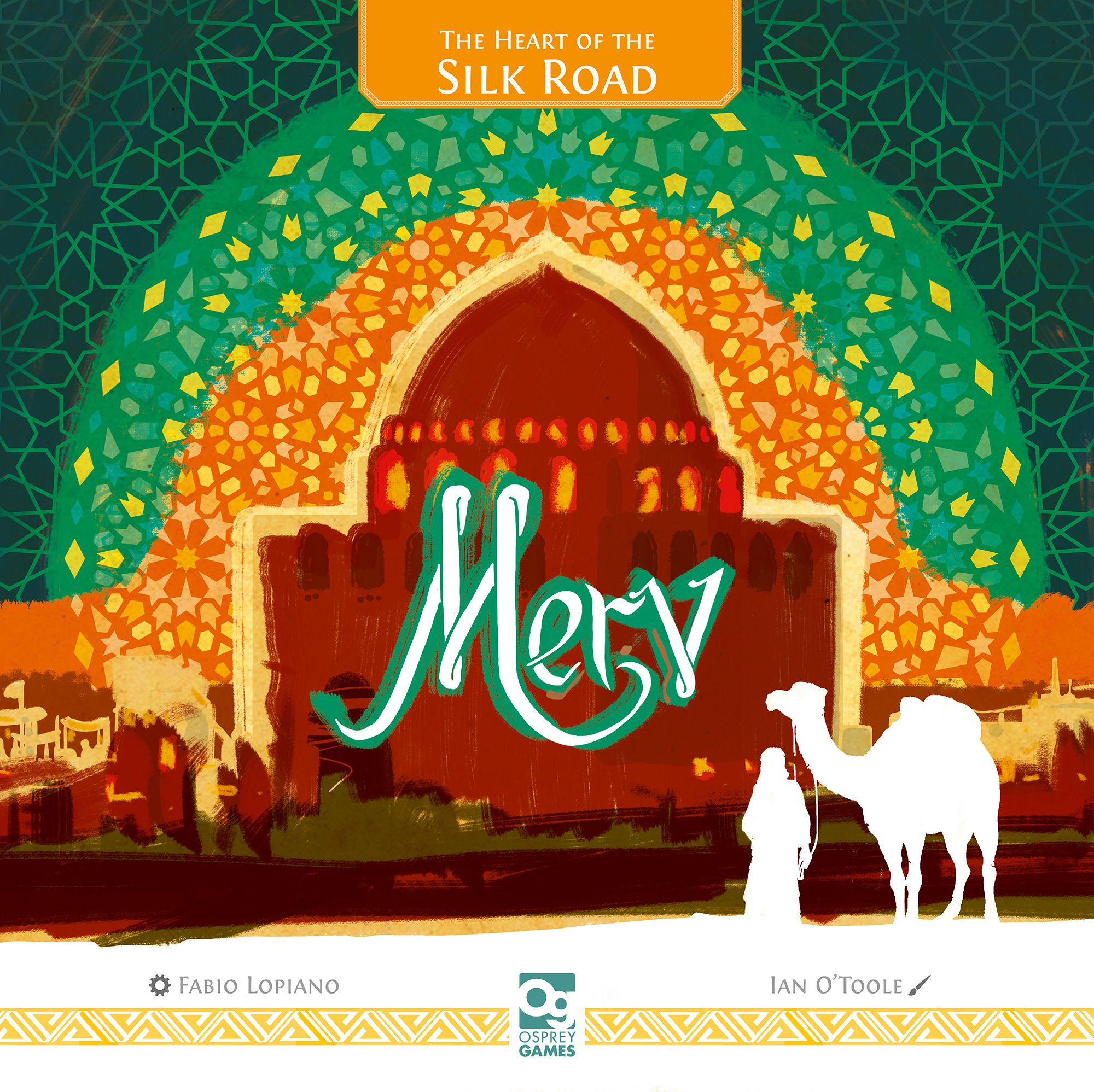
Summary
Merv is a game for two to four players (plus a solo mode) set in the city of Merv on the Silk Road. Over three years, players produce resources through buildings, trade, collect scrolls and caravan cards, fulfil contracts, and score points through their courtiers in the palace, their buildings, and their mosque progress, while Mongols threaten to destroy unprotected buildings. The player with the most points at the end of the game wins.
Setup
Each player takes the meeples, buildings, and disks of one colour, and places a disk on the first space of the favour, influence, and score tracks. Player master meeples go into the turn order queue in the north-west corner in random order. Place a camel on the first inner cities in the marketplace (Rayy, Samarkand, Nishapur, and Balkh) and on the four bottom spaces of the mosque track. Shuffle the building sites into the city, sort the contract cards into six face-up stacks by descending points value beside the mosque, and sort the breakthroughs in the library by scroll requirement. Shuffle the caravan cards into a face-down deck, reveal eight face up, and place camels on the two, three, or four furthest cards depending on player count. Place the walls and the year marker on the first year space.
In a two-player game, a third colour is used as the high courtier, starting on the last space of the turn order queue. In a single-player game, the high courtier starts third in the queue and a second unused colour is used as the corrupt magistrate, starting first, with the player second. Solo cards are shuffled with the 'Palace' card placed second, third, or fourth from the top of the deck.
A turn
The game is played over three years, each with four action rounds, and each player takes twelve turns in total. In each round, players take turns in queue order. On a turn:
- Choose an action slot on the side of the city you are on and move your master meeple there.
- Choose a building site in the active row or column: in the first and third rounds it must be in the same column, and in the second and fourth rounds in the same row. If the site is empty, place one of your buildings on it.
- Generate resources from the activated site and any sites in the active row holding buildings of the same colour, following upgrades. If the site has another player's building, that player also gains resources.
- Perform one action: the board action on the site, gain favour, or deploy a soldier.
At any point in your turn you may also trade at the camel market if it is in your active row, fulfil contracts, and use camels to skip ahead in the turn order queue.
Board actions include the caravansary (buy caravan cards with matching resources), the palace (place courtiers), the library (buy scrolls, which trigger breakthroughs), the marketplace (establish trading posts and buy goods), the mosque (advance along the track), and the wall (build walls for influence).
At the end of a round, master meeples move to the next corner and the queue is refilled, with players placing themselves to advance or fall back using camels.
In the second and third years, an invasion phase follows the action phase. Mongols attack unprotected buildings, and you must pay a ransom or return the building to your supply. Walls and soldiers protect buildings.
End of the game
The game ends after the scoring phase of the third year. Before the final ranking, each player scores end-game points for caravan cards.
Scoring
Each year ends with a scoring phase. Players spend favour for each courtier in the palace, scoring according to the hall: knowledge for scrolls, spice for caravan cards, trade for goods, and faith for mosque progress. Only as many courtiers as favour can score, and each courtier scores once per year. Then bonus points are scored: one point per building in the city, three points per building matching a held scoring tile, and four points per building with the mosque symbol if the final mosque space has been reached.
At game end, caravan cards are divided into sets with at most one card of each spice. A set of one scores 1 point, two scores 3, three scores 6, and four scores 10.
The player with the most points wins. Ties are broken by the most favour, then the most influence, then the player first in the turn order queue.
Variants
Two-player game: a high courtier, controlled jointly by the two players, is added. It does not score points but places buildings and takes action slots. The first player chooses its action slot and the second chooses its building site, and it never takes actions or generates resources.
Single-player game: the player competes against a corrupt magistrate, a computer-controlled colour, while also using the high courtier. The magistrate's turns are governed by solo cards that determine the building type it activates, its actions, and its scoring. The magistrate never spends favour, and the player wins by scoring more points than the magistrate at game end. Solo cards may also be removed from the game when certain conditions are met.
Changes
- Variants, by the rulebook draft, 23 November 2026 (shown now)
- Scoring, by the rulebook draft, 23 November 2026 (shown now)
- End of the game, by the rulebook draft, 23 November 2026 (shown now)
- A turn, by the rulebook draft, 23 November 2026 (shown now)
- Setup, by the rulebook draft, 23 November 2026 (shown now)
- Summary, by the rulebook draft, 23 November 2026 (shown now)