Rules of Metropolys
Summary
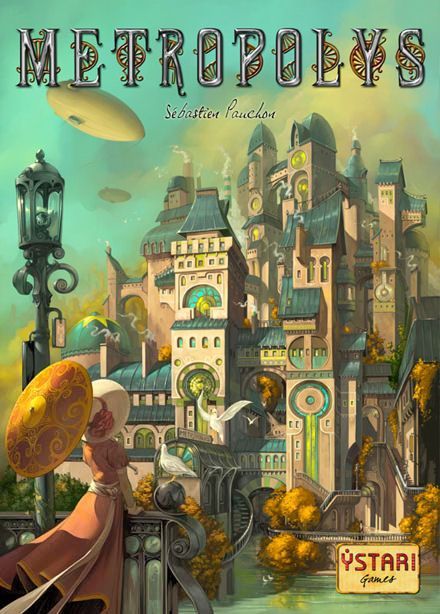
Players are urban planners placing numbered buildings on a city board, competing to build in the most valuable neighborhoods. Each turn, bidding by placing higher-valued buildings next to the last one builds exactly one building for the last bidder. Once a player places all of their buildings, the game ends, and the player with the most prestige points wins.
Setup
- Place the board in the center of the table.
- Lay out the neighborhood tokens as shown on the "Welcome" player aid for your first game. Later games may use a random layout: 7 tokens in the center district and 5 in each peripheral district.
- Place no tokens in blind alleys (neighborhoods surrounded by water with only one way out).
- Place the subway and archaeological site cards next to the board.
- Shuffle the 4 Family area cards. Each player takes one, looks at it in secret, and keeps it face down in their play area.
- Each player chooses a color and takes its 13 buildings.
- Choose a starting player.
A turn
Each turn is a call for proposal in which exactly one building is built.
The starting player places one of their buildings, of any value, in an empty neighborhood. The number must be visible.
Then, clockwise, each player either outbids or passes.
Outbidding: place one of your buildings with a higher value than the last one placed, in a neighborhood orthogonally adjacent to that building and unoccupied. Bridges may be crossed, but lakes and rivers cannot.
Passing: a player who passes may not place any more buildings during this call. Buildings already placed stay on the board until the call ends.
A player with no building of sufficient value must pass.
End of the game
A call for proposal ends when one of these happens:
- All players but one have passed.
- No one can place a building because the last building has no empty adjacent neighborhood.
- No one can outbid the last building.
The player who placed the last building wins the call. Turn that building over to its unnumbered side so it is built permanently. If a token is on that neighborhood, the winner takes it. Other buildings used in the call are removed, and each player takes back their unbuilt buildings (those still showing numbers).
The winner becomes the starting player for the next turn.
The game ends as soon as any player has built their last building.
Scoring
At game end, all players reveal their secret area cards and count points:
- Each trendy neighborhood token: 3 prestige points.
- Each subway token: 1 prestige point.
- Holder of the subway card: 3 prestige points.
- Each archaeological site token: loses 1 prestige point.
- Holder of the archaeological site card: loses 2 prestige points.
- Each building next to the area type shown on your area card: 3 prestige points.
Special cards: the subway card goes to the player with the most subway tokens and changes hands only when another player gets more. Ties do not move it. The archaeological site card goes to the player who most recently took an archaeological site token.
The player with the most prestige points wins. A tie is broken by the player who built the most buildings. If still tied, the tied players share the victory.
Variants
Expert version: a different game, not just a variant. Preparation changes as follows. Shuffle the 5 Expert area cards, deal one to each player, and discard the rest unseen. Neighborhood objective cards are dealt the same way. Each player has two secret objectives, one neighborhood and one area.
- Buildings have heights: 1 to 5 are small, 6 to 9 are medium, and 10 to 13 are tall.
- At game end, the player with the tallest building in each district takes a 5-point highest building token. Ties are broken by comparing second-tallest buildings, then third-tallest, and so on. If still tied, each tied player takes a token.
- Neighborhood objectives score 2 points per building in a matching neighborhood type.
- Area objectives score points per group of buildings that meets the card's requirements. Each building may count toward only one area objective, but a building may count toward both an area objective and a neighborhood objective.
Fewer players:
- 3 players: leave out one peripheral district. Remove 2 subway, 2 archaeological site, and 1 trendy neighborhood tokens. Place the rest as usual.
- 2 players: leave out two adjacent peripheral districts. Remove 3 subway, 3 archaeological site, and 4 trendy neighborhood tokens. Place the rest as usual. In the Family version, also remove the Borders area card.
Changes
- Variants, by the rulebook draft, 23 November 2026 (shown now)
- Scoring, by the rulebook draft, 23 November 2026 (shown now)
- End of the game, by the rulebook draft, 23 November 2026 (shown now)
- A turn, by the rulebook draft, 23 November 2026 (shown now)
- Setup, by the rulebook draft, 23 November 2026 (shown now)
- Summary, by the rulebook draft, 23 November 2026 (shown now)