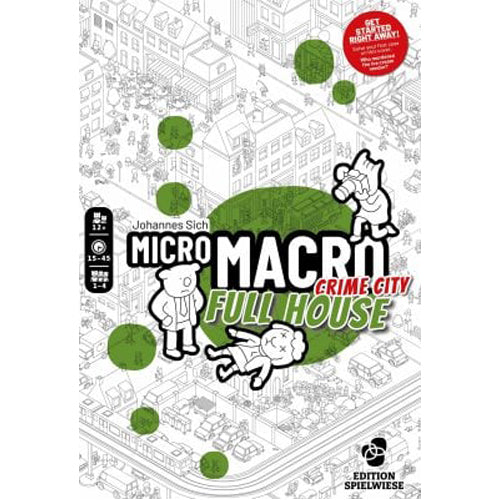
Rules of MicroMacro: Crime City – Full House
Summary
MicroMacro: Crime City Full House is a cooperative detective game. Players work together to solve 16 criminal cases by finding matching scenes on a large city map. The rulebook does not describe a separate way for one player to win.
Setup
Put the included sticker on the magnifying glass. Each case is a deck of case cards marked with a case icon and card number. Sort each case's cards into its envelope in the correct order.
Spread the city map open in a suitable place, such as a large table, the floor, or a wall. Keep these points in mind:
- The whole map should always be fully visible, with drinks and other items kept to the side.
- Keep the case cards next to the map.
- Use bright light, such as a good lamp or daylight, because small details are easy to miss in poor light.
Designate one player as the Lead Investigator, who leads the investigation and handles the cards. For a first game, take the deck for the introductory case, "The sombrero," and place it on the map. Reveal the start card and read its text aloud.
A turn
Each task works like this:
1. The Lead Investigator reads the front of the top card aloud without turning it over. The front describes a task on a black background.
2. Find the scene on the city map that matches the task.
3. Turn the card over and check whether the coordinates and scene on the back match your finding.
If the solution is correct, the Lead Investigator reads the back of the card aloud and the other players look at the illustration. If it is wrong, the card goes back on the deck unread, and the other players say the answer is incorrect. A player cannot simply guess; a scene on the map must confirm the solution. Once a task is resolved, set its card aside. The next card on the deck becomes the new task.
Some cards show a light bulb icon, which marks a clue that may help with a later task. Some cards have an instruction on the front that creates an extra task to work on at the same time. If the same prompt appears on the next card, the number of open questions can grow to three or four. Players may use the magnifying glass to study individual scenes closely.
End of the game
A case is finished when all of its tasks have been solved. The introductory case has four tasks that are solved one after another. The rulebook does not give a separate end condition for the whole game.
Variants
Advanced version: Once you have solved a few cases well, try solving a case without its case cards. Read the start card, which already has the information needed to solve the case, and work out the solution yourself. The solution texts and follow-up questions can act as hints, but this version is much harder. If you get stuck, you may look at the questions that have already been solved to get a hint or spot a mistake in your theory.
Changes
- Variants, by the rulebook draft, 22 November 2026 (shown now)
- End of the game, by the rulebook draft, 22 November 2026 (shown now)
- A turn, by the rulebook draft, 22 November 2026 (shown now)
- Setup, by the rulebook draft, 22 November 2026 (shown now)
- Summary, by the rulebook draft, 22 November 2026 (shown now)