Rules of Mombasa
Summary
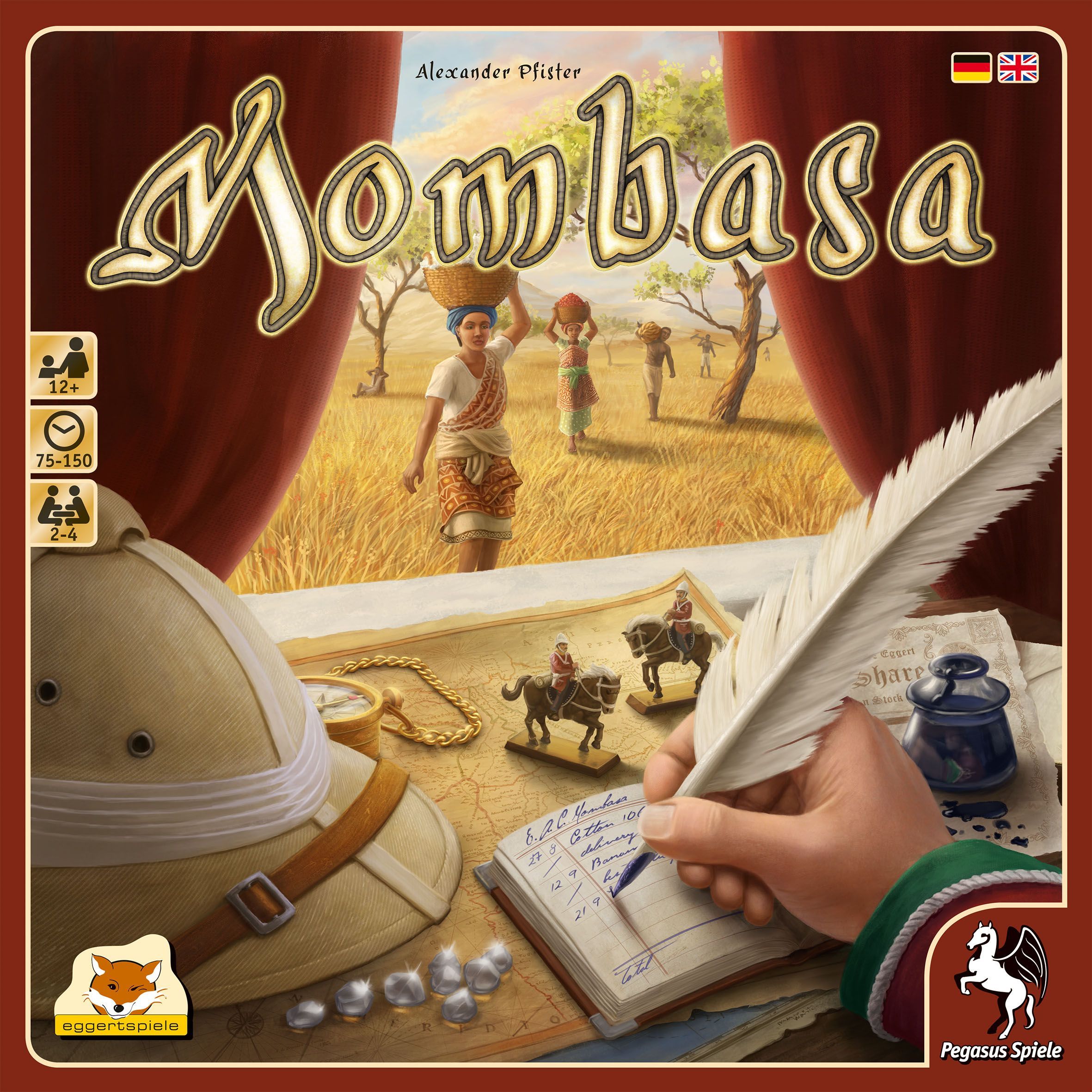
Mombasa is a trading and investment game for 2 to 4 players set in a fictional Africa. Players invest goods to gain shares in four chartered companies, spread their trading posts across the map to raise share values, and build diamond and bookkeeping progress. After seven rounds, the player with the most money wins.
Setup
Place the game board in the middle of the table and return the track cards to the box for a first game. Put each company track (A1, B1, C1, D1) at the matching board edge and fill each company base with trading posts of its color. Shuffle the action cards by letter, stacking E at the bottom and A on top to form the action card stack, then fill the 12-space card display. Place coins in the bank, fill round track spaces 2 to 7 according to player count (space 1 stays empty), and sort the book tiles by letter into a supply and fill the book display. Each player takes a player board, the 9 starting cards of their color, 4 track markers placed on the starting spaces, a diamond marker on the diamond track, an ink jar marker below the board, 1 pound, and bonus markers (3 each in a 2-player game, 2 each otherwise, with spares returned to the box). Give the first player marker to a player and distribute the "1"-expansion cards by seat order, then have each player secretly choose one of two starting tiles and resolve its starting bonus and starting cards.
A turn
Each round has three phases.
- Planning phase: Players simultaneously place cards face down from their hand into their available action slots, then reveal them together. Each unlocked extra action slot allows one more card.
- General action phase: Starting with the first player and continuing clockwise, each player takes exactly one of these actions on their turn: use goods cards of one type to acquire a card or advance on company tracks; use all expansion cards to expand one company into regions; use a bookkeeper card to move the ink jar; use a diamond merchant card to advance the diamond marker; place a bonus marker on a bonus space; or end your own action phase. Used cards are flipped face down. A player who ends their action phase drops out and takes one resting deck back into hand.
- Preparation phase: Move coins from the round track into the book display, refill the card display, and return bonus markers and any earned bonus tiles to their owners.
End of the game
The game ends after the General action phase of round 7. Players then return all resting decks to their hands and carry out the final scoring phase.
Scoring
Players collect all cards showing an additional company share and score seven categories on the scoring note pad: cash on hand, the value of shares in each of the four companies (uncovered coin icons in the base multiplied by shares held), the last value passed on the diamond track, and the last value passed on the bookkeeping track. Markers that did not advance far enough score nothing, and unused book tiles are worth nothing. The player with the highest total wins, and ties share the victory.
Variants
A more variable setup can be used by experienced players, replacing steps 2 and 13 of the standard setup with a different method. For the first game, the rulebook describes the standard setup; subsequent games use starting tiles, with track cards randomly determining which company tracks go on each edge of the board.
Changes
- Variants, by the rulebook draft, 22 November 2026 (shown now)
- Scoring, by the rulebook draft, 22 November 2026 (shown now)
- End of the game, by the rulebook draft, 22 November 2026 (shown now)
- A turn, by the rulebook draft, 22 November 2026 (shown now)
- Setup, by the rulebook draft, 22 November 2026 (shown now)
- Summary, by the rulebook draft, 22 November 2026 (shown now)