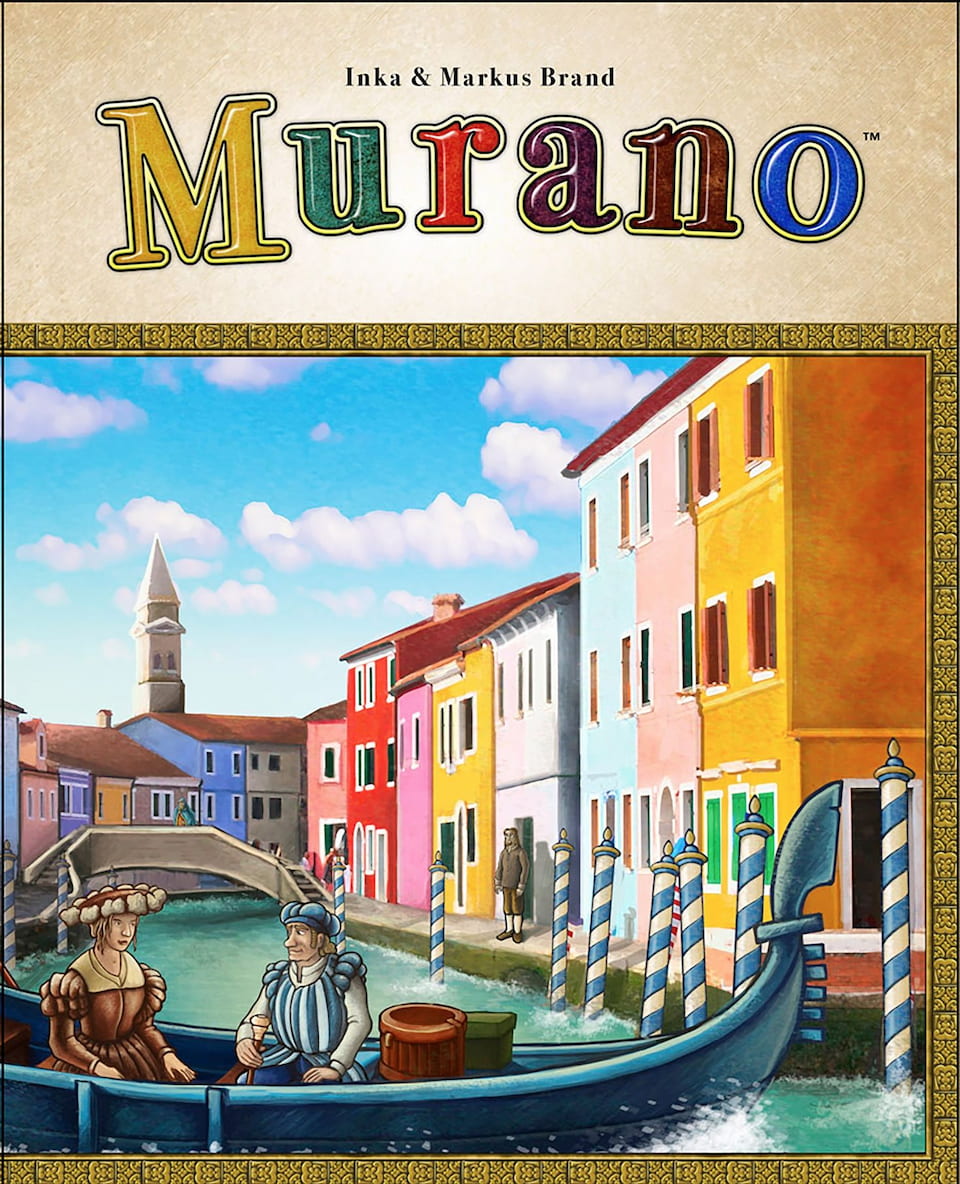
Rules of Murano
Summary
Murano is a game for 2 to 4 players about building up glassblowing businesses on the islands of the Venetian lagoon. Players use Ships on action spaces to build factories, shops, palaces and streets, earn gold, and collect Character Cards that score points at the end based on what is on each island. The player with the most Victory Points wins.
Setup
Place the game board in the middle of the table. In 2- and 3-player games, use its reverse side. Place one Ship on each action space that shows an anchor, with the Red Ship on any of them, all facing counter-clockwise. Each player takes 8 Gondoliers and the Markers of one color. Put 1 of your Gondoliers on space 5 of the Victory Point Track and 2 in the general supply. Keep your other 5 Gondoliers in front of you, ready to use.
In 2- and 3-player games, remove the two Character Cards for the Sacca Serenella island and the extra components listed in the rulebook.
Shuffle the Shop, Palace and Street tile stacks and place them on their spaces on the S. Giacomo e S. Maffio island; split the Street stack in two. Do not shuffle Glass Factory or Special Building tiles. Shuffle the Character Cards and Special Building Cards separately. Remove 5 Character Cards from the game without looking at them, then place the remaining Character Cards and Special Building Cards beside the board. Each player takes 5 Gold, and the rest of the Gold forms the supply. Put the glass beads in the bag beside the board.
A turn
Randomly choose a start player. Play goes clockwise. On your turn you either pass or choose one action space that one of your reachable Ships can get to.
A Ship cannot enter a space occupied by another Ship or move past one. If the space you want is occupied, you may move other Ships out of the way: the first move is free, the second costs 1 Gold, and each further move costs 1 Gold more than the previous one. Then carry out the action of the last space you moved a Ship onto. You take only one action per turn.
Pass: take 1 Gold from the supply and move one Ship to another action space without using its action.
The actions are:
- Take 2 Gold.
- Buy a Glass Factory for 1 Gold.
- Buy a Shop or a Palace for 2 Gold (blind from the stack), or 4 Gold to choose one from the stack.
- Buy a Special Building for 2 Gold.
- Recruit a Character: the first card costs 1 Gold, the second 2, and so on. Draw 3 cards, keep one, and return the rest to the bottom of the stack. You may decline, but then your turn ends without the pass Gold.
- Place a Gondolier on a gondola of your color for 2 Gold, or on any color for 5 Gold. Placed Gondoliers stay in place until the end.
- Build: place up to 3 tiles on Island spaces. Streets go on paved spaces; other buildings go on brown spaces next to a Street. Buildings must be ones you already own. A Glass Factory gives 1 VP, a Shop 2 VP, and a Palace 3 VP; Shops and Glass Factories get your Marker. A Special Building gives no VP but gives you a Special Building Card.
- Income: choose an island and up to 3 of your Shops there, at most one per color. Gain 1 Gold per Customer those Shops serve.
- Production: use any of your Glass Factories, losing 2 VP each (not below 0). Draw one bead per factory used. Then you may sell 1 to 3 beads of a single color for 5, 12 or 20 Gold, returning them to the bag.
- Gondolier: dismiss a Gondolier for 3 Gold, or hire one for 3 Gold (you can have at most 7).
End of the game
The game ends when two different tile stacks are empty (Streets, Shops, Glass Factories, Special Buildings or Palaces). The player who empties the second stack finishes their turn, then every other player gets one final turn. During final turns, a building you buy may be placed immediately at no cost, and it still gives its VP.
Scoring
Each player, starting with the player who triggered the end and continuing clockwise, reveals their Character Cards one at a time. For each card, choose an island where you have a Gondolier on a gondola, move that Gondolier onto the island, and score the card's VP for that island. A Gondolier can score only one card, and a card must be scored on the island it was placed on. Card scoring counts all players' buildings unless the card says otherwise.
Any Gondoliers still on gondolas that did not score a card give 1 VP each (Gondoliers in the general supply do not count). Unused Gold can be exchanged for VP at the rates on certain Character Cards.
The player with the most VP wins. If players are tied, the player with more Gold left wins.
Variants
The rulebook gives changes for 2- and 3-player games: use the reverse side of the board, where Sacca Serenella is just a space for placing cards; remove the two Character Cards for that island; and remove the listed components (one Shop of each color, one random Palace, three Special Buildings, one Glass Factory, three Street tiles with a Customer and four without). The rulebook does not describe solo or team variants.
Special Building Cards also give ongoing effects such as extra Gold, cheaper recruiting, Victory Points on certain actions, or changes to Ship movement, bead production or Gondolier actions.
Changes
- Variants, by the rulebook draft, 23 November 2026 (shown now)
- Scoring, by the rulebook draft, 23 November 2026 (shown now)
- End of the game, by the rulebook draft, 23 November 2026 (shown now)
- A turn, by the rulebook draft, 23 November 2026 (shown now)
- Setup, by the rulebook draft, 23 November 2026 (shown now)
- Summary, by the rulebook draft, 23 November 2026 (shown now)